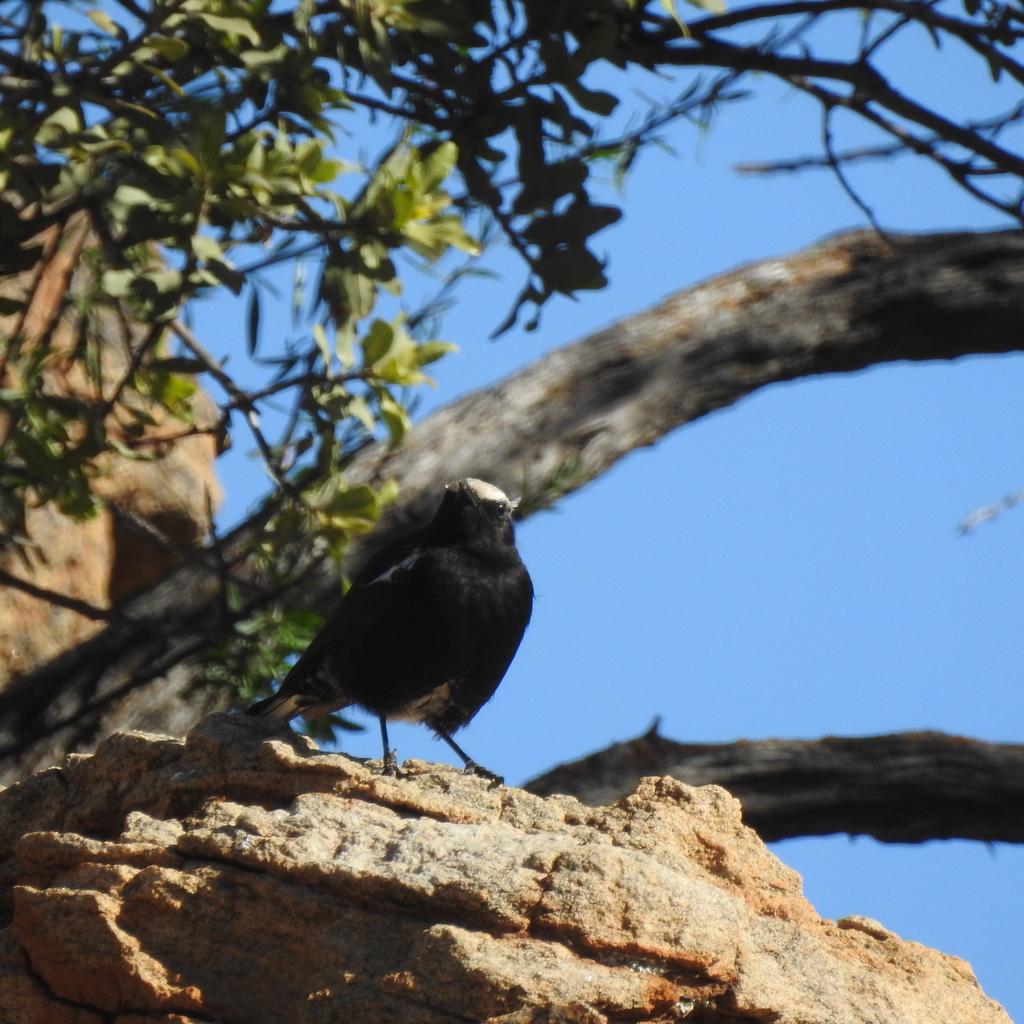
Mountain Chat
Photo © Noeleen du Toit
Photo © Noeleen du Toit — CC BY-SA 4.0 — Source: iNaturalist #180318946Identification
The Mountain Chat is a small insectivorous passerine measuring 18–20 cm in length. Like other chats, it displays a distinctive tail pattern featuring a white rump and white outer tail feathers that make it readily identifiable in flight. Both sexes have black legs and a pointed black bill.
Sexual dimorphism is pronounced in this species. Males are highly variable in plumage, though the white rump, outer tail feathers, and a characteristic white shoulder patch are always present. Male body plumage ranges from pale grey to almost black, and some individuals may sport a white crown while others lack it entirely. Females are considerably more uniform, appearing entirely dark brown except for the white rump and outer tail feathers.
Range & Habitat
The Mountain Chat is endemic to southwestern Africa, with a non-migratory, resident population found across Namibia, Botswana, South Africa, and southernmost Angola. This species shows a strong preference for mountainous and rocky habitats, making it a characteristic bird of elevated, rugged terrain throughout its range.
Behaviour & Diet
The Mountain Chat's song is a clear melodic whistle interspersed with harsh chatters, making it reasonably vocal and detectable by ear in suitable habitat. The species is monogamous and nests on the ground amongst rocks, where pairs lay clutches of 2–4 white eggs. Its diet consists primarily of insects supplemented with berries, typical of small chat species adapted to rocky mountain environments.
Best Time & Places to See It
As a year-round resident throughout its range, the Mountain Chat can be encountered in southwestern Africa at any time of year. The species is most reliably found in the mountainous regions of South Africa, Botswana, Namibia, and southernmost Angola, where rocky outcrops and elevated terrain provide ideal habitat. Look for them perched prominently on rocks and boulders, where their distinctive silhouette and behaviour make them relatively conspicuous when present.
Photography Tips
The Mountain Chat's preference for rocky, open habitats and its habit of perching openly on boulders and rock outcrops make it a reasonably accessible subject for bird photographers. The striking white rump and outer tail feathers are particularly photogenic, especially when the bird is in flight or performing tail displays. The variable plumage of males—particularly the presence or absence of a white crown—adds compositional interest to images. Early morning light on rocky mountain terrain will enhance the contrast between the bird's dark body plumage and its distinctive white markings. Patience and a telephoto lens are recommended for capturing detailed portraits of this small but engaging species.
Cederberg Wilderness Area
Cederberg Local Municipality, South Africa
+136 birds+12 mammals
Where ancient sandstone ridges rise dramatically from the semi-arid lowlands of Western Cape, the Cederberg Wilderness Area spreads across nearly 1,700 square kilometres of some of…
VIEW NATIONAL PARKKruger National Park
Ba-Phalaborwa Local Municipality, South Africa
+540 birds+91 mammals
Across the low-lying savanna of northeastern South Africa unfolds one of Africa's largest and most ecologically intact protected areas, where acacia woodlands merge into mopane scrub…
VIEW NATIONAL PARKTankwa-Karoo National Park
Hantam Local Municipality, South Africa
+201 birds+20 mammals
Across the semi-arid heartland of the Northern Cape, where winter rains carve ephemeral watercourses through endless ochre plains, Tankwa-Karoo National Park sprawls across more than 3,100…
VIEW NATIONAL PARKMountain Zebra National Park
Inxuba Yethemba Local Municipality, South Africa
+265 birds+35 mammals
Across the windswept plateaus and deeply incised valleys of the Eastern Cape's interior, Mountain Zebra National Park unfolds as a landscape of geological drama and ecological…
VIEW NATIONAL PARKAugrabies Falls National Park
Kai !Garib Local Municipality, South Africa
+176 birds+20 mammals
Where the Orange River cuts a dramatic scar through the Northern Cape's arid interior, Augrabies Falls National Park sprawls across nearly 1,200 square kilometers of raw,…
VIEW NATIONAL PARKAddo Elephant National Park
Sundays River Valley Local Municipality, South Africa
+388 birds+55 mammals
Where the Eastern Cape's semi-arid scrublands meet transitional woodland, Addo sprawls across 13,478 square kilometres of one of southern Africa's most biodiverse landscapes. The terrain rises…
VIEW NATIONAL PARKIthala Game Reserve
uPhongolo Local Municipality, South Africa
+328 birds+26 mammals
Rolling thornbush savanna and acacia woodland dominate the landscape of this 494-square-kilometre national park in KwaZulu-Natal's uPhongolo Local Municipality, where granite outcrops punctuate grassland plateaus and…
VIEW NATIONAL PARKSperrgebiet National Park
Barcelona, Namibia
+181 birds+18 mammals
Where the Namib's ancient gravel plains meet the Atlantic coast, one of Africa's most remote and geologically austere landscapes unfolds across more than 56,000 square kilometres.…
VIEW NATIONAL PARKDorob National Park
Henties Bay, Namibia
+230 birds+13 mammals
Where the Skeleton Coast meets the Namib Desert's inland reaches, Dorob National Park sprawls across 34,021 square kilometres of one of southern Africa's most austere and…
VIEW NATIONAL PARKSkeleton Coast Park
Barcelona, Namibia
+143 birds+7 mammals
Where the Atlantic's cold Benguela Current collides with one of Africa's most hostile coastlines, the Skeleton Coast Park sprawls across more than 104,000 square kilometres of…
VIEW OBSERVATION POINTNo community photos yet. Log in to add the first one.
No community observations of this species yet.