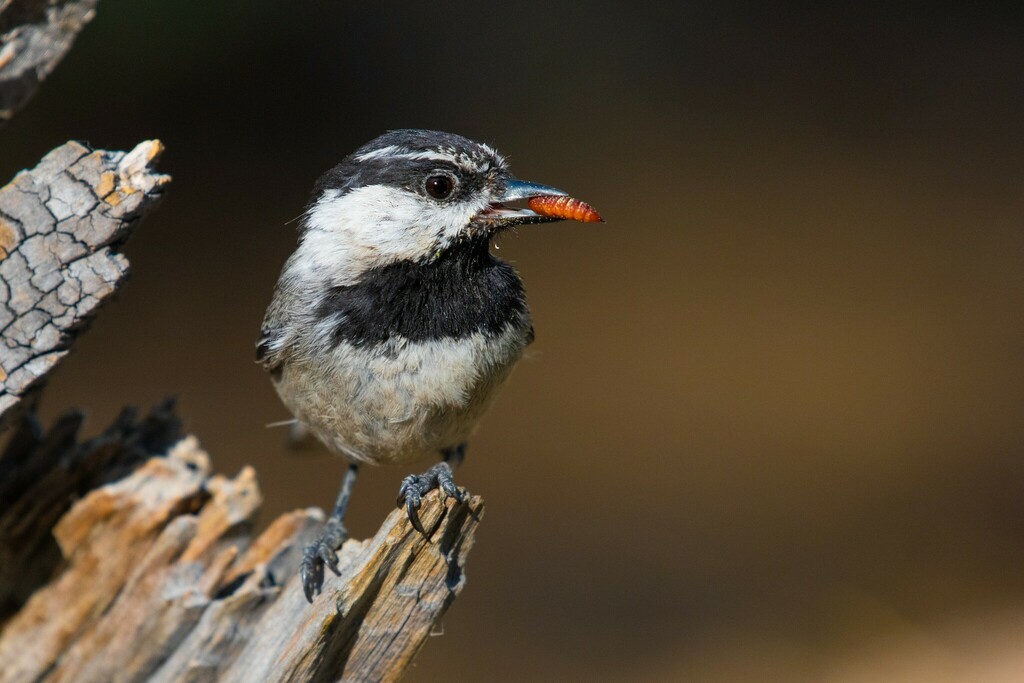
Mountain Chickadee
Photo © Adam Jackson
Photo © Adam Jackson — CC0 1.0 — Source: iNaturalist photo #339583269Identification
The mountain chickadee is a small songbird, typically 5–6 inches (13–15 cm) long with a wingspan of 7.5 inches (19 cm). Adults of both sexes are instantly recognizable by their distinctive white eyebrows and black cap marked with a characteristic white line running through it—a feature that sets them apart from all other North American chickadees, which have solid black caps. They have a black postocular stripe, gray backs and flanks, paler gray underparts, a short black bill, and a black bib.
Range & Habitat
Mountain chickadees are common inhabitants of mountainous regions throughout the western United States and Canada, with their range extending from southern Yukon south to California and the Rocky Mountain states. They occupy a wide range of altitudes and ecosystem types within these mountainous areas. Some populations may migrate locally, moving up into higher elevations in summer and descending to mountain foothills in winter, though this behavior is not well documented. Mountain chickadee populations tend to concentrate in locations with abundant natural cavities or suitable nesting sites.
Behaviour & Diet
Mountain chickadees are highly active birds, often seen grasping small twigs and hanging upside down while foraging. They spend most daylight hours searching for food, clinging to branch undersides and tree trunks to probe bark or hammer seeds open with their beaks. Their omnivorous diet consists of approximately 70 percent insects—including caterpillars, beetles, insect eggs, pupae, and spiders—and 30 percent plant material, particularly conifer seeds and other seeds taken year-round. They breed monogamously, producing 1–2 broods per year with clutch sizes averaging 5–9 eggs. Young remain in the nest for 21 days, fed by both parents. Mountain chickadees travel in pairs or small groups and join multi-species feeding flocks after breeding season. There is evidence they possess spatial cognition regarding cached food locations. Juvenile birds often leave adult groups for summer foraging but reunite with older birds in winter.
Best Time & Places to See It
Mountain chickadees are year-round residents throughout their range and can be observed in suitable habitat any season. They are particularly active and vocal during breeding season. Look for them in coniferous forests, mixed woodlands, and montane habitats at various elevations. They readily visit urban areas and have shown the ability to habituate quickly to human presence, making them accessible to birdwatchers even near populated regions. Their constant foraging activity and vocal nature make them relatively easy to locate once you're in appropriate mountain habitat.
Photography Tips
The mountain chickadee's bold facial markings—especially the distinctive white eyebrow stripes and white line through the black cap—photograph beautifully with proper lighting. Position yourself to capture their characteristic upside-down feeding postures, which make dynamic and engaging images. Early morning light often works best for highlighting the contrast between their black and white head markings and gray plumage. Since they're highly active and acrobatic, use a fast shutter speed to freeze their movement. Their small size requires patience and a telephoto lens, but their habituation to human presence in many areas makes them more approachable than many mountain species.
Arches National Park
Banff National Park
Bear River Migratory Bird Refuge
Black Canyon of the Gunnison National Park
Bosque del Apache National Wildlife Refuge
Bryce Canyon National Park
Canyonlands National Park
Capitol Reef National Park
Carlsbad Caverns National Park
Nothing matches these filters.
No community photos yet. Log in to add the first one.
No community observations of this species yet.