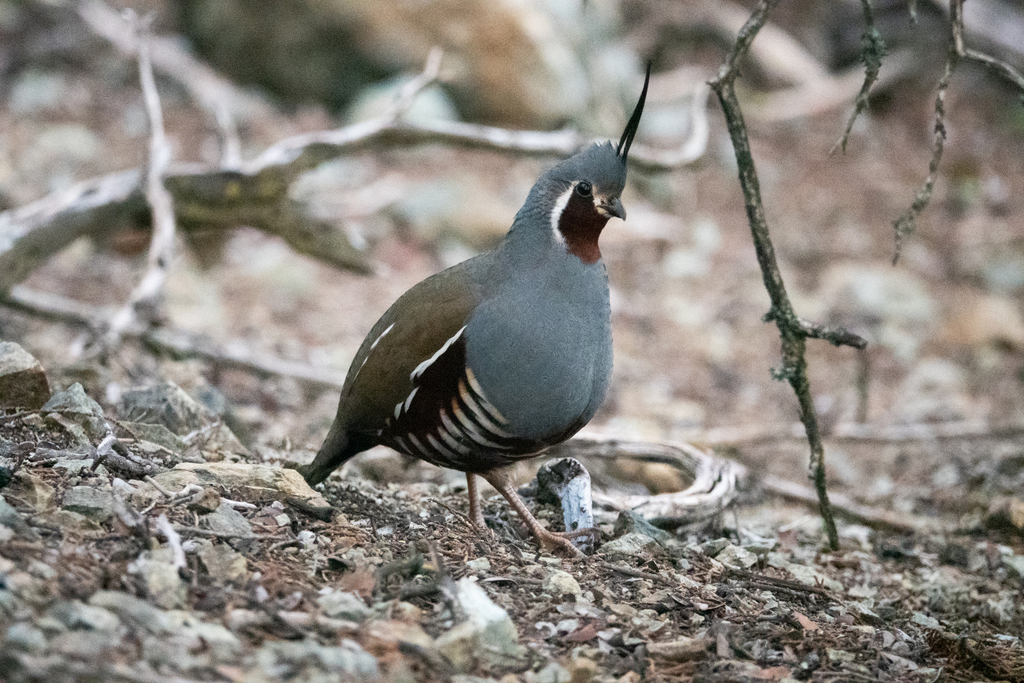
Mountain Quail
Photo © Kyle Nessen
Photo © Kyle Nessen — CC0 1.0 — Source: iNaturalist photo #32762909Identification
The mountain quail is a compact ground-dweller measuring 26–28 cm in length with a wingspan of 35–40 cm. Its most distinctive feature is a prominent topknot—shorter in females and varying in color by season and geographic population. These birds sport a brown face, gray breast, brown back and flight feathers, and heavily white-barred underparts. Males display richer coloring overall, while females show more brown on their backs, paler red on their undersides, and wider white barring on the flanks. A striking feature to note: young birds possess multi-colored primary coverts on their wings, which fade to solid colors by 15 months of age. Their relatively short, rounded wings and long, featherless legs are perfectly adapted for their terrestrial lifestyle.
Range & Habitat
This non-migratory species inhabits mountainous chaparral west of the Rocky Mountains, ranging from British Columbia and parts of Washington state southward to the Baja Peninsula in Mexico. Mountain quails thrive at elevations up to 3,000 m (9,800 ft) above sea level. They occupy diverse terrain including the lava reefs of California's Modoc Plateau, the chaparral and wooded areas of the Sierra Nevada Mountains, and the Coast Range. Although primarily sedentary, some populations exhibit altitudinal migration within certain mountain ranges, moving to different elevations seasonally. Their distribution is closely tied to suitable habitat, which flourishes in cooler, more arid climates.
Behaviour & Diet
Mountain quails are primarily walkers, moving with surprising speed through brush and undergrowth despite their secretive habits. Their flight is characteristically explosive—brief bursts of rapid wingbeats followed by a gliding descent to the ground. In late summer through winter, family groups of up to 20 birds congregate together. Their diet consists mainly of plant matter and seeds, though chicks are more insectivorous than adults, gradually transitioning to plant-based food as they mature. During breeding season, pairs are monogamous and maintain solitary nesting habits. Females typically lay 9–10 eggs in a simple scrape concealed in vegetation near trees or shrubs, usually close to water. Incubation lasts 21–25 days, predominantly by the female, though recent research suggests males may successfully incubate independently, potentially enabling pairs to raise two broods in a single season.
Best Time & Places to See It
Late summer through winter offers the best viewing opportunities, when birds congregate in family groups and are more likely to be encountered. Focus your search on mountainous chaparral habitats, particularly in California's Sierra Nevada and Coast Range, or the Modoc Plateau's lava reefs. Early morning hours are optimal for spotting these secretive ground-dwellers as they move through brush. Listen for their calls and watch for movement in dense vegetation, particularly near water sources. While not threatened overall and plentiful across much of their range, populations outside California face challenges, making California locations your most reliable destination.
Photography Tips
Patience and stealth are essential when photographing mountain quails. Their secretive nature and preference for dense brush demand a cautious approach and willingness to wait quietly. Focus on early morning light when birds are most active. Use a telephoto lens to maintain distance without disturbing them—these birds will flush explosively if startled. Frame shots to capture their distinctive topknots and the intricate white barring of their underparts. Photograph family groups during late-season gatherings for compelling behavioral images. The contrasting plumage of males and the subtler browns of females each offer distinct photographic opportunities.
Lassen Volcanic National Park
Shasta County, United States
+239 birds+18 mammals
Volcanic peaks and geothermal upheaval have sculpted 545 square kilometers of Northern California into a landscape where fire and water engage in perpetual dialogue. Lassen Peak…
VIEW NATIONAL PARKJoshua Tree National Park
Riverside County, United States
+221 birds+23 mammals
Across 5,610 square kilometers of Riverside County's high desert, a landscape of geological drama unfolds where granite monoliths pierce through bajadas of creosote scrub and Joshua…
VIEW NATIONAL PARKYosemite National Park
Mariposa County, United States
+224 birds+28 mammals
Granite cliffs soar nearly a kilometer above the valley floor in this expanse of high Sierra wilderness, where glacial U-shaped valleys sculpt a landscape of dramatic…
VIEW NATIONAL PARKCrater Lake National Park
Klamath County, United States
+174 birds+13 mammals
At 1,949 metres above sea level, a volcanic caldera of impossible clarity holds one of North America's deepest and most pristine alpine lakes, ringed by pumice-and-ash…
VIEW NATIONAL PARKRedwood National Park
Humboldt County, United States
+343 birds+43 mammals
Where the Pacific fog rolls deep into northern California's coastal valleys, some of the tallest trees on Earth rise from a landscape shaped by tectonic forces…
VIEW NATIONAL PARKSequoia National Park
Tulare County, United States
+187 birds+27 mammals
Granite peaks rising above 3,600 meters dominate the southern Sierra Nevada, where Sequoia National Park sprawls across one of North America's most vertically compressed wilderness zones.…
VIEW NATIONAL PARKKings Canyon National Park
Fresno County, United States
+186 birds+20 mammals
Where granite peaks fracture the Sierra Nevada skyline and the Kings River has carved one of North America's most dramatic canyons, a landscape of extreme relief…
VIEW NATIONAL PARKDeath Valley National Park
Inyo County, United States
+339 birds+25 mammals
Across nearly 3.5 million acres of southeastern California's Inyo County, vast salt flats meet sculpted badlands and alluvial fans in a landscape so extreme it defines…
VIEW NATIONAL PARKMalheur National Wildlife Refuge
Harney County, United States
+309 birds+24 mammals
Across the high desert plateau of southeastern Oregon, where sagebrush scrubland stretches toward distant ridgelines under an enormous sky, lies a sanctuary shaped by water in…
VIEW WILDLIFE SANCTUARYUpper Klamath National Wildlife Refuge
Klamath County, United States
+217 birds
Where shallow marshes and open water meet the high desert of south-central Oregon, the Upper Klamath National Wildlife Sanctuary creates a landscape of startling contrasts. Fed…
VIEW WILDLIFE SANCTUARYTule Lake National Wildlife Refuge
Siskiyou County, United States
+255 birds+9 mammals
Across the high volcanic plateau of northeastern California, where summer heat scorches the alkali flats and winter winds sweep unobstructed through open water and marsh, Tule…
VIEW WILDLIFE SANCTUARYNo community photos yet. Log in to add the first one.
No community observations of this species yet.