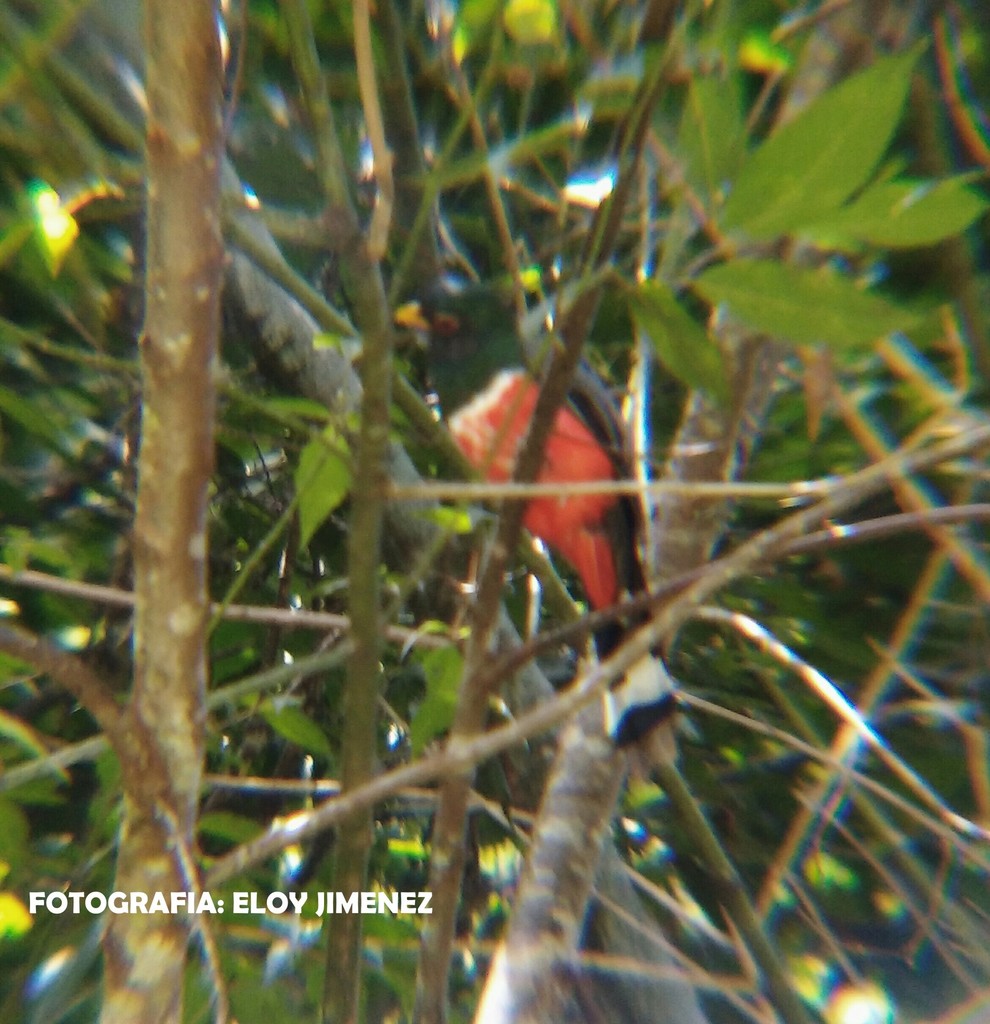
Mountain Trogon
Photo © ELOYJIMENEZ13
Photo © ELOYJIMENEZ13 — CC BY-SA 4.0 — Source: iNaturalist #32006680Identification
The mountain trogon is a compact bird measuring 11.5–12.5 inches (29–31.5 cm) in length, weighing around 71 grams on average. Like all trogons, it is sexually dimorphic. The male is striking: metallic green on the crown, nape, and upperparts, with a bluish-green tail tipped in black. His face and throat are blackish with an orange-red orbital ring and bright yellow bill. The chest is green, contrasting sharply with a brilliant red belly and undertail, separated by a narrow white band. The male's undertail is black with distinctive white blocks on the outer rectrices. The female is quite different—warm brown on head and upperparts with a rufous-brown tail. She has small white crescents both in front and behind her eye. Her chest is warm brown, separated from a brown lower chest and red belly by a narrow white band. Her primaries are blackish with white outer webs that form streaks along the folded wing.
Range & Habitat
The mountain trogon is a resident of the highlands of Mexico, Guatemala, and Honduras, with records as a vagrant in El Salvador. It inhabits subtropical and tropical moist montane forests at elevations between 3,000 and 10,000 feet (914–3,048 m). The species shows a strong preference for pine-evergreen and pine-oak woodlands, including cloud forests. Remarkably for a trogon, it demonstrates adaptability to human-modified landscapes and has been recorded in coffee plantations where suitable shade trees, particularly oaks, are present.
Behaviour & Diet
The mountain trogon is an active forager that catches insects and small fruits on the wing, plucking them with skill as it moves through the canopy. It may associate with mixed-species feeding flocks, joining them sporadically and moving through the upper and middle forest levels. Like all trogons, it is a cavity nester, both excavating its own holes in rotting wood and utilizing cavities made by woodpeckers. The female lays two white eggs, incubated by both parents, though the female contributes far longer brooding stints. Eggs hatch after 19 days. Nest cavities are typically placed below 4 feet (1.2 m) high, though occasionally reaching 12 feet (3.7 m).
Best Time & Places to See It
Mountain trogons are residents throughout their range, making them potentially available year-round. They are most reliably found in highland pine-oak and cloud forest zones from 3,000 to 10,000 feet elevation. Look for them in suitable habitat throughout Mexico, Guatemala, and Honduras. Their association with mixed-species flocks can make them easier to locate, and coffee plantations with mature shade trees may also provide viewing opportunities.
Photography Tips
The mountain trogon's sexual dimorphism offers excellent opportunities for comparative photography. Males with their metallic green and brilliant red plumage are particularly photogenic against forest foliage, especially when the white chest band catches light. Females require patience as their warmer brown tones blend well with montane forest. Position yourself in the middle to upper canopy levels where these birds forage. Early morning light works well for capturing the male's iridescent crown and the distinctive white eye-crescents of females. Capture birds in active feeding postures on the wing, as this showcases their hunting prowess.
Lagunas de Montebello National Park
Laguna de Montebello, Mexico
+360 birds+2 mammals
Where turquoise lagoons pierce the limestone plateau of southeastern Chiapas, the Lagunas de Montebello National Park unfolds across roughly 174 square kilometers of spectral water and…
VIEW NATIONAL PARKParque Nacional Benito Juárez
San Andrés Huayápam, Mexico
+128 birds+4 mammals
High in the Sierra Madre del Sur of Oaxaca, where cloud forest mingles with pine woodland and the terrain climbs steeply through ravines carved by mountain…
VIEW NATIONAL PARKTutuaca
Tosanachi, Mexico
+147 birds+13 mammals
Where copper canyons plunge deeper than the Grand Canyon itself, Mexico's remote Sierra Madre Occidental unfolds in dramatic vertical relief. Tutuaca anchors this wilderness realm, a…
VIEW PROTECTED LANDSCAPENo community photos yet. Log in to add the first one.
No community observations of this species yet.