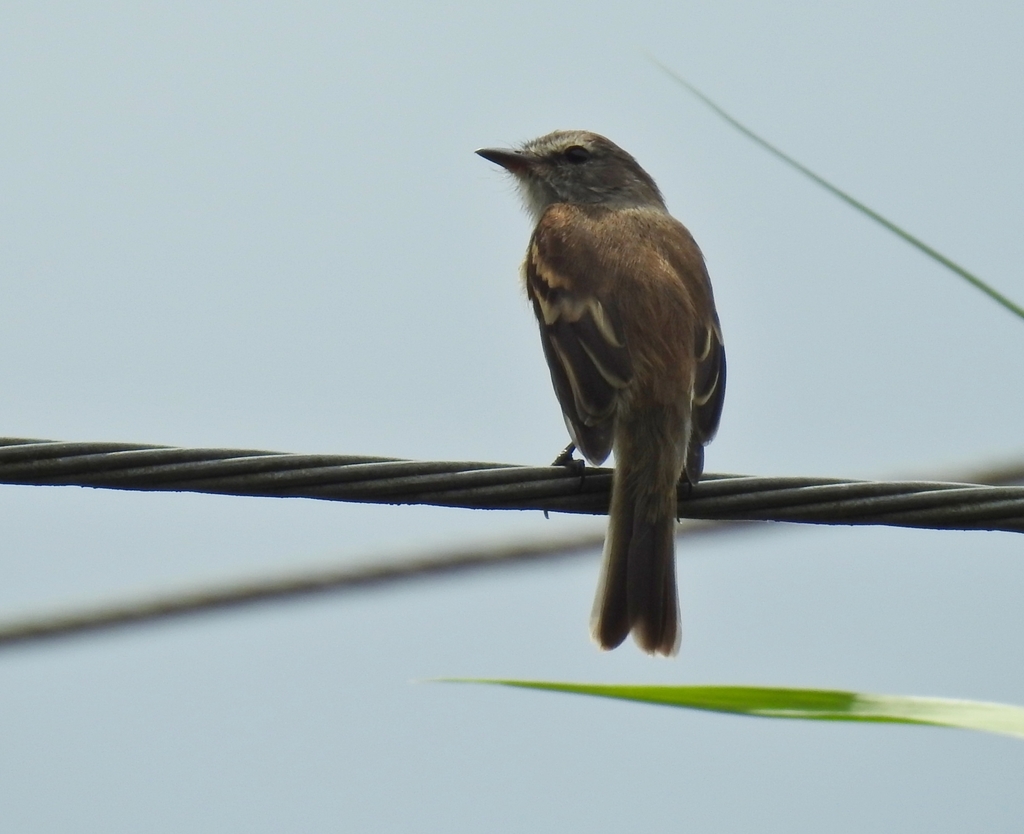
Mouse-grey Flycatcher
Photo © Esteban Poveda
Photo © Esteban Poveda — CC BY 4.0 — Source: iNaturalist #61789101The mouse-gray flycatcher or mouse-grey flycatcher (Myiophobus crypterythrus) is a species of bird in the family Tyrannidae, the tyrant flycatchers. It is found in Colombia, Ecuador, and Peru. == Taxonomy and systematics == The mouse-gray flycatcher was originally described by English ornithologist Philip Sclater in 1861 from a specimen sent to him from Pallatanga, Ecuador. Sclater originally placed it in the genus Myiobius but it was later placed in Myiophobus. Its specific epithet crypterythrus comes from the Greek crypto meaning hidden, and erythrus meaning reddish, a reference to its subtle reddish wing bars that aren't obviously apparent at first glance. Sclater noted its similarity to the bran-colored flycatcher (then under the name Myiobius naevius, now Myiophobus fasciatus) but noted differences in size and plumage. In the mid-twentieth century it was reclassified as a subspecies of the bran-colored flycatcher by Carl Eduard Hellmayr under the name Myiophobus fasciatus crypterythrus. Some publications used the name western banded flycatcher for the subspecies during the 20th century. Although its distinct appearance was apparent, some believed that it didn't even warrant a subspecies, with Zimmer considering it conspecific with M. f. rufescens due to a confusing female specimen from where the ranges overlap. Following studies…
Cerros de Amotape National Park
District of San Jacinto, Ecuador
+246 birds+1 mammals
Arid mountains rise abruptly from Peru's northwestern frontier, their slopes clothed in xerophytic scrubland and seasonal deciduous forest that transforms these Andean foothills into one of…
VIEW NATIONAL PARKPodocarpus National Park
Zamora, Ecuador
+496 birds+6 mammals
Where the Andes descend toward the Amazon basin, Podocarpus National Park sprawls across nearly 2,800 square kilometres of the most biodiverse terrain in Ecuador's southern highlands.…
VIEW NATIONAL PARKNo community photos yet. Log in to add the first one.
No community observations of this species yet.