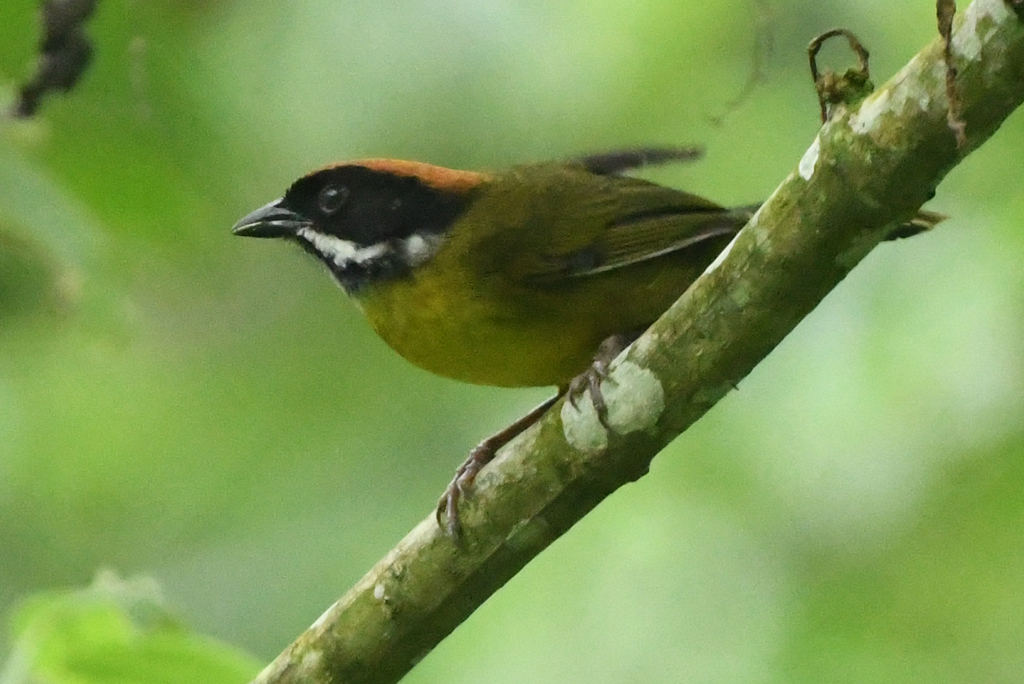
Moustached Brushfinch
Photo © Julien Renoult
Photo © Julien Renoult — CC BY 4.0 — Source: iNaturalist photo #586455110The moustached brushfinch (Atlapetes albofrenatus) is a species of bird in the family Passerellidae. It is found in northern Colombia, where its natural habitats are subtropical or tropical moist montane forest and heavily degraded former forest. == Taxonomy and systematics == The moustached brushfinch was first formally described in 1940 by the French ornithologist Auguste Boissonneau. He named it Tanagra (arremon) albo-frenatus, considering it to be part of the Tanager family. A study of the mitochondrial DNA gene sequences for the family Passerellidae indicated that the moustached brushfinch is most closely related to the ochre-breasted brushfinch, found in Colombia and Venezuela, and the Santa Marta brushfinch, endemic to Colombia. Two subspecies are recognised: A. a. albofrenatus (Boissonneau, A, 1840) – eastern Andes of Colombia (Norte de Santander to Cundinamarca) A. a. meridae (Sclater, PL & Salvin, O, 1871) – Andes of western Venezuela (Táchira and Mérida) The subspecies A. a. meridae has sometimes been treated as a separate species, the Merida brushfinch, but both taxa have variable plumage and there is no published genetic data. == Description == Like most Atlapetes species, the moustached brushfinch is a large-headed, long-tailed New World sparrow. Adult. Adults are between 17.5 and 18cm in…
Natural Serranía de los Yariguíes National Park
El Carmen de Chucurí, Colombia
+320 birds+3 mammals
Where the northern cordilleras of Colombia rise toward cloud forest, the Serranía de los Yariguíes unfolds across nearly 1,820 square kilometers of some of the most…
VIEW NATIONAL PARKNatural Chingaza National Park
Junín, Colombia
+285 birds+6 mammals
Where the Andes rise above three thousand metres in the Cundinamarca region, high-altitude grasslands and cloud forests converge in a landscape shaped by both geology and…
VIEW NATIONAL PARKNo community photos yet. Log in to add the first one.
No community observations of this species yet.