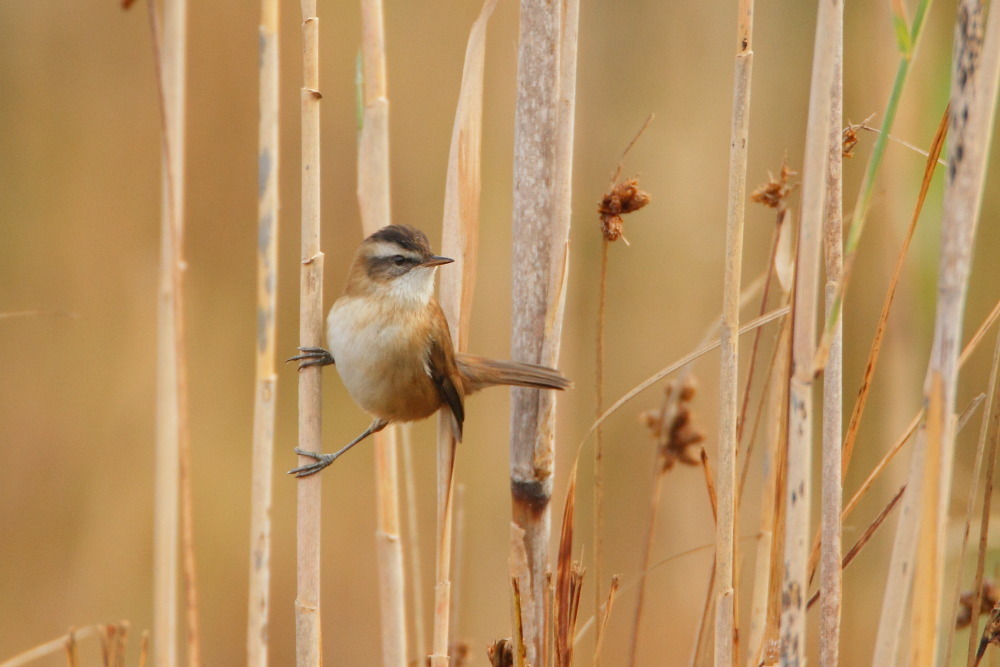
Moustached Warbler
Photo © Carles Pastor
Photo © Carles Pastor — CC BY-SA 4.0 — Source: iNaturalist photo #5693992Identification
The Moustached Warbler is a small songbird, measuring 12–13 cm in length, making it slightly smaller than the similar Sedge Warbler. Adults display a finely streaked brown back contrasting with white underparts. The most distinctive features include a flattened forehead, a prominent whitish supercilium (eyebrow stripe), grey ear coverts, and a strong, pointed bill. The sexes are identical in plumage, though young birds are noticeably more heavily streaked with markings on the breast, which can aid in age determination.
The species' song is fast and melodious, softer than those of related warblers and containing some mimicry along with typical whistles of the genus Acrocephalus. Notably, it includes phrases reminiscent of the Nightingale. Unlike the Sedge Warbler, it does not sing in flight, making it somewhat easier to locate by sound alone once perched.
Range & Habitat
The Moustached Warbler breeds in southern Europe and southern temperate Asia, with a small population in north-west Africa. It is partially migratory, with south-west European birds remaining resident year-round. Birds breeding in south-east Europe winter within the Mediterranean breeding range, while Asiatic populations migrate to Arabia, India, and Pakistan. The species is scarce north of its main range and has been recorded as a very rare vagrant in Poland and Denmark.
This warbler shows a strong preference for upright aquatic vegetation, particularly reedbeds and sedge beds, though it will also nest in suitable bushes. It is found in wetland habitats where dense vegetation provides both shelter and hunting grounds for its insectivorous diet.
Behaviour & Diet
The Moustached Warbler is insectivorous, foraging among reed and sedge stems for small invertebrates. It is typically monogamous, with both partners contributing to breeding activities. The female constructs a distinctive deep cup nest suspended over water among reeds, rushes, or in a bush, anchoring it securely to withstand wind and water movement.
Breeding occurs from mid-April, with clutches of 3 to 6 eggs. Both sexes incubate the eggs for 13 to 15 days and feed the young, which fledge after approximately 12 days. Young birds become independent 18–22 days after leaving the nest. The species typically raises two broods each breeding season, maximizing reproductive success during the warmer months.
Best Time & Places to See It
The best time to observe Moustached Warblers is during the breeding season from April onwards, when birds are present, territorial, and vocal. South-west European populations remain throughout the year and may be seen in winter, while spring and early summer offer the best opportunities to encounter breeding birds in south-east Europe and Asia. Birds migrating to winter quarters in Arabia, India, and Pakistan can be found in those regions during winter months.
Target extensive reedbeds and sedge beds in southern European wetlands, Mediterranean marshes, and suitable habitats across temperate Asia. Early morning, when birds are most vocal and active, offers the best chance for observation and photography.
Photography Tips
Photographing Moustached Warblers requires patience, as they spend considerable time concealed within dense reed and sedge vegetation. Position yourself near known breeding territories at dawn or early morning when singing birds are most active and likely to emerge into open perches. A telephoto lens of at least 300–400mm is essential, as birds often remain distant and partially obscured by vegetation.
Focus on capturing the distinctive facial markings—the whitish supercilium, grey ear coverts, and pointed bill—which are key identification features. Behavior shots showing the bird foraging among reeds or perched on a reed stem are particularly valuable. Overcast days can provide softer, more even lighting in reedbed habitats, improving image quality in these typically shaded environments.
S’Albufera Natural Park
Platja de Muro, Spain
+253 birds+6 mammals
Where Mediterranean lagoons meet the Balearic coast, S'Albufera stretches across nearly 1,600 hectares of wetland and dune systems that rank among Europe's most ecologically vital shallow-water…
VIEW NATURAL PARKMarjal Pego-Oliva Natural Park
Molinell, Spain
+219 birds+2 mammals
Where the Valencian littoral flattens into wetland and reed-bed, Marjal Pego-Oliva straddles the boundary between the Mediterranean and its inland margins, a mosaic of shallow lagoons,…
VIEW NATURAL PARKDoñana National Park
Hinojos, Spain
+300 birds+13 mammals
Where the Guadalquivir River delta spreads into the Atlantic, vast marshes, cork woodlands, and coastal dunes converge to create one of southwestern Europe's most biodiverse wetland…
VIEW NATIONAL PARKTablas de Daimiel National Park
Daimiel, Spain
+246 birds+6 mammals
Where the Guadiana River spreads into a labyrinth of shallow lagoons and reed beds across the sun-baked plains of central Spain, Tablas de Daimiel National Park…
VIEW NATIONAL PARKCabo de Gata-Níjar Natural Park
San José, Spain
+274 birds+11 mammals
Where volcanic ridges plunge toward the Mediterranean, Cabo de Gata-Níjar Nature Park unfolds across one of Europe's most arid coastlines, a landscape sculpted by tectonic violence…
VIEW NATURAL PARKDelta de l’Ebre Natural Park
Eucaliptus, Spain
+341 birds+18 mammals
Where the Ebro River spreads into a vast labyrinth of shallow lagoons, reed beds, and brackish marshes before surrendering to the Mediterranean, one of southern Europe's…
VIEW NATURAL PARKDanube Delta Biosphere Reserve
Tulcea, Romania
+277 birds+27 mammals
Where the Danube surrenders to the Black Sea, a vast labyrinth of channels, reed beds, and freshwater lakes sprawls across nearly 13,400 square kilometers of eastern…
VIEW NATIONAL PARKHortobágy National Park
Hortobágy, Hungary
+260 birds+17 mammals
Across the North Great Plain of Hungary stretches one of Europe's most expansive semi-natural grassland systems, where horizon-wide vistas of steppe and wetland create a landscape…
VIEW NATIONAL PARKFertő–hanság National Park
Fertőszéplak, Hungary
+246 birds+11 mammals
Where the Austro-Hungarian plains meet the foothills of Western Transdanubia, nearly 900 square kilometres of wetland, reed bed, and mixed woodland form one of Central Europe's…
VIEW NATIONAL PARKEspacio Natural Remolar-Filipinas
El Prat del Llobregat, Spain
+297 birds+7 mammals
Where the Llobregat River delta meets the Mediterranean, a patchwork of salt marshes, reed beds, and shallow lagoons creates one of Catalonia's most dynamic wetland ecosystems.…
VIEW NATURE RESERVEUrdaibai Biosphere Reserve
Txatxarramendi, Spain
+268 birds+8 mammals
Where the Pyrenean foothills surrender to the Bay of Biscay, tidal estuaries carve through Basque limestone, creating one of Europe's most ecologically vital wetland complexes. Salt…
VIEW BIOSPHERE RESERVECamargue Regional Nature Park
Saintes-Maries-de-la-Mer, France
+378 birds+48 mammals
Where the Rhône Delta sprawls into the Mediterranean, a landscape of stark and haunting beauty emerges—vast salt marshes punctuated by shallow lagoons, reed beds, and scrubland…
VIEW NATURAL PARKCirceo National Park
Italy
+232 birds+6 mammals
Where limestone headlands plunge toward the Tyrrhenian Sea, Circeo National Park preserves a rare mosaic of Mediterranean coastal habitats that few Italian reserves can match. The…
VIEW NATIONAL PARKGargano National Park
Cagnano Varano, Italy
+219 birds+7 mammals
Where the Gargano Peninsula's limestone plateaus descend toward the Adriatic, Cagnano Varano sits at the threshold of one of southern Italy's most ecologically vital landscapes. The…
VIEW NATIONAL PARKKeoladeo National Park
Shreenagar Rural, India
+326 birds+14 mammals
Where shallow wetlands shimmer beneath vast Rajasthani skies, one of Asia's finest bird sanctuaries pulses with extraordinary life. This former maharaja's hunting reserve, now spanning 29…
VIEW NATIONAL PARKKerkini Lake National Park
Serres, Greece
+291 birds+18 mammals
Where the Strymon River widens into a sprawling freshwater lake hemmed by the Rhodope Mountains, Kerkini National Park unfolds across northern Greece as one of southeastern…
VIEW NATIONAL PARKPort-Cros National Park
Hyères, France
+271 birds+29 mammals
Where Mediterranean granite islands rise from crystalline waters off the Provençal coast, Port-Cros National Park protects one of Europe's most intact marine and terrestrial ecosystems. The…
VIEW NATIONAL PARKNo community photos yet. Log in to add the first one.
No community observations of this species yet.