Identification
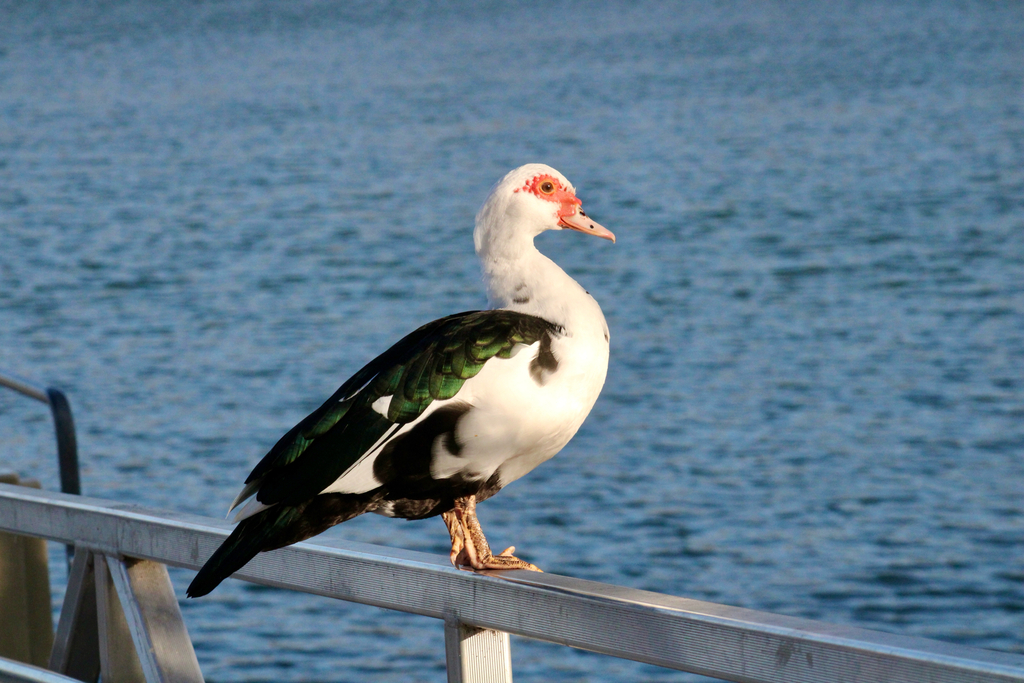
The Muscovy duck is a large and distinctive waterfowl, with males significantly larger than females. Males reach 76–84 cm in length and weigh up to 3–4 kg, while females are smaller at 71–76 cm and around 1.25 kg. The wingspan ranges from 137 to 152 cm. Both sexes display predominantly black plumage with striking large white patches on the wings, though males show more iridescent and glossy feathering, particularly on the back and wing feathers, while females appear more drab. Juveniles are duller overall with little or no white on the wings.
Males possess a distinctive short crest on the nape and a characteristic blackish or dark red knob at the bill base, matched by bare facial skin of similar colouration. The bill itself is black with pale pink speckling, and the eyes are yellowish-brown. Females lack the prominent knob and have a feathered face instead. Both sexes feature long claws on their feet, dark webbed feet, and a notably wide, flat tail. Males produce a low breathy call, while females emit a quiet trilling coo.
Range & Habitat
The Muscovy duck is native to the Americas, ranging from the Lower Rio Grande Valley of Texas and Mexico southward to Argentina and Uruguay. While these birds originate from tropical regions, they display remarkable adaptability to cooler climates, thriving in temperatures as cold as −12 °C and surviving even colder conditions. This cold hardiness has enabled the species to establish feral populations beyond its native range.
Feral populations of Muscovy ducks now occur locally in New Zealand, Australia, the United States, and in Central and Eastern Europe, all descended from domesticated birds that have escaped or been released. The species has been domesticated since pre-Columbian times by Native Americans. Domestic Muscovy ducks are generally heavier and less capable of sustained flight than their wild counterparts, and their plumage is often more variable, frequently featuring extensive white patches.
Behaviour & Diet
Muscovy ducks are dabbling ducks belonging to the subfamily Anatinae, though recent genetic analysis suggests they may be more closely related to the subfamily Tadorninae. The species exhibits striking sexual dimorphism not only in size but also in plumage appearance. Males possess distinctive helical penises that can become erect within 0.3 seconds. Females have evolved coiled vaginas that spiral in the opposite direction, apparently functioning as an adaptation to limit forced copulation by males.
The species is monotypic with no recognized subspecies, though domesticated birds are sometimes informally referred to as a "subspecies domestica," though this has no valid taxonomic standing. Domesticated Muscovy ducks are commonly referred to as pato criollo in Spanish, and in culinary contexts they are often called Barbary duck.
Best Time & Places to See It
In their native range, Muscovy ducks can be encountered from the Lower Rio Grande Valley of Texas and Mexico through Central and South America to Argentina and Uruguay. Travellers seeking wild populations should explore wetland habitats throughout this vast range. The species' adaptability to varied climates means it may be encountered in diverse environments across these regions.
Outside their native range, feral populations can be found in New Zealand, Australia, parts of the United States, and Central and Eastern Europe, where established populations may be more accessible to travellers. Local knowledge of water bodies and parks in these regions will help locate feral birds that have become semi-habituated to human presence.
Photography Tips
The Muscovy duck's striking plumage and substantial size make it an excellent photography subject. The contrast between black and white wing patches is particularly dramatic and photographs well in good light. Males are especially photogenic due to their larger size, prominent facial knob, and distinctive head crest, which create distinctive silhouettes and facial detail shots.
Capture the birds on water to showcase their wide, flat tail and webbed feet, or photograph them on land to highlight their large claws and upright posture. The yellowish-brown eyes provide good focal points for close-up portraits. Early morning or late afternoon light will enhance the iridescent and glossy qualities of male plumage. Sexual dimorphism means photographing both sexes together illustrates the species' remarkable size difference and allows comparison of their distinct facial features.
Abruzzo, Lazio and Molise National Park
Amacayacu National Park
Amazônia National Park
Anavilhanas National Park
Antisana National Park
Arenal Volcano National Park
Arrecifes de Cozumel National Park
Bahuaja Sonene National Park
Bannau Brycheiniog National Park
Nothing matches these filters.
No community photos yet. Log in to add the first one.
No community observations of this species yet.