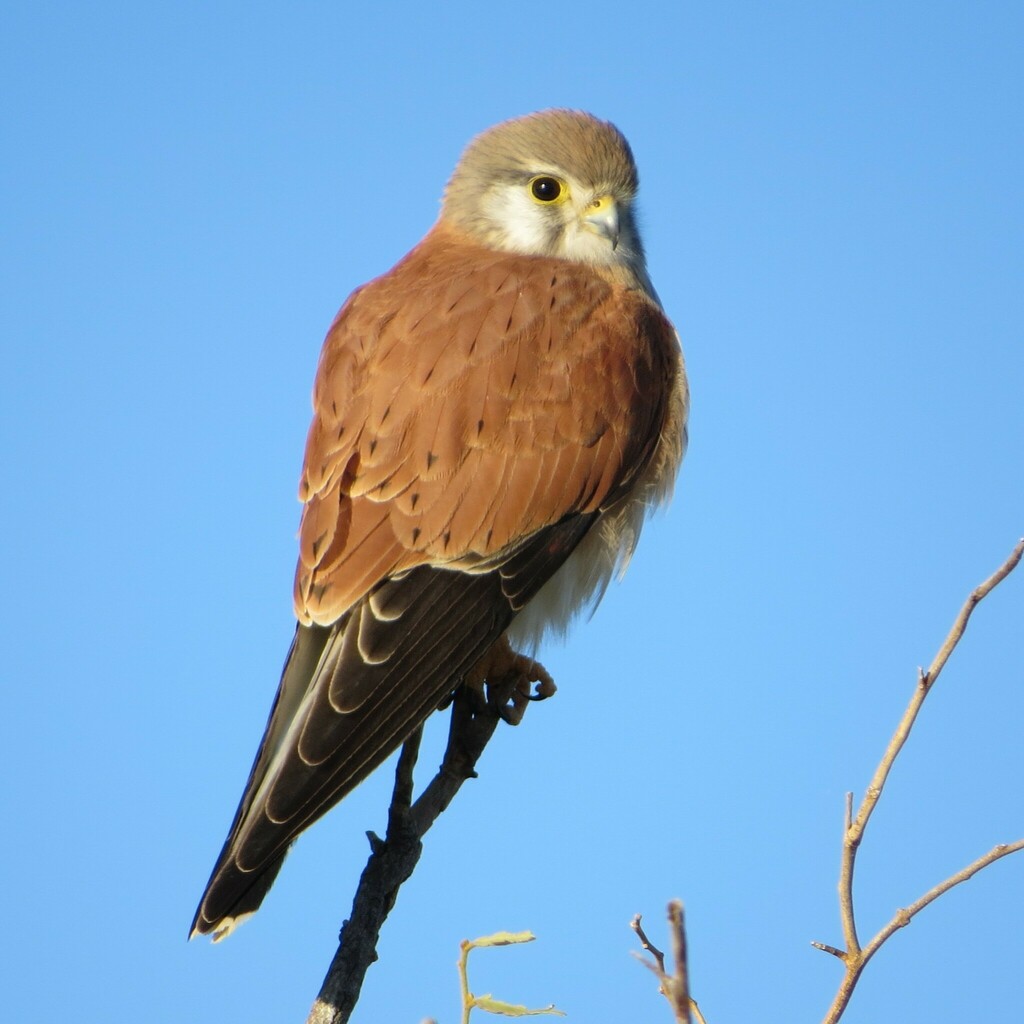
Nankeen Kestrel
Photo © pimelea
Photo © pimelea — CC BY 4.0 — Source: iNaturalist #207135826Identification
The nankeen kestrel is one of the smallest falcons, measuring 28 to 35 cm long with a wingspan of 66 to 78 cm. Males weigh 121 to 195 g, while females are slightly heavier at 115 to 273 g. The plumage is distinctive: pale rufous upper-parts contrast sharply with black flight-feathers, and the underparts are finely streaked white with a black subterminal band. The cere, eye-ring, and legs are yellow. Males display a pale grey crown and tail with a darker tear-mark, whereas females and juveniles have a rufous crown and finely barred tail. The slim build and small size make identification straightforward, especially when combined with the bird's characteristic straight-winged hovering technique—a habit shared only by larger, lighter-coloured elanid kites and the much bulkier brown falcon.
Range & Habitat
This very common and easily observed raptor is native to Australia, New Guinea, and nearby islands, with irregular visits to New Zealand. It thrives in open country that is not too densely vegetated, particularly temperate grasslands and open woodlands. In tropical northern regions and sandy western deserts, distribution becomes patchy and seasonal. Birds favour perches on coastal cliffs, phone lines, and power lines, especially in windy areas. Unlike many raptors, the nankeen kestrel follows no fixed migratory pattern: established pairs in southern grasslands remain year-round, while others migrate north during austral winter or roam the arid interior in pursuit of food. Typically seen singly or in pairs, they occasionally aggregate into loose flocks of up to 30 in favourable conditions.
Behaviour & Diet
The nankeen kestrel is an adaptable hunter with a varied diet comprising large numbers of insects—grasshoppers, crickets, beetles, moths, and ants—alongside other arthropods such as centipedes and spiders. Small birds, particularly feral starlings and sparrows, reptiles including small lizards and skinks, and small rodents, especially mice, round out its prey. Carrion is occasionally taken. The bird employs multiple hunting strategies, most commonly perching in an exposed position on a dead tree or telephone pole to watch for prey. Its most distinctive behaviour is hovering motionless over croplands and grasslands—a technique that sets it apart from other Australian raptors. Pairs are typically monogamous, and breeding occurs in late winter when three to seven eggs are laid (usually four). The female incubates alone for 26 to 28 days, while the male provides food. Multiple broods may be raised in good seasons.
Best Time & Places to See It
The nankeen kestrel is one of Australia's most common raptors and is easily seen throughout its range. Open grasslands and woodlands offer the best viewing opportunities, particularly during daylight hours when the bird is actively hunting. In southern Australia, resident pairs are present year-round, while populations in the tropical north and arid interior fluctuate seasonally. Coastal cliffs in Western Australia and areas with scattered perches such as dead trees and power lines are reliable locations. Early morning and late afternoon tend to be productive periods for observation.
Photography Tips
The nankeen kestrel's habit of perching openly on prominent structures makes it highly approachable for photography. Look for birds on dead trees, telephone poles, and power lines in open grassland. The distinctive hovering behaviour offers dynamic shooting opportunities; patience at grassland edges during calm mornings may reward you with captures of the bird suspended in mid-air. The rufous and grey plumage renders beautifully in warm, directional light, particularly the yellow cere and eye-ring. Use a longer lens to maintain distance while photographing perched birds, and be prepared for the bird's sudden launches into hovering mode or rapid dives toward prey. The slim profile and small size require attention to shutter speed when capturing flight shots.
Bald Rock National Park
Barrington Tops National Park
Belair National Park
Ben Boyd National Park
Blue Mountains National Park
Boodjamulla National Park
Bouddi National Park
Bribie Island National Park
Budawang National Park
Nothing matches these filters.
No community photos yet. Log in to add the first one.
No community observations of this species yet.