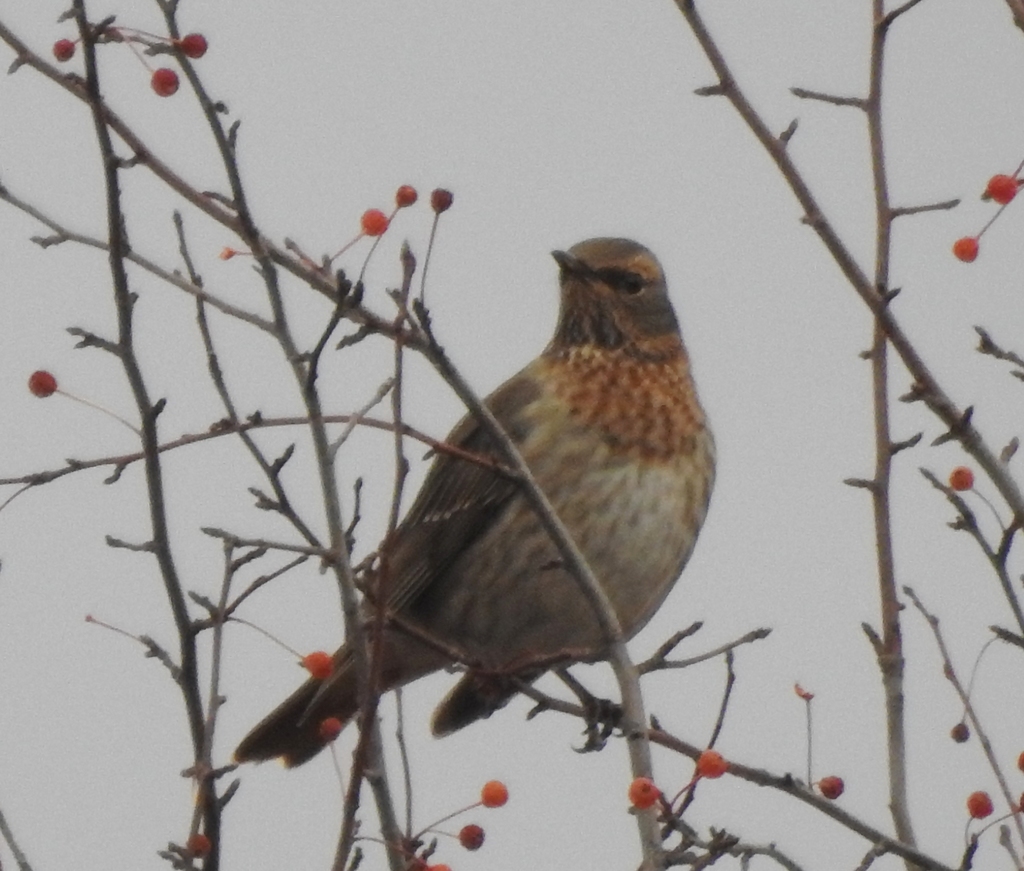
Naumann’s Thrush
Photo © Анна Васильченко
Photo © Анна Васильченко — CC BY 4.0 — Source: iNaturalist #97519687Identification
Naumann's thrush is a medium-sized, stocky thrush with a structure reminiscent of a small fieldfare. The species is characterized by its pale brown back and head, with distinctive reddish-brown coloring on the face, breast, flank spots, and rump. The belly and undertail are white, while the underwing shows a striking reddish-brown tone. A pale supercilium (eyebrow stripe) is another key identifying feature. Females are fairly similar to males, though immatures display weaker patterning overall. When comparing with the closely related dusky thrush, Naumann's shows a notably paler brown back and rump, whereas dusky thrush has darker brown plumage with black rather than reddish facial and breast markings.
The song of Naumann's thrush differs from that of its dusky thrush relative, offering another useful identification clue for keen birders in the field.
Range & Habitat
Naumann's thrush breeds across a vast range from central Siberia eastward through North Manchuria, Amurland, and Sakhalin. It is a strongly migratory species, abandoning its breeding grounds entirely to winter across South Asia and Southeast Asia, with populations concentrating principally in China, Korea, and neighboring countries. The species is a rare vagrant to western Europe, making any sightings outside its normal range noteworthy for birders.
Within its breeding range, this thrush favors open woodland areas, distinguishing it from its close relative the dusky thrush, which is more tolerant of mountainous and tundra-edge habitats. This preference for more open woodlands makes Naumann's thrush a species of relatively specific habitat requirements during the breeding season.
Behaviour & Diet
Naumann's thrush is an omnivorous forager with a remarkably broad diet. It feeds on a wide range of insects—particularly mosquitoes—as well as earthworms and berries. This dietary flexibility allows it to exploit diverse food sources across its range and is likely an adaptation to its highly migratory lifestyle, where food availability varies seasonally and geographically.
During breeding, pairs nest in trees, constructing untidy nests that are neatly lined, in which they lay clutches of 3–5 eggs. Outside the breeding season, both migrating and wintering birds often gather in small flocks, a social behavior that likely aids in predator detection and foraging efficiency during their extended journeys and periods away from breeding grounds.
Best Time & Places to See It
For travelers and photographers hoping to encounter Naumann's thrush in its natural habitat, the breeding season in central Siberia and eastward across North Manchuria, Amurland, and Sakhalin is the best opportunity. However, accessing these remote regions presents logistical challenges for most nature travellers.
A more accessible alternative is to target the wintering range in South Asia and Southeast Asia, particularly in China and Korea, where populations concentrate. Birders visiting these regions during winter months may encounter flocking birds in open woodland habitats. Vagrant sightings in western Europe remain rare but possible, offering occasional unexpected opportunities for European-based observers.
Photography Tips
The pale brown, reddish, and white plumage of Naumann's thrush offers good contrast for photography, particularly the striking reddish-brown underwing visible in flight shots and the distinctive pale supercilium in close-ups. The stocky, fieldfare-like structure makes this thrush a relatively robust subject for capturing field marks.
Winter flocking behavior in South Asia and Southeast Asia provides opportunities for photography, as birds often remain approachable within open woodland settings. Early morning light will best reveal the subtle distinctions between the pale back and richer red tones of the face and breast that distinguish this species from its dusky thrush relative.
Baikal National Park
Ольхонский район, Russia
+184 birds+11 mammals
Where the world's deepest freshwater lake meets ancient Siberian taiga, Baikal National Park sprawls across 66,203 square kilometers of one of Earth's most singular ecosystems. The…
VIEW NATIONAL PARKGiant Panda National Park
Mianyang, China
+447 birds+47 mammals
Where the eastern slopes of China's Sichuan plateau descend into cloud-wrapped valleys, one of Asia's most biodiverse landscapes unfolds across more than 350,000 square kilometres. This…
VIEW NATIONAL PARKGorkhi-Terelj National Park
Ulaanbaatar, Mongolia
+137 birds+5 mammals
Where granite monoliths rise abruptly from rolling steppe grasslands, Gorkhi-Terelj National Park unfolds across the landscape north of Ulaanbaatar, a sanctuary where forest and alpine meadow…
VIEW NATIONAL PARKHustai National Park
Altanbulag, Mongolia
+198 birds+16 mammals
Where the steppe rolls endlessly beneath vast Mongolian skies, Hustai National Park preserves one of Central Asia's most dynamic grassland ecosystems. Rolling hills and open prairie…
VIEW NATIONAL PARKKhoridol Saridag National Park
Khatgal, Mongolia
+164 birds+6 mammals
Where granite peaks thrust skyward across Mongolia's remote southeastern reaches, a landscape of raw geological drama unfolds. Deep river gorges carved through ancient stone create a…
VIEW NATIONAL PARKLand of the Leopard National Park
Khasansky District, Russia
+83 birds+11 mammals
Where coniferous and mixed forests sweep across the rolling terrain of Russia's Far East, Land of the Leopard National Park embraces a landscape shaped by the…
VIEW NATIONAL PARKNortheast China Tiger and Leopard National Park
Mu Dan Jiang Shi, China
+202 birds+19 mammals
Across the temperate forests of northeastern China, where winters grip the landscape in subzero silence and summers remain cool and brief, the Mudanjiang region supports a…
VIEW NATIONAL PARKYancheng National Nature Reserve
Yancheng, China
+208 birds+4 mammals
Where the East China Sea's tidal rhythms sculpt the Jiangsu coast, Yancheng National Nature Reserve sprawls across one of Asia's most dynamic wetland complexes. This vast…
VIEW NATURE RESERVEZhalong National Nature Reserve
Qiqihar, China
+78 birds
Across the wetlands of northeastern China, where the Heilongjiang climate swings between brutal winters and warm summers, lies one of East Asia's most vital refuges for…
VIEW NATURE RESERVEPoyang Lake National Nature Reserve
Shangrao, China
+270 birds+7 mammals
Where the Yangtze River's massive floodplain spreads across central China, Poyang Lake National Nature Reserve encompasses one of the continent's most dynamic and water-rich wetland systems.…
VIEW NATURE RESERVEQinghai Lake National Nature Reserve
Hainan Tibetan Autonomous Prefecture, China
+243 birds+11 mammals
At 3,200 metres above sea level on the Tibetan plateau, where winter temperatures plunge far below freezing and snow blankets the landscape for half the year,…
VIEW NATURE RESERVEGaoligong Mountain National Nature Reserve
Nujiang Lisu Autonomous Prefecture, China
+443 birds+13 mammals
VIEW NATURE RESERVEAlaska Maritime National Wildlife Refuge
Alaska, United States
+391 birds+58 mammals
Where the North Pacific collides with Alaska's rugged coastline, a sprawling archipelago of islands, rocky outcrops, and coastal headlands forms one of North America's most remote…
VIEW WILDLIFE SANCTUARYNo community photos yet. Log in to add the first one.
No community observations of this species yet.