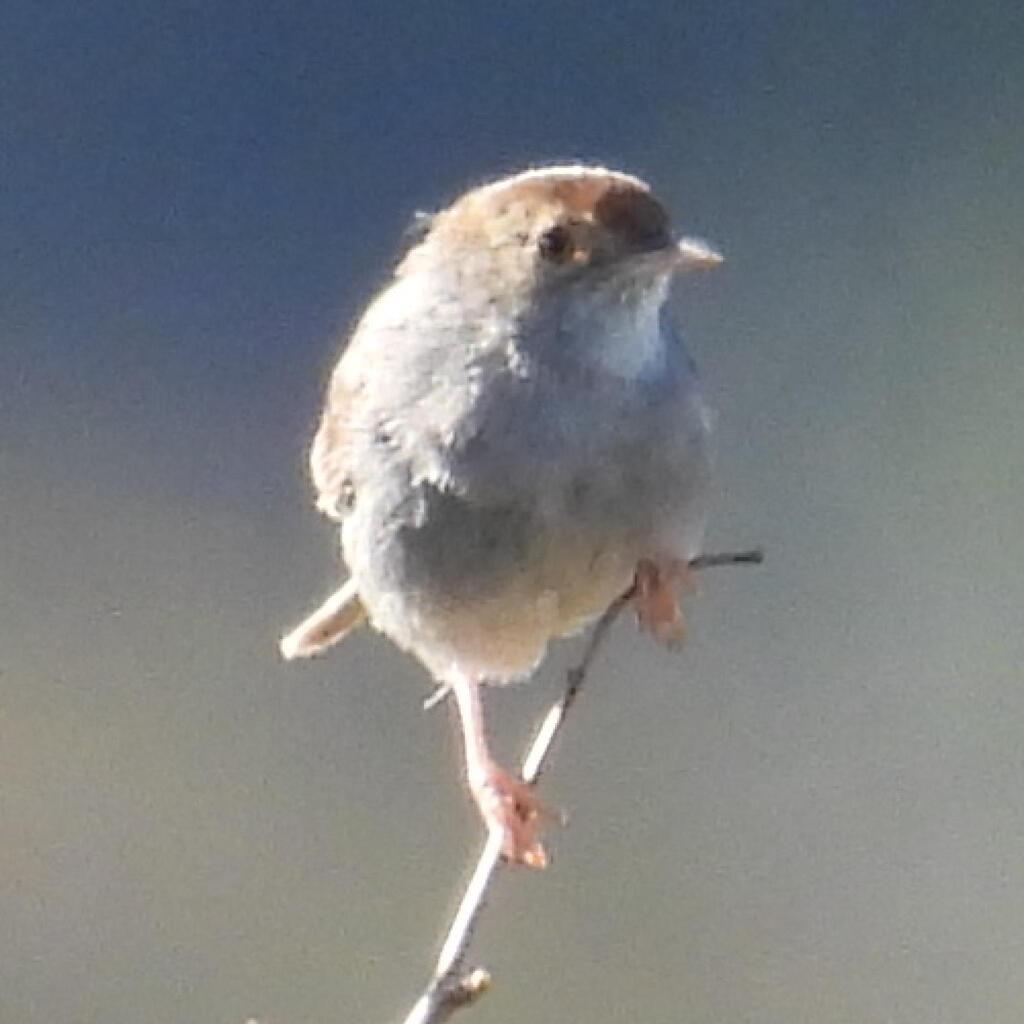
Neddicky
Photo © Henry de Lange
Photo © Henry de Lange — CC BY 4.0 — Source: iNaturalist #343933684Identification
The neddicky is a small passerine measuring 11 cm in length, with a distinctive reddish cap and plain brown back. Its underparts are buff, darker on the breast, while the short, straight bill is brown and the legs and feet are pinkish-brown. The eye is light brown. The tail is notably longer than in some other cisticola species, and the sexes are similar, though juveniles appear yellower overall. Southern subspecies show greyish face and underpart plumage with a greyish-brown back, making them visually distinctive from other cisticolas.
Range & Habitat
This resident breeder occurs throughout much of sub-equatorial Africa, from Gabon, the Democratic Republic of Congo, Rwanda and Tanzania south to the Cape. The neddicky favours open woodlands and savannah with scattered trees, as well as open plantations of exotic species. It is common throughout its range but avoids densely wooded habitats, preferring more open country.
Behaviour & Diet
The neddicky is usually encountered singly or in pairs, flitting actively through bushes and grass at the base of trees while foraging for small insects. It is a highly vocal bird, with a monotonous, penetrating call of repeated weep weep weep notes. When alarmed, it produces a loud clicking tictictictic sound, like a fingernail running across the teeth of a comb. The species breeds mainly from September to March in South Africa, constructing a distinctive ball-shaped nest with a side entrance from dry grass, cobwebs and felted plant down, typically placed low in a thorny shrub or thick grass.
Best Time & Places to See It
The neddicky is common and widespread across open woodlands and savannah throughout southern Africa. Its large range extends across 4.1 million square kilometres. The breeding season from September to March in South Africa offers opportunities to observe courtship and nesting behaviour, while the bird's loud, repetitive calls make it relatively easy to locate year-round in suitable habitat.
Photography Tips
The neddicky's small size and habit of foraging in low vegetation and grass requires patience and a keen eye. Early morning when the bird is most vocal offers the best chance of locating individuals. The reddish cap and buff underparts provide subtle but useful identification features to capture. Fast shutter speeds are essential to freeze the bird's active, flitting movements through bushes. Its preference for open country means less obstructing vegetation than forest species, making photography more feasible once the bird is located.
Addo Elephant National Park
Agulhas National Park
Bontebok National Park
Bwabwata National Park
Camdeboo National Park
Cederberg Wilderness Area
Chobe National Park
Etosha National Park
Ithala Game Reserve
Nothing matches these filters.
No community photos yet. Log in to add the first one.
No community observations of this species yet.