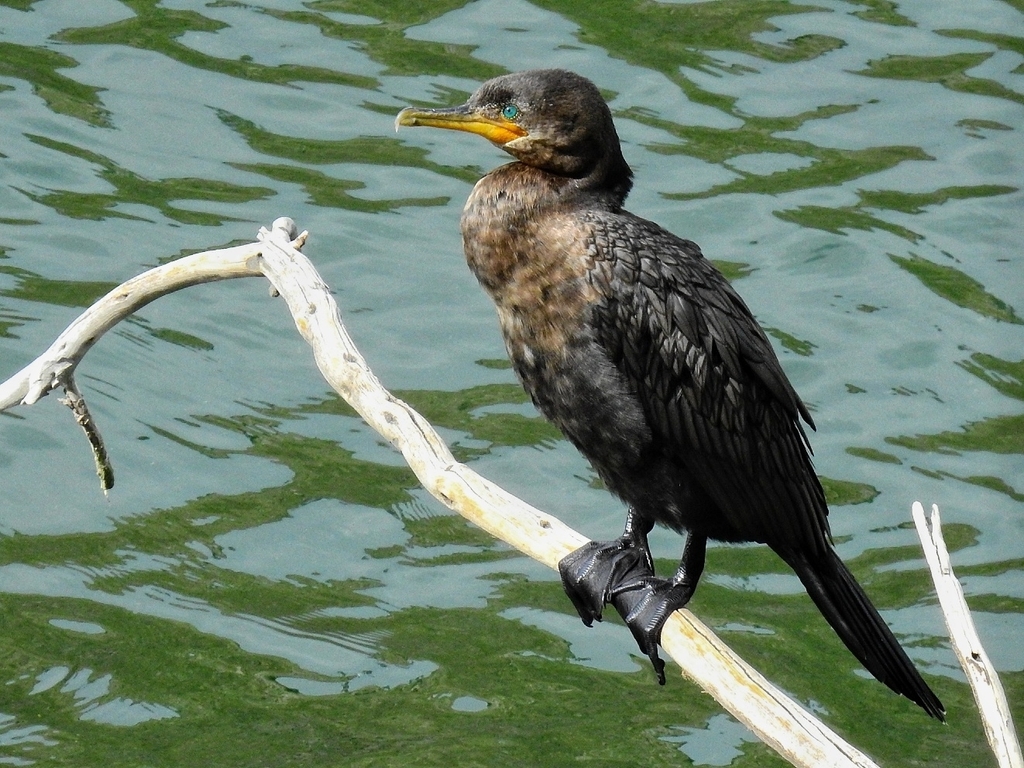
Neotropic Cormorant
Photo © Esteban Poveda
Photo © Esteban Poveda — CC BY 4.0 — Source: iNaturalist photo #179140956Identification
The Neotropic Cormorant is a medium-sized cormorant measuring 64 cm in length with a 100 cm wingspan. It is notably small and slender compared to the larger double-crested cormorant, with a characteristically long tail and a distinctive S-shaped neck posture. Adult birds are predominantly black with a yellow-brown throat patch that develops a white edge during breeding season. At this time, white tufts appear on the sides of the head, accompanied by scattered white filoplumes along the head and neck. The upper wings are somewhat grayer than the rest of the body. Juveniles are brownish in color, making them distinguishable from adults. Males are larger than females, weighing 1.1 to 1.5 kg compared to females which weigh 50 to 100 g less.
Range & Habitat
Found throughout the American tropics and subtropics, the Neotropic Cormorant ranges from the middle Rio Grande and the Gulf and Californian coasts of the United States south through Mexico and Central America to southern South America. It also breeds in the Bahamas, Cuba, and Trinidad. The species inhabits both coastal areas—including some mangrove regions—and inland waters, making it highly adaptable to diverse aquatic environments. Two subspecies are recognized: N. b. mexicanum occupies the northern range from the central USA through Nicaragua, while N. b. brasilianum is found from Costa Rica to Tierra del Fuego. Southern populations tend to be larger than their northern counterparts.
Behaviour & Diet
Unlike most other cormorants, the Neotropic Cormorant frequently perches on wires, a distinctive behavioral trait. It feeds primarily on small fish but also consumes tadpoles, frogs, aquatic insects such as dragonfly nymphs, and shrimp. Inland birds favor small, abundant fish species found in ponds and sheltered inlets, typically less than 10 cm in length. The bird forages by diving underwater, propelling itself with its feet in brief dives lasting 5 to 15 seconds. Notably, it sometimes forages in groups, with several birds beating the water with their wings to drive fish into shallows.
Best Time & Places to See It
The Neotropic Cormorant is largely a permanent resident throughout its range, though some birds occasionally wander northward during warmer months. Look for this species along coastlines, in mangrove areas, and around inland water bodies throughout the American tropics and subtropics. In Peru, the species is particularly notable as it is traditionally used by the Uru people for fishing, offering unique cultural and wildlife viewing opportunities in that region.
Photography Tips
The bird's habit of perching on wires provides excellent opportunities for photography in accessible locations. Look for the distinctive white head tufts and filoplumes during breeding season to capture the most visually striking plumage. The bird's slender profile and characteristic S-shaped neck posture make for distinctive silhouettes. Photographing foraging behavior—particularly group feeding where birds beat the water—requires patience but rewards the photographer with dynamic action shots. The contrast between the black body plumage and the yellow-brown throat patch provides good compositional opportunities.
Amacayacu National Park
Amazônia National Park
Anavilhanas National Park
Antisana National Park
Araucárias National Park
Arenal Volcano National Park
Bahuaja Sonene National Park
Barbilla National Park
Baritú National Park
Nothing matches these filters.
No community photos yet. Log in to add the first one.
No community observations of this species yet.