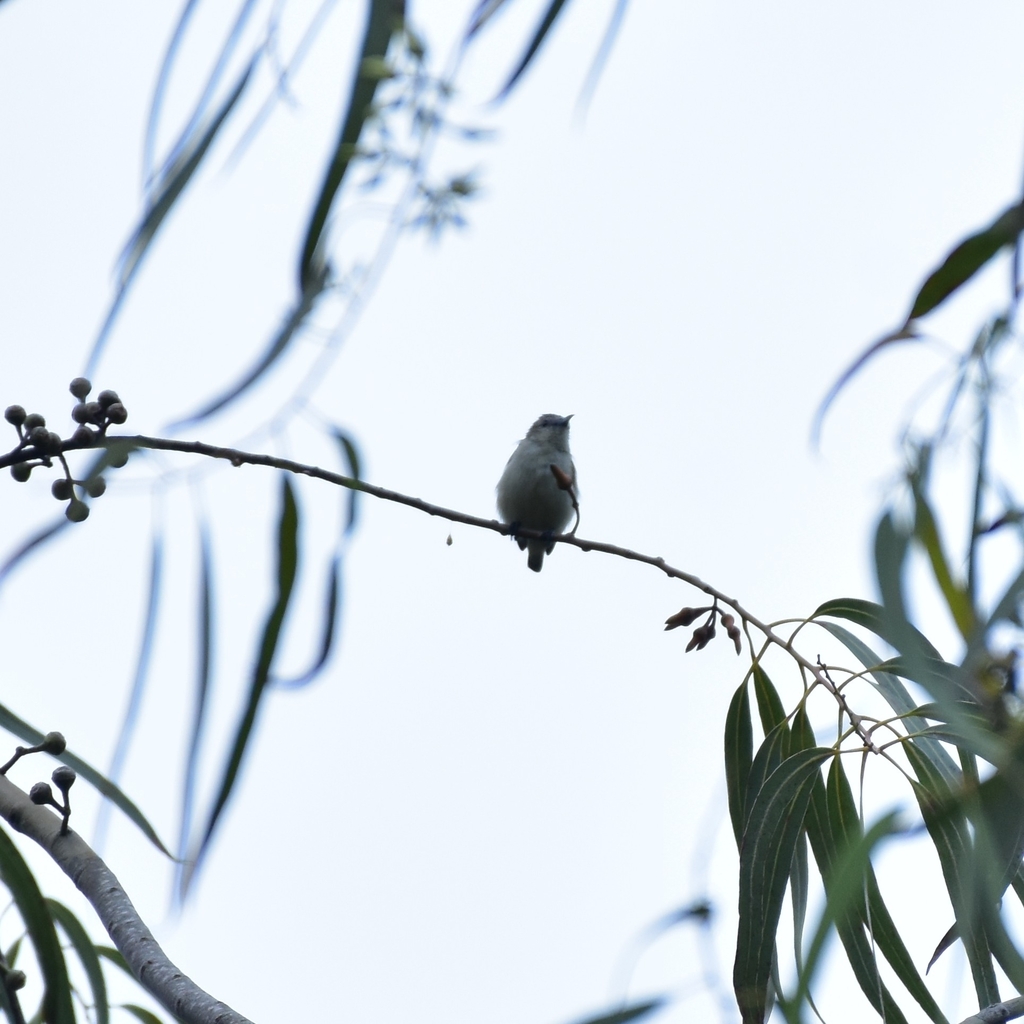
Nilgiri Flowerpecker
Photo © Renjith Jacob Mathews
Photo © Renjith Jacob Mathews — CC BY 4.0 — Source: iNaturalist #190697876Identification
The Nilgiri flowerpecker is among the tiniest members of the flowerpecker family, measuring just 9 cm in length. Both males and females share identical plumage, making sex determination by sight impossible. The bird's upperside is pale brown, while the underside is whitish. A distinguishing feature is the whitish eyebrow stripe in front of the eye, which is notably wider than that found in related species such as Dicaeum erythrorhynchos. This subtle but characteristic marking is key to separating it from other flowerpeckers in its range.
Range & Habitat
The Nilgiri flowerpecker is found exclusively in the hill forests of southern India, with its range restricted to the Western Ghats and the Nilgiri hills. This non-migratory species inhabits woodland edges, cultivation areas, and isolated stands of trees, showing a preference for hilly country. Its distribution is stable across this region, where it remains a common resident breeding bird year-round.
Behaviour & Diet
True to its family name, the Nilgiri flowerpecker is primarily a nectar feeder, equipped with a specialized feathery tongue that allows it to sip nectar with precision. However, its diet is more varied than this might suggest—the bird also supplements its intake with soft berries and small insects, foraging actively within the forest canopy. These tiny, energetic birds are highly vocal, producing a sharp "check" call or rapid series of ticks, with males delivering a distinctive high-pitched trill as their song.
The breeding season in the Nilgiris spans January to April, with pairs potentially raising a second brood in May and June. Nesting is a remarkable feat for such a small bird: they construct purse-like nests suspended delicately from tree branches or bushes, in which they typically lay two or three eggs. Beyond reproduction, these birds play a vital ecological role as important pollinators and seed dispersers of mistletoes throughout tropical forests.
Best Time & Places to See It
January to June offers the best window for observing Nilgiri flowerpeckers, particularly during the breeding season when birds are most active and vocal. Target the Western Ghats and Nilgiri hills of southern India, focusing on woodland edges and areas with isolated stands of flowering trees. Early morning visits to areas with abundant flowering and fruiting trees will yield the best encounters with this common resident species.
Photography Tips
Photographing the Nilgiri flowerpecker presents a rewarding challenge owing to its tiny size and active, canopy-dwelling habits. Use a telephoto lens of at least 400-500 mm to capture adequate detail from a distance, as approaching too closely will disturb these small, flighty birds. The pale brown and whitish plumage offers subtle tones that require careful exposure metering to avoid blown highlights on the whitish underside. Focus on capturing the diagnostic whitish eyebrow stripe, which is essential for field identification. Early morning light filtering through the canopy is ideal, and patience near flowering or fruiting trees will eventually reward you with opportunities to document this engaging species at work.
Eravikulam National Park
Devikulam, India
+192 birds+7 mammals
High in the Western Ghats of Kerala, where monsoon mists cling to slopes that rise above 2,000 metres, Eravikulam National Park preserves one of South India's…
VIEW NATIONAL PARKPeriyar National Park
Mlappara, India
+232 birds+4 mammals
Dawn breaks over mist-shrouded ridges where the Western Ghats tumble toward Kerala's spice-scented lowlands. Here, ancient tropical forests envelope a glittering artificial lake, creating a mosaic…
VIEW NATIONAL PARKPampadum Shola National Park
Vattavada, India
+258 birds+14 mammals
Where misty shola forests cling to the high plateaus of the Nilgiri Mountains, ancient evergreen remnants create a world apart. This 2,316-hectare reserve protects one of…
VIEW NATIONAL PARKBandipur National Park
Hirehalli, India
+302 birds+19 mammals
Where the Western Ghats descend into the Deccan plateau, ancient deciduous forests blanket a landscape carved by the Nugu River. Bandipur unfolds across 880 square kilometres…
VIEW NATIONAL PARKNagarahole Tiger Reserve
Nalkeri Forest, India
+323 birds+23 mammals
Where granite escarpments rise above dense deciduous forests and the Kabini River carves through pristine wilderness, one of India's most biodiverse landscapes unfolds across the Western…
VIEW NATIONAL PARKNo community photos yet. Log in to add the first one.
No community observations of this species yet.