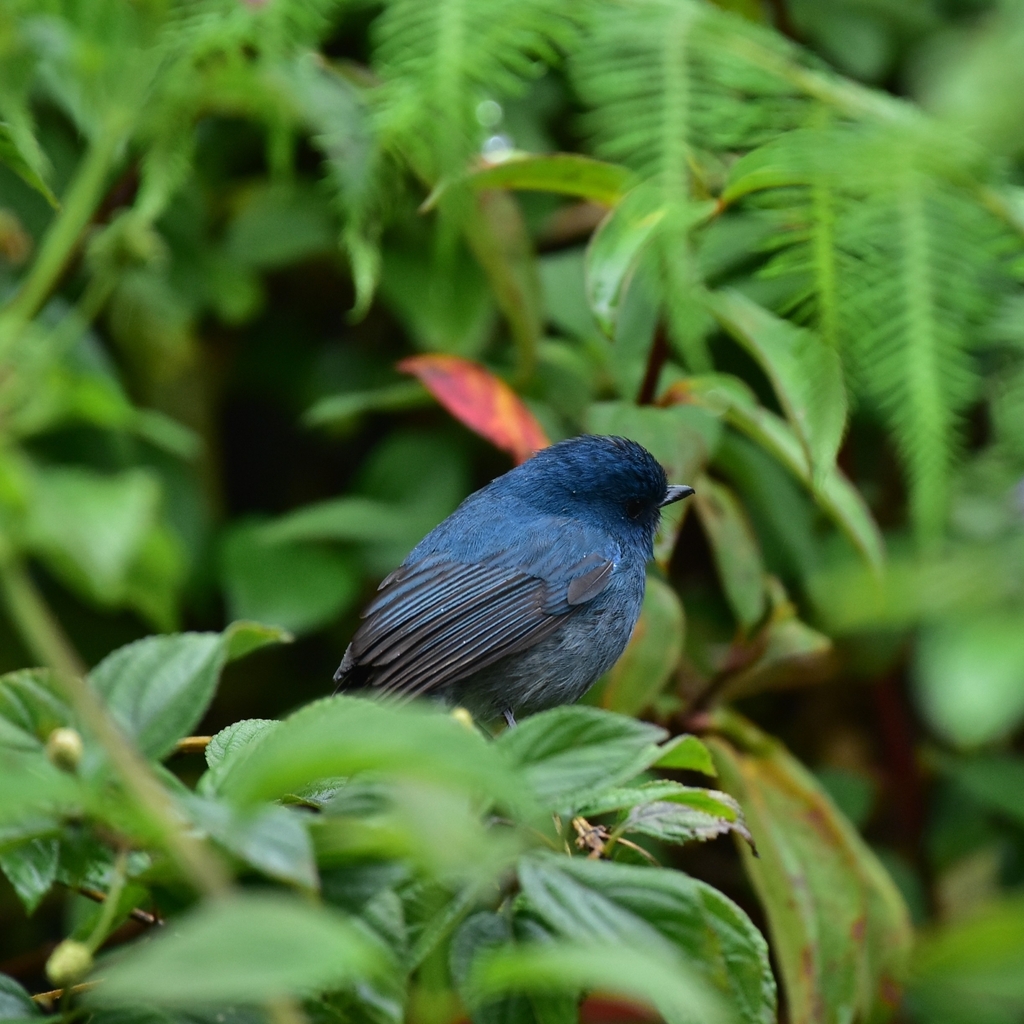
Nilgiri Flycatcher
Photo © Renjith Jacob Mathews
Photo © Renjith Jacob Mathews — CC BY 4.0 — Source: iNaturalist #144537884Identification
The Nilgiri Flycatcher is a small, somewhat long-tailed flycatcher measuring about 13 cm (5.1 in) in length. Males are dark steely indigo blue with violet-blue on the forehead and darker lores, appearing noticeably darker than the similar verditer flycatcher, without the strong contrast between pale face and black lores found in that species. Two small white patches at the base of the tail are visible when the bird is in flight, though not easily seen when perched. The two central tail feathers are blue, while the lateral feathers are dark brown edged with indigo. Wing feathers are dark brown with a narrow outer fringe of blue.
Females are considerably duller, with dark brown upperparts and dark grey underparts. Juveniles are dark brown with creamy spots and a scaly appearance on the throat and breast. Both sexes have black bills and legs, with dark brown irises. When observing this species, note the upright perching posture and characteristic tail-flicking behaviour during vocalizations, which can aid in identification in the field.
Range & Habitat
The Nilgiri Flycatcher has a very restricted range confined to the hills of southern India, where it inhabits higher altitude shola forests. The species is found mainly above 1200 m elevation in the Nilgiris, Palni Hills, Anaimalai Hills, Brahmagiri, Bababudan Hills, and Biligiriranga Hills of the Western Ghats. This highly specialized habitat preference makes it a sought-after species for birdwatchers visiting these montane forest regions.
Behaviour & Diet
Like most flycatchers, the Nilgiri Flycatcher is an active insectivore that captures prey by making characteristic sallies from a perch, returning to its lookout after each foray. It forages mainly in the lower storey of the forest but occasionally ventures to the top of the canopy in search of insects. The species is vocal, producing a series of rich warbling notes that resemble the call of the pied bushchat, along with a distinctive soft nasal chipping call described as "eep."
Breeding occurs from March to June, with peak egg-laying in April. Nests are built in cavities in earth banks or tree holes, and the species readily uses human structures such as house eaves and bridge woodwork. The nest is a cup lined with mosses and lichens on the outside, with some feathers, though the interior is not heavily lined. Clutches typically contain two to three creamy brown eggs densely mottled along their broadest part.
Best Time & Places to See It
The Nilgiri Flycatcher is a year-round resident of the high-altitude shola forests of southern India's Western Ghats. The breeding season from March to June offers opportunities to observe birds actively engaged in nesting behaviour. Visitors should focus on the higher elevation areas above 1200 m in the Nilgiris and surrounding hill ranges, where the species' specialized habitat is concentrated.
Photography Tips
The Nilgiri Flycatcher's small size and preference for forest perches require patience and a telephoto lens for successful photography. Look for birds perching upright on exposed branches, particularly during their characteristic tail-flicking displays when producing their chipping calls. The contrast between the males' dark steely blue plumage and the forest's green background provides good photographic opportunities. Early morning hours typically offer the best light and increased vocal activity, making this an ideal time for both observation and photography.
Eravikulam National Park
Devikulam, India
+192 birds+7 mammals
High in the Western Ghats of Kerala, where monsoon mists cling to slopes that rise above 2,000 metres, Eravikulam National Park preserves one of South India's…
VIEW NATIONAL PARKPeriyar National Park
Mlappara, India
+232 birds+4 mammals
Dawn breaks over mist-shrouded ridges where the Western Ghats tumble toward Kerala's spice-scented lowlands. Here, ancient tropical forests envelope a glittering artificial lake, creating a mosaic…
VIEW NATIONAL PARKPampadum Shola National Park
Vattavada, India
+258 birds+14 mammals
Where misty shola forests cling to the high plateaus of the Nilgiri Mountains, ancient evergreen remnants create a world apart. This 2,316-hectare reserve protects one of…
VIEW NATIONAL PARKNo community photos yet. Log in to add the first one.
No community observations of this species yet.