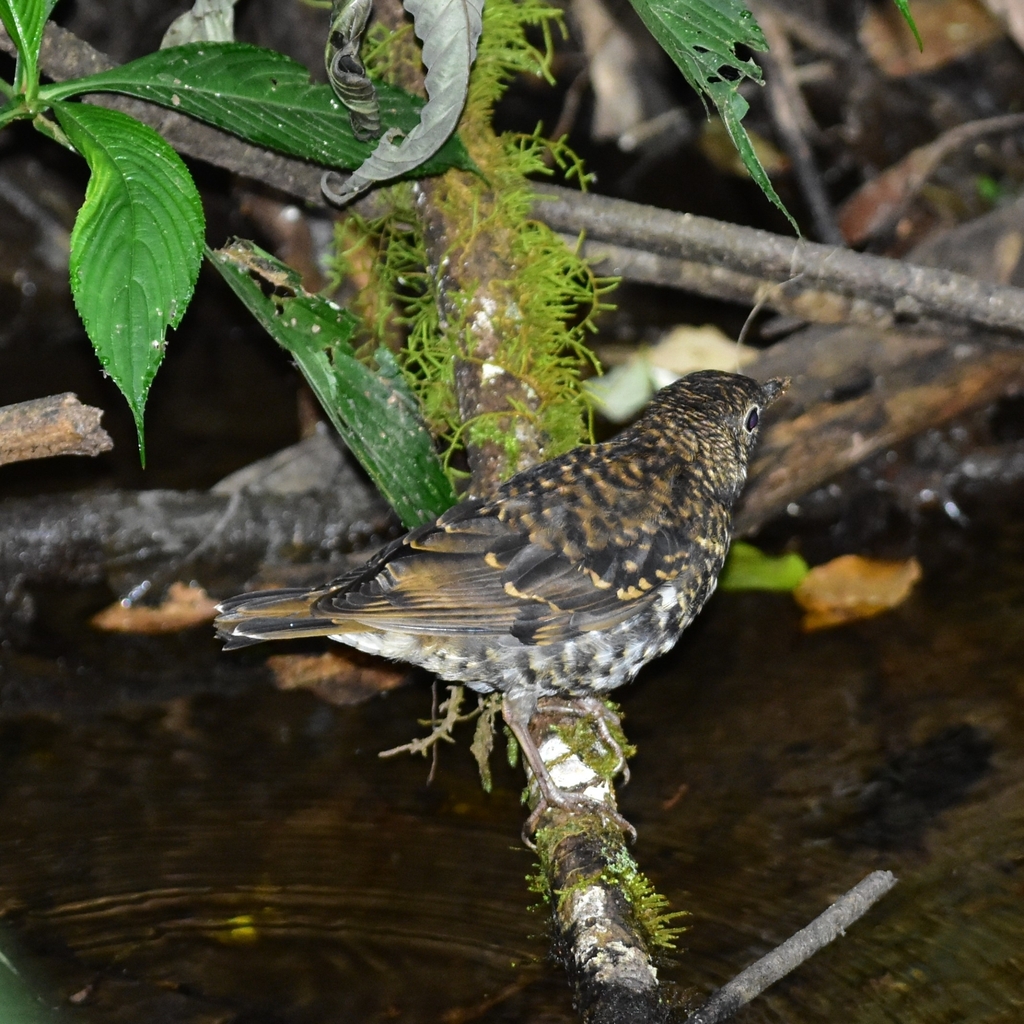
Nilgiri Thrush
Photo © Renjith Jacob Mathews
Photo © Renjith Jacob Mathews — CC BY 4.0 — Source: iNaturalist #140676785The Nilgiri thrush (Zoothera neilgherriensis) is a member of the thrush family. == Distribution and habitat == The Nilgiri thrush is endemic to the Western Ghats. It is largely restricted to the sholas, isolated cloud forests found in high altitudes that are separated by rolling montane grassland. It is also rarely found in roadways on rainy days. It feeds on insects and is an opportunistic insectivore. The thrush stays on the terrestrial lower canopy of the moist shola ecosystem. The scaled pattern of this species gives it a protective side of camouflage in terrestrial understory of the forest. Habitat extent is distributed throughout the moist shola forests in the region. == Description == The sexes are similar, 27–31 cm long, with black scaling on a paler white or yellowish background. The most striking identification feature in flight is the black band on the white underwings, a feature shared with Siberian thrush. The male has a song which is a loud, far-carrying mechanical whistle, with 5-10 second pauses between each one second long phrase twee...tuuu....tuuu....tuuu. It was previously considered a subspecies of the scaly thrush.
Eravikulam National Park
Devikulam, India
+192 birds+7 mammals
High in the Western Ghats of Kerala, where monsoon mists cling to slopes that rise above 2,000 metres, Eravikulam National Park preserves one of South India's…
VIEW NATIONAL PARKPeriyar National Park
Mlappara, India
+232 birds+4 mammals
Dawn breaks over mist-shrouded ridges where the Western Ghats tumble toward Kerala's spice-scented lowlands. Here, ancient tropical forests envelope a glittering artificial lake, creating a mosaic…
VIEW NATIONAL PARKPampadum Shola National Park
Vattavada, India
+258 birds+14 mammals
Where misty shola forests cling to the high plateaus of the Nilgiri Mountains, ancient evergreen remnants create a world apart. This 2,316-hectare reserve protects one of…
VIEW NATIONAL PARKNo community photos yet. Log in to add the first one.
No community observations of this species yet.