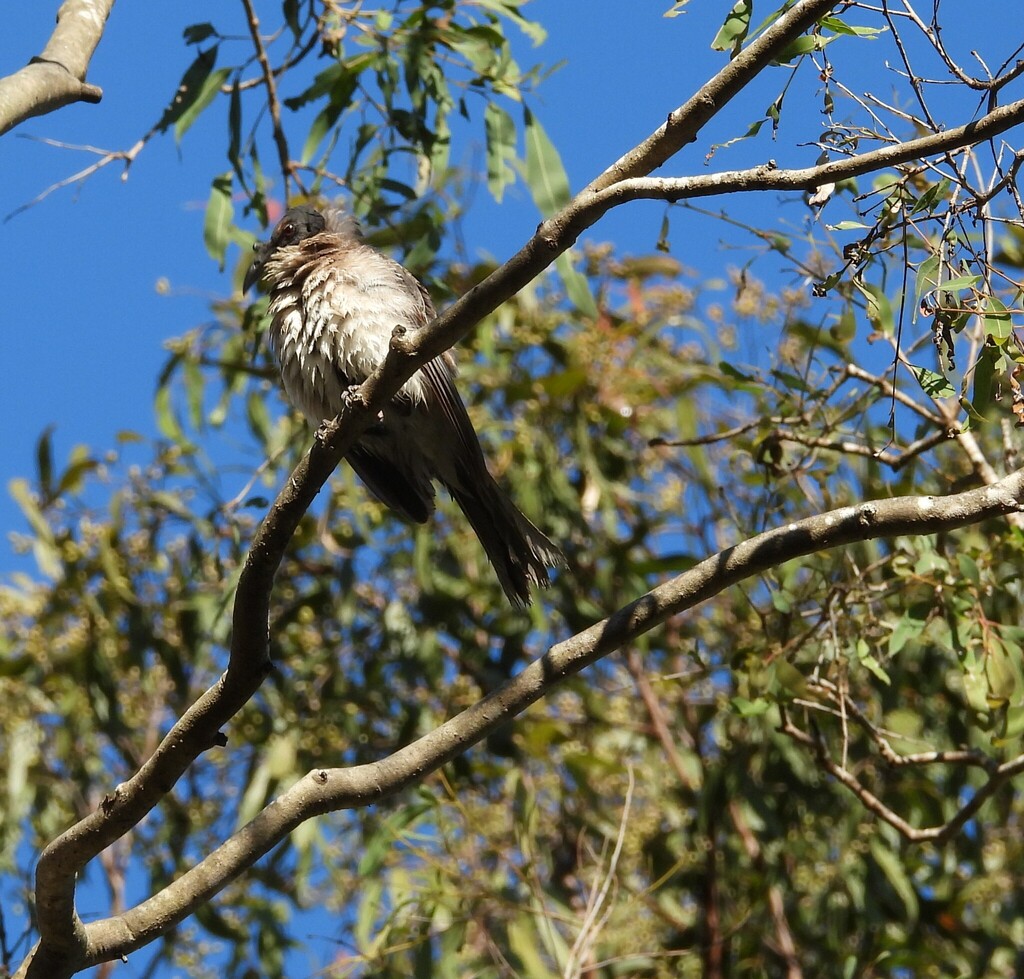
Noisy Friarbird
Photo © Mark Clarke
Photo © Mark Clarke — CC BY 4.0 — Source: iNaturalist #284216623Identification
The noisy friarbird is a large honeyeater measuring 31–36 cm in length, with dull brownish-grey upperparts and paler brown-grey underparts. Its most distinctive feature is its completely bare black head, apart from tufts of feathers under the chin and along the eyebrow. A rounded knob above the black bill is visible even at distance, making field identification straightforward. The bird has dark blue-black legs and striking red eyes. Its common name is well-earned: it is notably vocal, with calls famously likened to 'four o'clock'.
Range & Habitat
The noisy friarbird's natural range extends from the vicinity of Lakes Entrance and the Murray valley in Victoria, northward through New South Wales and Queensland to Cape York. It also occurs in southern New Guinea, where it is restricted to the Trans-Fly region and is locally abundant. In the southern parts of eastern Australia, the species is migratory, moving north to overwinter and returning south in spring.
Behaviour & Diet
These birds are highly social and often gather in large aggregations, frequently associating with little friarbirds. When feeding together in numbers, their constant cackling and chattering can fill the forest with sound. This vocal behaviour serves to identify feeding territories and announce the presence of food sources worth defending. The noisy friarbird feeds on nectar, insects, and fruit. They are aggressively protective of their nests and will swoop at intruders. Breeding occurs from July to January, with one or two broods during this period. The nest is a large, deep cup with an inverted rim, constructed from bark and grass and suspended 1–3 metres above ground from a horizontal branch.
Best Time & Places to See It
In Victoria and southern New South Wales, the best time to encounter noisy friarbirds is during spring and summer when migratory birds return from their northern wintering grounds. Queensland and Cape York offer year-round opportunities. Large aggregations are most likely during peak flowering periods when nectar availability attracts multiple individuals to the same locality. Look for them in areas with flowering trees and listen for their distinctive, loud calls to locate them.
Photography Tips
The noisy friarbird's bare head and striking facial features make it visually distinctive and photographically rewarding. The red eyes and dark knob above the bill are diagnostic details worth capturing. Their aggressive territorial behaviour means they are often conspicuous and active, providing opportunities for behaviour photography, particularly during nest-defence swoops or territorial displays. Their loud, conspicuous nature makes locating subjects relatively straightforward, and their tendency to gather in aggregations offers compositional possibilities for capturing multiple birds in flight or perched together.
Alpine National Park
Bald Rock National Park
Barrington Tops National Park
Ben Boyd National Park
Blue Mountains National Park
Bouddi National Park
Bribie Island National Park
Budawang National Park
Bunya Mountains National Park
Nothing matches these filters.
No community photos yet. Log in to add the first one.
No community observations of this species yet.