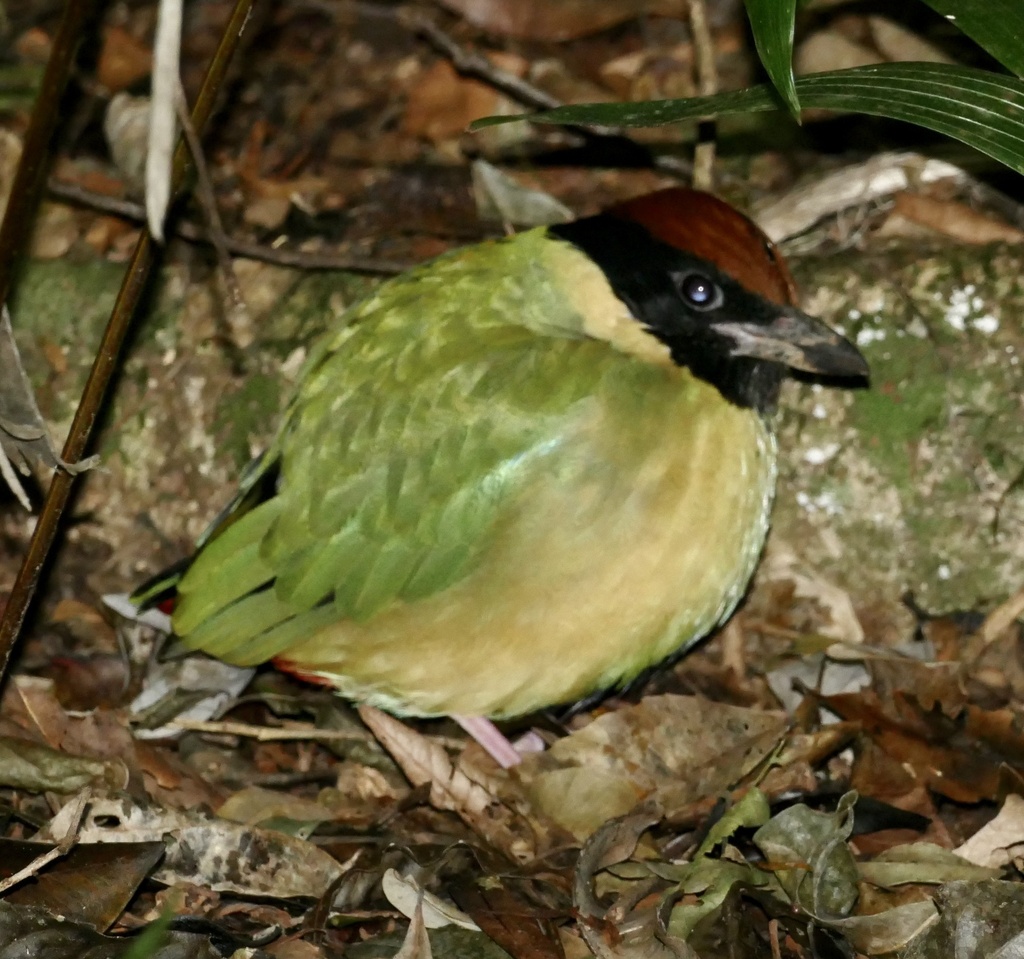
Noisy Pitta
Photo © Jean-Paul Boerekamps
Photo © Jean-Paul Boerekamps — CC0 1.0 — Source: iNaturalist #127634084Identification
The noisy pitta is a compact, colourful bird measuring 19–21 cm in length. Its most distinctive features are a black head and nape contrasting with a chestnut crown, bright green wings edged with turquoise, and a lemon-yellow throat, breast and belly. The tail is black with striking orange-red under-tail coverts. Males weigh 70–112 g and females 70–128 g. Juveniles are duller overall, with olive-green wings, grey-washed buffy breasts, and black-tipped chestnut crown feathers.
Range & Habitat
This species is found along the east coast of Australia from the Torres Strait Islands and Cape York Peninsula southwards to the New South Wales/Victoria border, with populations also occurring in southern New Guinea where they are winter migrants. The noisy pitta favours rainforest but also inhabits drier woodland and scrub. It is primarily a bird of the forest floor, preferring dense cover where it can forage undisturbed.
Behaviour & Diet
The noisy pitta is notably shy, and its distinctive call—a sequence of three ascending notes often rendered as "walk-to-work," usually repeated twice—is heard far more often than the bird itself is seen. Calling peaks in early morning and around midday, with secondary peaks at dusk and at night; it is most frequent during breeding season (September–February) and almost ceases from March to August.
On the forest floor, this pitta rummages through leaf litter for earthworms, insects, snails, woodlice and other invertebrates. While foraging, it characteristically bobs its head and flicks its tail. It also eats some fruit and notably cracks open mollusc shells—including those of the giant panda snail—against an "anvil" stone, a behaviour that earned it the colloquial name "anvil-bird." Small lizards are similarly bashed against hard surfaces before consumption.
Best Time & Places to See It
The breeding season, peaking in late spring and early summer, offers the best opportunity to locate this species, as calling activity is most intense then. Timing varies across its range: in southern Queensland and northern New South Wales eggs are laid July–February (peak November); around Cape York, November–February (peak January); and in the Torres Strait Islands, January–April. Listen for its distinctive call in rainforest habitats, particularly in early morning and midday hours, when the bird is most vocal.
Photography Tips
The noisy pitta's shyness and preference for dense forest floor habitat make it a challenging photographic subject. Success depends on patience, careful approach, and ideally locating calling birds during peak vocalization periods (early morning or midday during breeding season). Use a long lens and high shutter speed to capture movement, as the bird constantly bobs and flicks while foraging. The bird's vibrant plumage—particularly the chestnut crown, turquoise wing edges, and orange-red under-tail coverts—rewards persistent efforts with striking images.
Barrington Tops National Park
Bribie Island National Park
Bunya Mountains National Park
Daintree National Park
Dorrigo National Park
Girringun National Park
Glass House Mountains National Park
Great Sandy National Park
Ku-ring-gai Chase National Park
Nothing matches these filters.
No community photos yet. Log in to add the first one.
No community observations of this species yet.