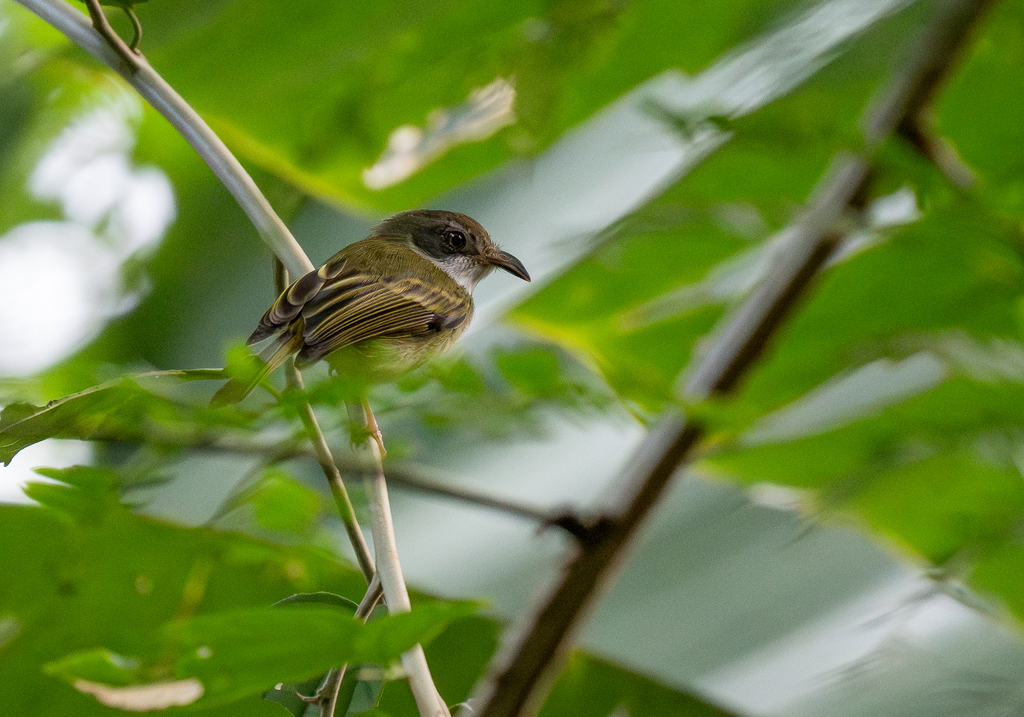
Northern Bentbill
Photo © Forest Botial-Jarvis
Photo © Forest Botial-Jarvis — CC BY 4.0 — Source: iNaturalist photo #355234124Identification
The northern bentbill is a tiny tyrant flycatcher, measuring just 9.5 to 10.5 cm in length and weighing around 4.5 to 7 grams. Its most distinctive feature is a fairly thick, downward-curved bill that gives the species its common name. The bird displays pale gray plumage on the head, with a slightly darker crown, while the back, rump, and upper tail coverts are olive-green. The wings are dusky with striking lemon-yellow edges on the flight feathers and yellow tips on the wing coverts, creating two visible wing bars. The throat and breast are pale gray with olive streaks, and the belly is pale lemon-yellow with an olive wash on the flanks. Both sexes are identical in plumage. Look for the pale yellow iris, gray bill with a pinkish base, and pinkish legs. Juveniles are distinguishable by their olive crown, buffy edges on flight feathers, and dusky bill.
Range & Habitat
The northern bentbill ranges from southern Veracruz and northern Oaxaca in Mexico, through the Yucatán Peninsula and southward along both Caribbean and Pacific slopes through Central America to western Panama. A single confirmed record from Colombia near the Panama border suggests possible vagrant or disjunct populations. This species inhabits humid lowland evergreen forests, semi-deciduous and deciduous forests, secondary woodlands, and partially open scrublands within the tropical zone. It consistently favors dense thickets and undergrowth, ranging from sea level to approximately 1,500 m elevation, though it reaches only about 1,100 m in Costa Rica.
Behaviour & Diet
The northern bentbill is a year-round resident throughout its range, never undertaking long-distance migrations. It feeds primarily on arthropods, occasionally supplementing its diet with small berries. This solitary or paired forager typically remains within dense vegetation, searching for prey from near ground level up to about 6 meters high. Its hunting technique consists of short upward sallies from a perch to snatch prey items directly from leaves, after which it flies to a new vantage point. Notably, this species does not join mixed-species feeding flocks as many other small passerines do.
The breeding season appears to include April in El Salvador and Costa Rica. The female constructs an elongated, domed nest ball made from plant fibers, featuring a characteristic side entrance and sometimes with fibers dangling from the base. Nests hang from twigs or leaves anywhere from very near the ground to approximately 4 meters high. The clutch consists of two eggs, which the female incubates alone and provisions solely. The precise incubation and fledging periods remain undocumented.
Best Time & Places to See It
The northern bentbill is a year-round resident, making it potentially observable throughout the year, though April appears to be particularly active during breeding season. It is fairly common in northern Central America and common in most of Costa Rica, though less frequently encountered on the Pacific side of northern Costa Rica. Several protected areas throughout its range harbor populations. This inconspicuous bird favors dense undergrowth and thickets, so searching such habitats during early morning hours when birds are most vocal will improve your chances of encountering it.
Photography Tips
Photographing the northern bentbill presents a genuine challenge owing to its small size, preference for dense vegetation, and habit of foraging low in undergrowth. Position yourself near dense thickets and secondary forest edges at dawn when light is optimal and activity is highest. Move slowly and listen carefully for its distinctive vocalizations—a rapid toad-like trill, a trilling call, and sharp notes that can help you locate hidden individuals. When you spot movement in thick vegetation, remain still and patient; the bird may emerge as it sallies out from perches to capture prey. A telephoto lens of at least 400mm is essential for filling the frame with this diminutive species while maintaining safe distance from dense brush.
Arenal Volcano National Park
Barbilla National Park
Barra del Colorado National Wildlife Refuge
Braulio Carrillo National Park
Cahuita National Park
Caño Negro National Wildlife Refuge
Carara National Park
Corcovado National Park
Curú National Wildlife Refuge
Nothing matches these filters.
No community photos yet. Log in to add the first one.
No community observations of this species yet.