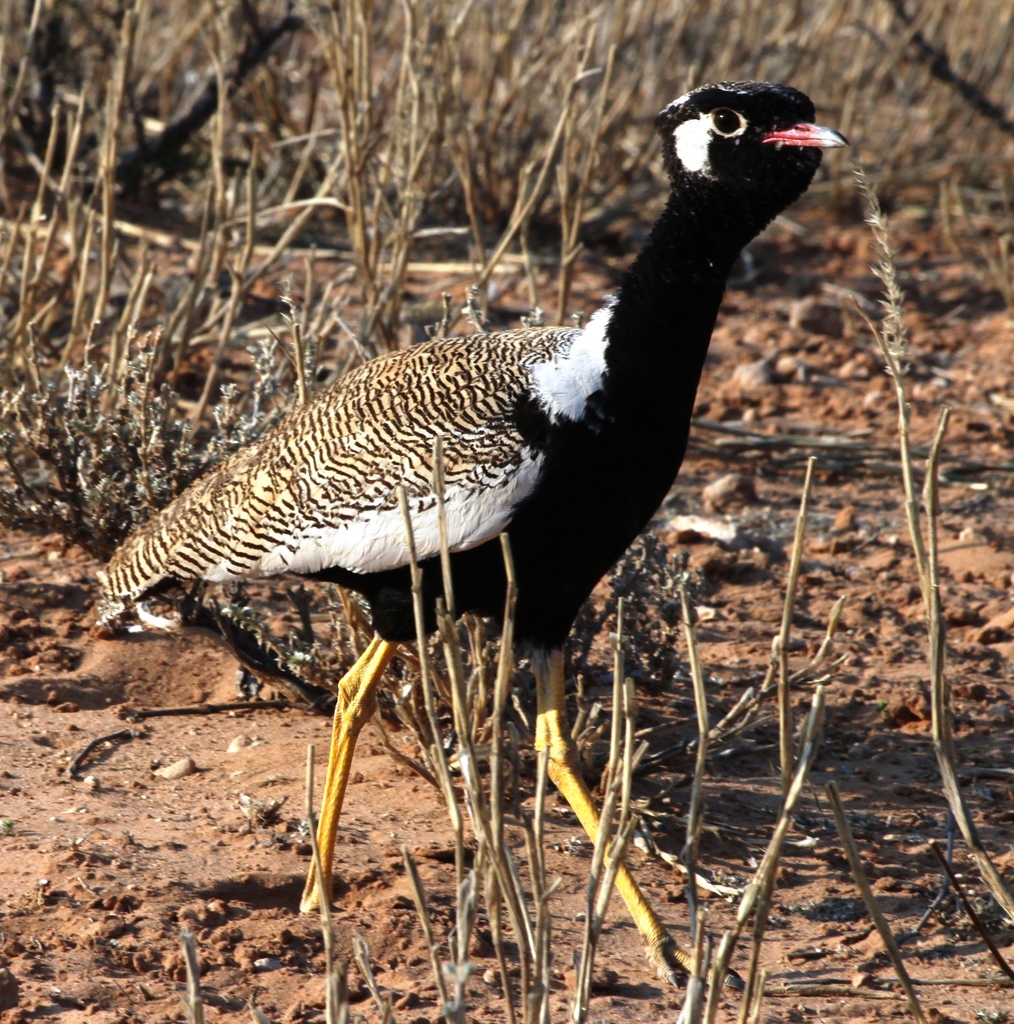
Northern Black Korhaan
Photo © Tony Rebelo
Photo © Tony Rebelo — CC BY-SA 4.0 — Source: iNaturalist #10849680Identification
The northern black korhaan is a striking ground-dwelling bustard with bold sexual dimorphism. Males display dramatically contrasting plumage: regularly-arranged black and white barring across the back and wings, with the head, neck and underparts entirely black. Females are more subtly patterned, with the head, neck, breast and upper parts barred or chequered in black and buff, while the belly remains black. Both sexes share distinctive features: bright red beaks and vivid yellow legs. The species is most reliably distinguished from its close relative, the southern black korhaan, by the white primary feathers—the southern species has black primaries instead.
Range & Habitat
The northern black korhaan is widely distributed across Southern Africa, occurring in Namibia, Botswana, Lesotho and northern South Africa. The species favours open grasslands and semi-arid environments, typically inhabiting grassland with vegetation reaching up to a metre high, grassy dunes, semi-arid scrubland and open veldt. This preference for expansive, relatively unobstructed terrain reflects the bird's ground-dwelling lifestyle and need for space to forage and display.
Behaviour & Diet
This is primarily a terrestrial bird, spending much of its time walking along the ground in search of food. The diet is opportunistic and insectivorous, comprising termites, ants, grasshoppers, beetles, spiders and ticks, supplemented with seeds. Males are highly vocal and territorial, producing a loud, raucous "kraark, kraark" call when alarmed or disturbed, often bursting into flight to escape threats. When confronted by an intruder, males characteristically run away with head and neck extended before abruptly freezing, at which point their barred plumage renders them surprisingly cryptic and difficult to locate.
Females are far less conspicuous and are seldom observed. Males engage in elaborate courtship displays involving dipping flights, flaring their white feathers prominently and engaging in ritual chasing of competitors. A territorial male will display to multiple females while actively defending his territory from rival males. Breeding occurs at any time of year, with nests consisting of simple ground scrapes containing one or two eggs.
Best Time & Places to See It
The northern black korhaan is a common species with a wide, stable population across its range, offering reliable viewing opportunities throughout Southern Africa. Look for them in open grassland and scrubland habitats across Namibia, Botswana, Lesotho and northern South Africa. Since breeding can occur year-round, there is no specific seasonal peak, though males are most conspicuous and vocal during territorial and courtship periods. Early morning and late afternoon often provide the best visibility, as birds are more active during cooler parts of the day.
Photography Tips
Photographing the northern black korhaan presents both challenges and rewards. Males are more approachable and vocal than females, making them the primary subject for field photographers. Their dramatic black and white plumage and bright yellow legs and red beak offer striking photographic opportunities, especially in good light. Patience is essential, as disturbed birds will freeze rather than flush, creating opportunities for patient photographers to capture detailed images. The male's dipping courtship flights and wing-flaring displays offer dynamic action sequences. Use a telephoto lens to maintain distance and avoid flushing birds, and approach slowly through open terrain where the bird's preferred habitat provides little cover. Early morning light will enhance the contrast and detail in the barred plumage.
Chobe National Park
Botswana
+446 birds+45 mammals
Where the Chobe River cuts a sinuous path through northern Botswana, the landscape transforms into one of Africa's most dynamic wetland-savanna mosaics. This national park encompasses…
VIEW NATIONAL PARKPilanesberg National Park
Moses Kotane Local Municipality, South Africa
+364 birds+49 mammals
Granite peaks and volcanic ridges rise unexpectedly from the savanna floor across this 734-square-kilometre expanse in the North West province, creating a landscape of profound ecological…
VIEW NATIONAL PARKMokala National Park
Siyancuma Local Municipality, South Africa
+246 birds+35 mammals
Across the semi-arid savanna of the Northern Cape, where red earth meets sparse acacia woodland and open grassland punctuated by rocky outcrops, lies a landscape shaped…
VIEW NATIONAL PARKKruger National Park
Ba-Phalaborwa Local Municipality, South Africa
+540 birds+91 mammals
Across the low-lying savanna of northeastern South Africa unfolds one of Africa's largest and most ecologically intact protected areas, where acacia woodlands merge into mopane scrub…
VIEW NATIONAL PARKMountain Zebra National Park
Inxuba Yethemba Local Municipality, South Africa
+265 birds+35 mammals
Across the windswept plateaus and deeply incised valleys of the Eastern Cape's interior, Mountain Zebra National Park unfolds as a landscape of geological drama and ecological…
VIEW NATIONAL PARKAugrabies Falls National Park
Kai !Garib Local Municipality, South Africa
+176 birds+20 mammals
Where the Orange River cuts a dramatic scar through the Northern Cape's arid interior, Augrabies Falls National Park sprawls across nearly 1,200 square kilometers of raw,…
VIEW NATIONAL PARKAddo Elephant National Park
Sundays River Valley Local Municipality, South Africa
+388 birds+55 mammals
Where the Eastern Cape's semi-arid scrublands meet transitional woodland, Addo sprawls across 13,478 square kilometres of one of southern Africa's most biodiverse landscapes. The terrain rises…
VIEW NATIONAL PARKMarakele National Park
Modimolle Local Municipality, South Africa
+341 birds+36 mammals
Granite ridges and sprawling grasslands dominate this 1,176-square-kilometre reserve in Limpopo's heartland, where bushveld transitions between rocky outcrops and open savanna. The park's rugged topography creates…
VIEW NATIONAL PARKNamib-Naukluft National Park
Namibia
+217 birds+33 mammals
Across nearly 94,000 square kilometers of southwestern Namibia, a landscape of extremes unfolds where towering sand dunes meet rugged mountain ranges, and ancient riverbeds carve through…
VIEW NATIONAL PARKBwabwata National Park
Namibia
+377 birds+35 mammals
Where the Kavango River winds through northeastern Namibia, vast floodplains and dense riparian woodland create one of southern Africa's most ecologically dynamic protected landscapes. Spanning 14,249…
VIEW NATIONAL PARKEtosha National Park
Namibia
+356 birds+58 mammals
Across northern Namibia's stark semi-arid plateau, a vast shallow depression transforms seasonally into one of Africa's most dramatic wildlife theaters. Etosha National Park, encompassing more than…
VIEW NATIONAL PARKNamibRand Nature Reserve
Hammerstein, Namibia
+107 birds+12 mammals
Where rust-coloured dunes surrender to sculpted granite outcrops and vast plains stretch toward an endless horizon, one of southern Africa's most pristine wilderness areas unfolds. The…
VIEW NATURE RESERVEMakgadikgadi Pans National Park
Gucta, Botswana
+272 birds+27 mammals
Where salt-crusted flatlands stretch endlessly toward a shimmering horizon, one of Africa's most extraordinary ecosystems awakens with the rains. The Makgadikgadi Pans comprise vast mineral-rich basins…
VIEW NATIONAL PARKNo community photos yet. Log in to add the first one.
No community observations of this species yet.