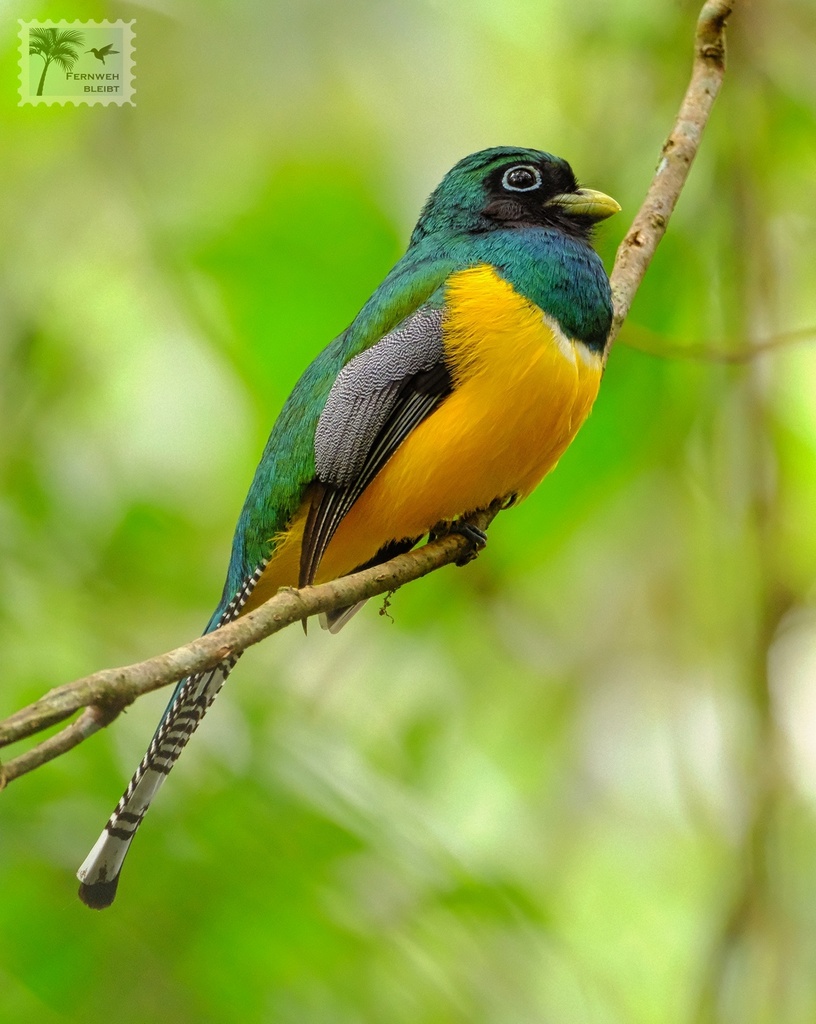
Northern Black-throated Trogon
Photo © Martin Gutewort
Photo © Martin Gutewort — CC BY 4.0 — Source: iNaturalist photo #478774011Identification
The northern black-throated trogon is a relatively small trogon, measuring 23 to 26 cm in length and weighing 50 to 59 grams. Like all trogons, it exhibits striking sexual dimorphism. Adult males are unmistakable: they feature a black face and throat, a pale blue orbital ring, and metallic green upperparts including the crown, back, and rump. Their upper breast is also metallic green, contrasting sharply with a bright yellow lower breast and belly. The wings show a complex pattern of black and white, and the tail displays a distinctive pattern of blue, black, and white with white tips on the underside.
Adult females are considerably more subdued in coloration, with mostly brown upperparts, a darker crown, and a lighter rump. Their face is brown with a whitish to pale blue orbital ring. Females retain the yellow belly of males but have a paler brown throat and upper breast. The bill is notably variable in females, ranging from black with some yellow to dusky yellow with some black, while males have a bright yellow to yellow-green bill. Both sexes have dark brown irises and bluish-gray legs and feet in adults.
Range & Habitat
The northern black-throated trogon is found from southeastern Honduras south through Nicaragua and Costa Rica to Panama, occurring on both the Caribbean and Pacific slopes. Its range extends into far northwestern Colombia's Chocó Department. This species is a year-round resident throughout its range, though it possibly moves downslope during periods of heavy rain.
The species primarily inhabits humid primary forest, with a preference for mature secondary forest from Costa Rica southward. Elevationally, it ranges from sea level to approximately 400 meters in northern Central America, mostly to about 900 meters but occasionally reaching 1,200 meters in Costa Rica, and up to 750 meters with peaks at 1,200 meters in Panama.
Behaviour & Diet
The northern black-throated trogon feeds primarily on insects, supplemented with fruit. It typically hunts in the forest understory to mid-story, capturing insects and plucking fruit by sallying or hovering from a perch before returning to eat. Notably, the species has been observed following troops of Central American squirrel monkeys, apparently to capture prey disturbed by their movement. Like other trogons, it perches erectly with its tail hanging downward and may remain motionless and quiet for extended periods.
The species produces a distinctive song of low, weak, mellow notes delivered in series of two to three notes, sometimes four, and rarely up to six, rendered as "cow cow" or "cow cow cow." It also utters a "churr" call. During breeding season, both members of a pair excavate a nest cavity in a decaying tree or stump, positioning it as high as 6 meters above ground. They lay two slightly glossy white eggs, with an incubation period of about 18 days and fledging 14 to 15 days after hatching. Both parents share incubation duties, provisioning, and brooding responsibilities.
Best Time & Places to See It
The northern black-throated trogon is a year-round resident throughout its range, making it potentially viewable at any season. Breeding season activity, particularly nest excavation, begins as early as mid-February, with egg laying continuing into June and July at lower elevations. The species is most readily encountered in humid primary forest and mature secondary forest habitats across its range from Honduras through northwestern Colombia.
Target humid lowland and foothill forests on both Caribbean and Pacific slopes of Central America and into Colombia. Scanning the understory to mid-story levels during early morning hours, when birds are most active, offers the best opportunities for observation. The species' preference for remaining perched and relatively still means patience and careful scanning are often rewarded.
Photography Tips
The northern black-throated trogon's brilliant plumage and contrasting male and female colorations make it an attractive photographic subject. Males, with their metallic green and vibrant yellow undersides framed by a black throat, are particularly striking. Position yourself to capture the distinctive pale blue orbital ring and the complex tail pattern, which is a diagnostic feature. Early morning light is ideal for rendering the metallic green tones accurately.
Since the species feeds by sallying from perches, position yourself near fruiting or insect-rich areas and wait patiently for it to return. The characteristic upright posture and hanging tail provide excellent compositional opportunities. Females, though subtler in coloration, offer an opportunity to document the species' remarkable sexual dimorphism. The variable female bill coloration is also worth capturing in detail.
Corcovado National Park
Puerto Jiménez, Costa Rica
+444 birds+48 mammals
Where the Osa Peninsula juts into the Pacific, rainforest descends almost to the tide line, and Corcovado National Park protects one of Central America's most intact…
VIEW NATIONAL PARKManuel Antonio National Park
Quepos, Costa Rica
+426 birds+22 mammals
Where tropical rainforest descends steeply to a rocky Pacific coastline, Manuel Antonio National Park distills Central American biodiversity into one of Costa Rica's most compressed and…
VIEW NATIONAL PARKArenal Volcano National Park
Peñas Blancas, Costa Rica
+551 birds+21 mammals
Straddling the border between Alajuela and Guanacaste in northwestern Costa Rica, this national park rises dramatically around one of Central America's most active volcanic systems. The…
VIEW NATIONAL PARKTortuguero National Park
Roxana, Costa Rica
+420 birds+23 mammals
Canals and lagoons thread through a labyrinth of lowland rainforest where the Caribbean coast of Costa Rica meets the wetland frontier. This is terrain shaped by…
VIEW NATIONAL PARKBraulio Carrillo National Park
Las Horquetas, Costa Rica
+547 birds+18 mammals
Where the Caribbean slope descends from the central volcanic cordillera toward the humid lowlands of Heredia, Braulio Carrillo National Park preserves one of Costa Rica's most…
VIEW NATIONAL PARKPiedras Blancas National Park
Golfito, Costa Rica
+386 birds+24 mammals
Where the Golfo Dulce meets the southwestern Pacific coast of Costa Rica, Piedras Blancas National Park protects a dramatic transition zone where lowland rainforest descends toward…
VIEW NATIONAL PARKSanta Rosa National Park
Santa Elena, Costa Rica
+359 birds+30 mammals
Where Pacific-facing slopes descend from volcanic uplands toward the Guanacaste lowlands, Santa Rosa National Park unfolds across a mosaic of tropical dry forest, gallery woodland, and…
VIEW NATIONAL PARKGuanacaste National Park
Santa Elena, Costa Rica
+461 birds+17 mammals
Where the Pacific slopes of northwestern Costa Rica rise toward the Continental Divide, dry tropical forest gives way to cloud-laden peaks and misty ridges—a landscape that…
VIEW NATIONAL PARKGeneral de División Omar Torrijos Herrera National Park
La Pintada, Panama
+401 birds+2 mammals
Across the highlands of central Panama, where the continental divide funnels moisture-laden trade winds into steep river valleys, the terrain rises and falls in a landscape…
VIEW NATIONAL PARKSoberanía National Park
Cristóbal, Panama
+495 birds+34 mammals
Rainforest and riverine woodland blanket the rolling terrain of this 714-square-kilometre national park in Colón Province, where the Caribbean watershed feeds a maze of streams and…
VIEW NATIONAL PARKChagres National Park
Caimitillo, Panama
+486 birds+19 mammals
Where the Chagres River carves through the humid tropics of central Panama, a vast montane and lowland forest sprawls across more than 2,300 square kilometers, anchoring…
VIEW NATIONAL PARKDarién National Park
Tucutí, Panama
+534 birds+13 mammals
Where the spine of Central America crumbles into wetland and rainforest, Darién National Park sprawls across more than 20,000 square kilometres of some of the tropics'…
VIEW NATIONAL PARKPortobelo National Park
Portobelo, Panama
+366 birds+9 mammals
Where the Caribbean's turquoise waters meet the Darién's verdant shore, Portobelo National Park sprawls across 570 square kilometers of coastal forest, mangrove wetland, and coral-fringed islands…
VIEW NATIONAL PARKParque Internacional la Amistad
Teribe, Panama
+325 birds+11 mammals
Where the continental divide rises between the Caribbean and Pacific watersheds, a wilderness of extraordinary biological richness unfolds across the Talamanca Range and into lowland rainforest—a…
VIEW NATIONAL PARKCarara National Park
Tárcoles, Costa Rica
+397 birds+19 mammals
Where the Pacific coastal plain meets transitional forest, Carara National Park straddles one of Central America's most dynamic ecological boundaries. The park's landscape encompasses lowland deciduous…
VIEW NATIONAL PARKCahuita National Park
Talamanca, Costa Rica
+359 birds+15 mammals
Where the Caribbean shoreline dissolves into mangrove creeks and coral gardens, Cahuita's mosaic of habitats unfolds across the Limón coast. The park's signature feature—a living coral…
VIEW NATIONAL PARKRincón de la Vieja National Park
Liberia, Costa Rica
+451 birds+30 mammals
Where volcanic slopes rise abruptly from the Guanacaste lowlands, Rincón de la Vieja National Park sprawls across a landscape shaped by geothermal drama and seasonal extremes.…
VIEW NATIONAL PARKTapantí Macizo de la Muerte National Park
Orosi, Costa Rica
+503 birds+18 mammals
Where montane cloud forest rises steeply from the Orosi Valley, Tapantí Macizo de la Muerte National Park enfolds a landscape of perpetual moisture and emerald complexity.…
VIEW NATIONAL PARKLa Amistad International Park
Crorina, Costa Rica
+532 birds+20 mammals
Where the Caribbean slopes of Costa Rica's Talamanca Mountains rise steeply inland from Limón, the boundary between two nations dissolves into an unbroken expanse of rainforest.…
VIEW NATIONAL PARKBarbilla National Park
Chirripó, Costa Rica
+226 birds
Where the Caribbean slope of Costa Rica's eastern cordillera plunges into perpetual moisture, Barbilla National Park rises as one of Central America's most water-rich ecosystems. Fed…
VIEW NATIONAL PARKVolcán Tenorio National Park
Guatuso, Costa Rica
+480 birds+12 mammals
Where volcanic slopes rise through Costa Rica's northwestern borderlands, Volcán Tenorio National Park sprawls across terrain shaped by ancient lava flows and mineral-rich springs. The park's…
VIEW NATIONAL PARKMarino Ballena National Park
Bahía Ballena, Costa Rica
+336 birds+8 mammals
Where mangrove forests meet coral-fringed shorelines along Costa Rica's southern Pacific coast, Marino Ballena National Park encompasses a marine and terrestrial mosaic that ranks among Central…
VIEW NATIONAL PARKCaño Negro National Wildlife Refuge
Caño Negro District, Costa Rica
+486 birds+16 mammals
Where the San Juan River's seasonal floodplain opens into expansive wetlands, Caño Negro Wildlife Sanctuary sprawls across one of Central America's most productive freshwater ecosystems. This…
VIEW WILDLIFE SANCTUARYGandoca-Manzanillo National Wildlife Refuge
Manzanillo, Costa Rica
+394 birds+18 mammals
Where the Caribbean coastal plain surrenders to water-logged forest and mangrove tangles, Gandoca-Manzanillo Wildlife Sanctuary shelters one of Costa Rica's most biodiverse lowland wetland ecosystems. The…
VIEW WILDLIFE SANCTUARYBarra del Colorado National Wildlife Refuge
Tortuguero, Costa Rica
+462 birds+36 mammals
Where the Caribbean's restless waters meet the Limón Province coastline, Barra del Colorado National Wildlife Sanctuary unfolds across a landscape of extraordinary ecological complexity. This equatorial…
VIEW WILDLIFE SANCTUARYNo community photos yet. Log in to add the first one.
No community observations of this species yet.