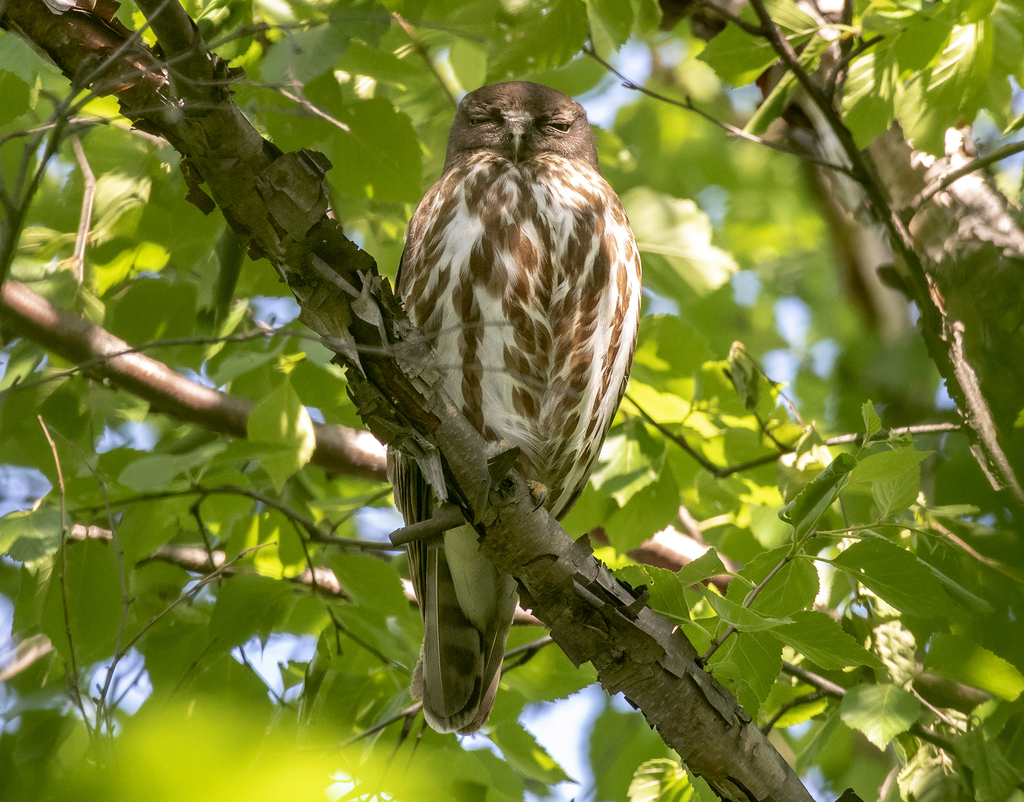
Northern Boobook
Photo © Griha Hasanov
Photo © Griha Hasanov — CC BY 4.0 — Source: iNaturalist #82671531The northern boobook (Ninox japonica) belongs to the family Strigidae (true owls) and is a raptorial owl endemic to eastern and southern countries of Asia. The species was considered, until recently, a conspecific of Ninox scutulata or brown boobook, a species of similar distribution encompassing 11 subspecies. The species currently includes two subspecies, the migrant Ninox japonica japonica and the non-migrant Ninox japonica totogo. Despite being considered as the most common breeding owl in Japan, little research has been conducted on the species and subspecies and the taxonomic classification of N. j. totogo and N. j. japonica has been a subject of debate. There are no indications of significant decline in northern boobook populations and therefore its conservation status has been classified as least concern by the IUCN Red List. == Description == Ninox japonica is a hawk owl species with a body length averaging between 29 and 33 cm and a wingspan of approximately 60 to 70 cm wide. Current knowledge on the species shows no sexual dimorphism and an average weight of approximately 168g. The northern boobook has a hawk-like appearance and its subspecies are practically indistinguishable. Individuals of the species will have a brown back and wings…
Mount Nanling Forest Park
Ruyang Forest Farm, China
+179 birds+3 mammals
Granite ridges and weathered peaks rise through a canopy of subtropical montane forest where Ruyang Forest Farm anchors one of southern China's most biodiverse landscapes. Across…
VIEW FOREST & JUNGLELand of the Leopard National Park
Khasansky District, Russia
+83 birds+11 mammals
Where coniferous and mixed forests sweep across the rolling terrain of Russia's Far East, Land of the Leopard National Park embraces a landscape shaped by the…
VIEW NATIONAL PARKNortheast China Tiger and Leopard National Park
Mu Dan Jiang Shi, China
+202 birds+19 mammals
Across the temperate forests of northeastern China, where winters grip the landscape in subzero silence and summers remain cool and brief, the Mudanjiang region supports a…
VIEW NATIONAL PARKNo community photos yet. Log in to add the first one.
No community observations of this species yet.