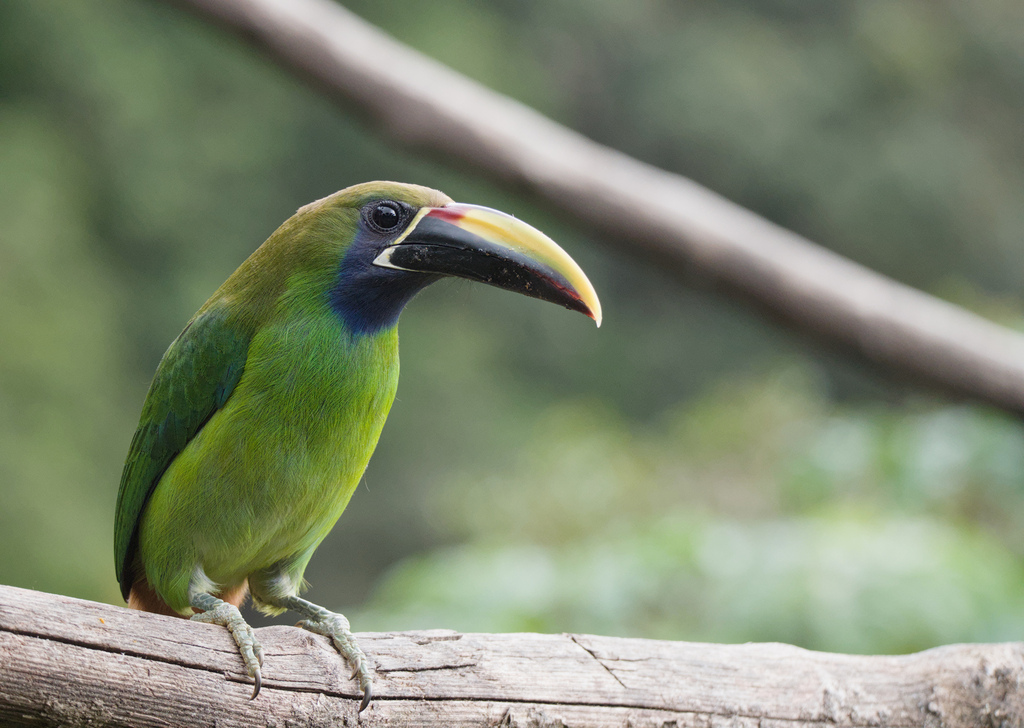
Northern Emerald Toucanet
Photo © Blake Ross
Photo © Blake Ross — CC BY 4.0 — Source: iNaturalist photo #599285455Identification
The Northern Emerald Toucanet is a striking small toucan, measuring 29 to 37 cm in length and weighing 150 to 240 grams. Like all toucans, it is brightly marked with a characteristically large bill. The plumage is predominantly emerald green, lighter on the underparts, with a white lower face and throat. The crown has a bronze tinge, while the nape and upper back display a yellowy bronze hue. A distinctive feature is the bright yellow-green to green-yellow flanks contrasting with chestnut undertail coverts and tail underside. The eye is dark brown, surrounded by even darker bare skin. The bill is particularly diagnostic: it features a black mandible, a yellow maxilla with a black patch near the nares, and a white vertical strip at its base. The sexes are alike, though females are generally smaller and shorter-billed. Immatures appear grayer than adults with reduced chestnut on the tail tips.
Range & Habitat
The Northern Emerald Toucanet occurs in montane regions from southern Mexico through Central America to southern Panama. It is a non-migratory species with seven recognized subspecies distributed across this range, from the Sierra Madre del Sur in southwestern Mexico through Guatemala, Belize, El Salvador, Honduras, Nicaragua, Costa Rica, and Panama. The species primarily inhabits humid montane forest but shows considerable habitat flexibility, also occurring in secondary forest, shrublands, pastures, and plantations. Elevationally, it ranges from near sea level to at least 3,000 meters, making it accessible to birdwatchers and photographers across a variety of terrain and altitude zones.
Behaviour & Diet
The Northern Emerald Toucanet is gregarious and frequently gathers in groups of up to about 10 individuals. It forages by gleaning, typically while perched rather than in active flight. The species has an eclectic and varied diet, consuming a wide variety of fruits along with invertebrates of many orders. It also hunts vertebrate prey, including birds, eggs, lizards, and snakes, demonstrating the predatory versatility typical of many toucan species. Breeding occurs from March to July, with birds nesting in tree cavities—both natural holes and those abandoned by woodpeckers—sometimes as high as 27 meters above the ground. Clutch sizes typically range from three to four eggs, though one to five may be laid. Both sexes incubate, with the female contributing more; incubation lasts 16 days and fledging occurs 42 to 45 days after hatching. The species is vocally active, producing a distinctive nasal, barking call described as "Wok!-Wok!-Wok!..." repeated multiple times, along with growling, throaty vocalizations.
Best Time & Places to See It
The Northern Emerald Toucanet is best observed during its breeding season from March to July, when birds are more active and vocal. Its very large range across Mexican and Central American highlands offers numerous opportunities for viewing. The species' non-migratory status means it can be found year-round throughout its range, making it accessible to travellers at most times. Look for it in humid montane forests at elevations where cloudforest transitions occur, as well as in more open secondary habitats and plantations. Early morning is typically the best time for observation, when birds are most active. The species' gregarious nature and habit of foraging while perched rather than in flight make it relatively approachable for patient observers.
Photography Tips
Photographing the Northern Emerald Toucanet presents excellent opportunities due to its bright, contrasting plumage and perching behaviour. The dramatic green, yellow, and chestnut coloration photographs particularly well in bright montane light. The species' characteristic white throat and facial markings provide strong contrast that translates well to digital sensors. Since birds typically forage while perched, a moderate telephoto lens (300-500mm) should be sufficient for most situations. Early morning light is ideal for capturing the vibrant emerald tones of the plumage. When photographing groups, the birds' gregarious nature may allow for interesting compositional opportunities showing multiple individuals. The large, ornate bill is a key identifying feature worth capturing in detail. Patient positioning downslope or at eye level with perching birds will yield the most flattering angles and natural behaviour sequences.
Arenal Volcano National Park
Peñas Blancas, Costa Rica
+551 birds+21 mammals
Straddling the border between Alajuela and Guanacaste in northwestern Costa Rica, this national park rises dramatically around one of Central America's most active volcanic systems. The…
VIEW NATIONAL PARKChirripó National Park
Rivas, Costa Rica
+274 birds+6 mammals
Where the volcanic spine of Costa Rica's Central Cordillera reaches its apex, Chirripó National Park encompasses a landscape that shifts dramatically with elevation, from montane cloud…
VIEW NATIONAL PARKBraulio Carrillo National Park
Las Horquetas, Costa Rica
+547 birds+18 mammals
Where the Caribbean slope descends from the central volcanic cordillera toward the humid lowlands of Heredia, Braulio Carrillo National Park preserves one of Costa Rica's most…
VIEW NATIONAL PARKGuanacaste National Park
Santa Elena, Costa Rica
+461 birds+17 mammals
Where the Pacific slopes of northwestern Costa Rica rise toward the Continental Divide, dry tropical forest gives way to cloud-laden peaks and misty ridges—a landscape that…
VIEW NATIONAL PARKVolcán Poás National Park
Toro Amarillo, Costa Rica
+237 birds+4 mammals
Where volcanic slopes rise sharply from the Central Valley floor, Volcán Poás National Park protects one of Costa Rica's most active and accessible volcanic systems. The…
VIEW NATIONAL PARKNatural Farallones de Cali National Park
Buenaventura, Colombia
+733 birds+27 mammals
Where the Pacific coastal plain meets the western slopes of the Andes, Farallones de Cali National Park sprawls across nearly 3,500 square kilometers of dramatic topography…
VIEW NATIONAL PARKNatural Chingaza National Park
Junín, Colombia
+285 birds+6 mammals
Where the Andes rise above three thousand metres in the Cundinamarca region, high-altitude grasslands and cloud forests converge in a landscape shaped by both geology and…
VIEW NATIONAL PARKGuácharos Cave National Natural Park
Acevedo, Colombia
+359 birds
High in the Andean foothills of southern Huila, where mist-laden slopes rise above 1,600 metres, lies a landscape carved by underground rivers and crowned by karst…
VIEW NATIONAL PARKNatural Nevado del Huila National Park
Planadas, Colombia
+117 birds
Where the Colombian Andes rise above 5,000 metres, tropical cloud forest yields to páramo and glaciated peaks, and the Planadas region of Tolima contains one of…
VIEW NATIONAL PARKBaru Volcano National Park
Cerro Punta, Panama
+402 birds+6 mammals
Where the land rises sharply toward the Caribbean's western spine, Baru Volcano National Park sprawls across roughly 220 square kilometres of southwestern Panama, anchored by the…
VIEW NATIONAL PARKDarién National Park
Tucutí, Panama
+534 birds+13 mammals
Where the spine of Central America crumbles into wetland and rainforest, Darién National Park sprawls across more than 20,000 square kilometres of some of the tropics'…
VIEW NATIONAL PARKParque Internacional la Amistad
Teribe, Panama
+325 birds+11 mammals
Where the continental divide rises between the Caribbean and Pacific watersheds, a wilderness of extraordinary biological richness unfolds across the Talamanca Range and into lowland rainforest—a…
VIEW NATIONAL PARKLagunas de Montebello National Park
Laguna de Montebello, Mexico
+360 birds+2 mammals
Where turquoise lagoons pierce the limestone plateau of southeastern Chiapas, the Lagunas de Montebello National Park unfolds across roughly 174 square kilometers of spectral water and…
VIEW NATIONAL PARKTikal National Park
Tikal, Guatemala
+399 birds+16 mammals
Dense rainforest canopy rises above the limestone plateau of Petén, where archaeological wonder and ecological richness merge seamlessly across one of Central America's most biodiverse landscapes.…
VIEW NATIONAL PARKLaguna del Tigre National Park
Petén, Guatemala
+399 birds+29 mammals
Where the Petén lowlands dissolve into wetland and forest, Laguna del Tigre National Park protects one of Guatemala's most ecologically vital landscapes. This sprawling reserve encompasses…
VIEW NATIONAL PARKLos Quetzales National Park
Copey, Costa Rica
+232 birds+3 mammals
Cloud forest sweeps across the upper slopes of the Central Valley watershed, where elevation and persistent moisture forge an ecosystem unlike any other in Costa Rica.…
VIEW NATIONAL PARKRincón de la Vieja National Park
Liberia, Costa Rica
+451 birds+30 mammals
Where volcanic slopes rise abruptly from the Guanacaste lowlands, Rincón de la Vieja National Park sprawls across a landscape shaped by geothermal drama and seasonal extremes.…
VIEW NATIONAL PARKTapantí Macizo de la Muerte National Park
Orosi, Costa Rica
+503 birds+18 mammals
Where montane cloud forest rises steeply from the Orosi Valley, Tapantí Macizo de la Muerte National Park enfolds a landscape of perpetual moisture and emerald complexity.…
VIEW NATIONAL PARKLa Amistad International Park
Crorina, Costa Rica
+532 birds+20 mammals
Where the Caribbean slopes of Costa Rica's Talamanca Mountains rise steeply inland from Limón, the boundary between two nations dissolves into an unbroken expanse of rainforest.…
VIEW NATIONAL PARKVolcán Tenorio National Park
Guatuso, Costa Rica
+480 birds+12 mammals
Where volcanic slopes rise through Costa Rica's northwestern borderlands, Volcán Tenorio National Park sprawls across terrain shaped by ancient lava flows and mineral-rich springs. The park's…
VIEW NATIONAL PARKNo community photos yet. Log in to add the first one.
No community observations of this species yet.