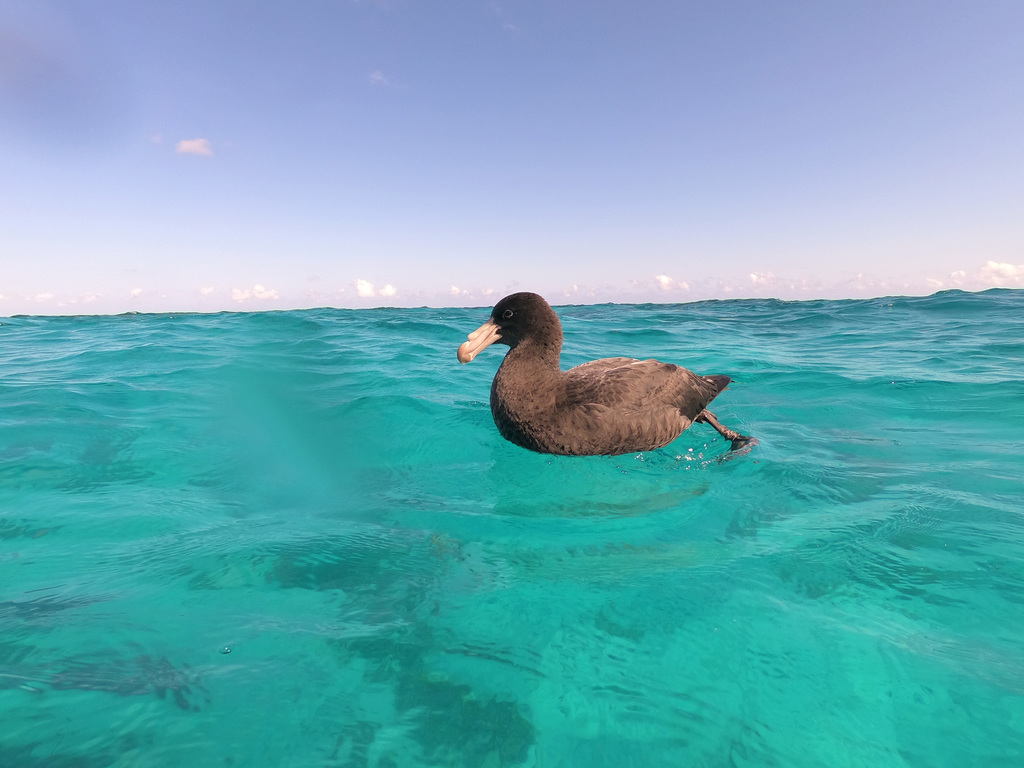
Northern Giant Petrel
Photo © elawrey
Photo © elawrey — CC BY 4.0 — Source: iNaturalist #19374352Identification
The northern giant petrel is a large, powerful seabird averaging 90 cm in length with a wingspan of 150 to 210 cm. Adults display distinctive grey-brown plumage with a noticeably lighter forehead, face sides, and chin. The pinkish-yellow bill, tipped with brown and measuring 90–110 mm, is slightly longer than that of its southern cousin and provides a useful field mark—the southern giant petrel's bill has a greenish tone on top, whereas the northern's does not. Eyes are grey, and the species shows size variation across its range, with South Georgian birds notably larger than those from the Chatham Islands. Juveniles are uniformly dark brown and gradually lighten with age.
Range & Habitat
This pelagic species ranges throughout the Southern Ocean north of the Antarctic Convergence Zone, extending into temperate waters off Chile, Argentina, South Africa, New Zealand, and Australia. Northern giant petrels breed on islands including South Georgia (hosting over 4,500 pairs), the Chatham Islands, Kerguelen Islands, Crozet Islands, and Macquarie Island, often sharing colonies with their southern counterparts. Their combined range encompasses approximately 82.6 million square kilometres of open ocean and coastal waters.
Behaviour & Diet
Northern giant petrels are aggressive predators and scavengers with a diverse diet. They feed primarily on carrion—particularly dead penguins and seals—supplemented by fish, krill, squid, and other cephalopods. They habitually follow fishing vessels and cruise ships to scavenge discarded fish and waste. Notably, they will actively hunt and kill other seabirds, including penguin chicks, weak or injured adult penguins, and the young of other species, even targeting birds as large as albatrosses. Sexual and temporal segregation in foraging habits reduces competition: females make more pelagic foraging trips than males, and northern giant petrels breed six weeks earlier than southern giant petrels, allowing both species to exploit similar feeding areas at different times.
Best Time & Places to See It
The breeding season offers the best viewing opportunities, particularly at island colonies in South Georgia, where the largest concentrations occur. Visitors to the Southern Ocean aboard expedition cruises frequently encounter these birds year-round as they patrol pelagic waters and scavenge around vessels. South Georgia remains the premier destination, while the Kerguelen and Crozet Islands also support breeding populations. Pelagic waters throughout the Southern Ocean north of the Antarctic Convergence provide regular sightings.
Photography Tips
The northern giant petrel's size and aggressive nature make it relatively approachable, particularly around ships and at breeding colonies. Photograph the distinctive pale face and forehead pattern against the darker body, and capture the characteristic bill colouration—pinkish-yellow with a dark tip. In flight, frame the broad, powerful wings against ocean and sky to emphasise the bird's impressive 2-metre wingspan. Early morning light at breeding colonies reveals plumage details well. Take advantage of the bird's bold behaviour around vessels, but maintain respectful distance at nesting sites. Capturing hunting or scavenging behaviour provides compelling documentary images of this formidable predator.
Abel Tasman National Park
Agulhas National Park
Archipiélago Juan Fernández National Park
Ben Boyd National Park
Brown Bluff
Cabo de Hornos National Park
Cape Dolphin
Chiloé National Park
Cooper Bay
Nothing matches these filters.
No community photos yet. Log in to add the first one.
No community observations of this species yet.