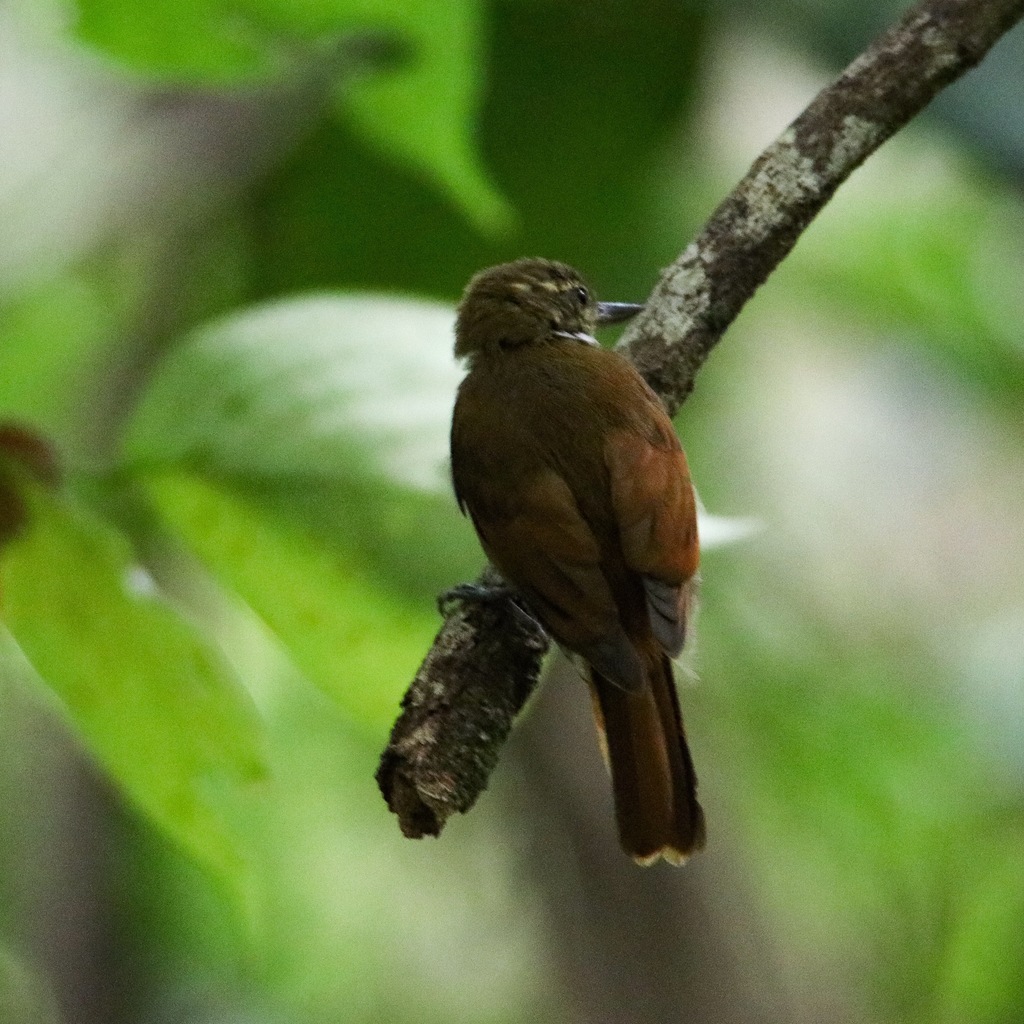
Northern Plain Xenops
Photo © Aitor
Photo © Aitor — CC BY 4.0 — Source: iNaturalist #34498710Identification
The Northern Plain Xenops is a small passerine, measuring 11 to 13 cm in length and weighing between 10.4 and 12.8 grams. This diminutive bird is characterized by a distinctive wedge-shaped, slightly upturned bill—a feature well-suited to its foraging technique. Adults of the nominate subspecies display a conspicuous buff or whitish supercilium and a wide white malar stripe, with dull brown to rufous-brown unstreaked upperparts and a darker, lightly streaked crown. The tail and wings are cinnamon with black markings, accented by a tawny band on the flight feathers. The underparts are plain grayish brown with pale throat and light buff spotting on the foreneck and breast. Males and females are alike in plumage. Other subspecies show variations in rufousness and coloration, ranging from less rufous overall to more olivaceous underparts, but all share the characteristic upturned bill and supercilium.
Range & Habitat
The Northern Plain Xenops is distributed across a broad swath of Central and South America, from southern Mexico through Panama to northern Colombia, northwestern Venezuela, and western Ecuador into Peru. Five subspecies occupy distinct ranges: the nominate subspecies inhabits southern Mexico and Central America from Veracruz south through Honduras; ridgwayi occupies Nicaragua through central Panama; littoralis ranges from Panama's Darién Province through Colombia and Ecuador into northwestern Peru; neglectus is found in northeastern Colombia and northwestern Venezuela; and olivaceus occupies the Serranía del Perijá on the Colombia-Venezuela border.
This species favors the interior and edges of tropical lowland forest, semideciduous forest, and mature secondary forest. Elevational range varies by region, from sea level to 1,300 meters in northern Central America, reaching 2,200 meters in Venezuela (though mostly below 1,500 meters), and up to 900 meters in Ecuador.
Behaviour & Diet
The Northern Plain Xenops is a year-round resident throughout its range. Its diet consists almost entirely of arthropods—both adults and larvae—including termites, ants, bees, beetles, katydids, millipedes, and spiders. The bird forages from the forest understory to mid-canopy levels, often joining mixed-species foraging flocks for added vigilance and feeding efficiency.
This xenops has evolved specialized foraging techniques that exploit its unique bill structure. It captures prey through gleaning, hammering, chiseling, and prying, working primarily on thin dead branches—often rotten ones that have fallen into the understory—and along vines. Breeding occurs between December and June in Costa Rica and Panama, with both members of a pair excavating cavities in rotten wood, typically 3 to 10 meters above ground, which they line with soft plant material.
Best Time & Places to See It
The Northern Plain Xenops can be found year-round throughout its range, making it accessible to travellers visiting tropical forests of Central America and northwestern South America. The breeding season (December to June in Central America) may offer opportunities to observe pair behavior and cavity-nesting activity. Look for this species in mature secondary forest and forest edges, particularly in lowland areas, though it can be found at higher elevations depending on the region and subspecies.
Photography Tips
Photographing the Northern Plain Xenops requires patience and attention to detail. Look for the bird foraging along dead branches and fallen woody material in the understory and mid-canopy levels, where it is most active. Early morning hours typically offer the best light and activity levels. Focus on capturing the bird's distinctive upturned bill and facial markings—the white supercilium and malar stripe are key identification features. Since this species often joins mixed foraging flocks, scanning these groups can increase your chances of encountering it. Use a steady hand or tripod, as the bird's small size and active foraging behavior demand quick, precise focusing.
Corcovado National Park
Puerto Jiménez, Costa Rica
+444 birds+48 mammals
Where the Osa Peninsula juts into the Pacific, rainforest descends almost to the tide line, and Corcovado National Park protects one of Central America's most intact…
VIEW NATIONAL PARKManuel Antonio National Park
Quepos, Costa Rica
+426 birds+22 mammals
Where tropical rainforest descends steeply to a rocky Pacific coastline, Manuel Antonio National Park distills Central American biodiversity into one of Costa Rica's most compressed and…
VIEW NATIONAL PARKArenal Volcano National Park
Peñas Blancas, Costa Rica
+551 birds+21 mammals
Straddling the border between Alajuela and Guanacaste in northwestern Costa Rica, this national park rises dramatically around one of Central America's most active volcanic systems. The…
VIEW NATIONAL PARKPiedras Blancas National Park
Golfito, Costa Rica
+386 birds+24 mammals
Where the Golfo Dulce meets the southwestern Pacific coast of Costa Rica, Piedras Blancas National Park protects a dramatic transition zone where lowland rainforest descends toward…
VIEW NATIONAL PARKSoberanía National Park
Cristóbal, Panama
+495 birds+34 mammals
Rainforest and riverine woodland blanket the rolling terrain of this 714-square-kilometre national park in Colón Province, where the Caribbean watershed feeds a maze of streams and…
VIEW NATIONAL PARKMontes Azules
Candelaria, Mexico
+395 birds+47 mammals
Where jungle-clad limestone plateaus plunge into canyon systems carved by the Usumacinta River, Mexico's most pristine rainforest reserve unfolds across the Lacandón region of Chiapas. Montes…
VIEW BIOSPHERE RESERVETikal National Park
Tikal, Guatemala
+399 birds+16 mammals
Dense rainforest canopy rises above the limestone plateau of Petén, where archaeological wonder and ecological richness merge seamlessly across one of Central America's most biodiverse landscapes.…
VIEW NATIONAL PARKCarara National Park
Tárcoles, Costa Rica
+397 birds+19 mammals
Where the Pacific coastal plain meets transitional forest, Carara National Park straddles one of Central America's most dynamic ecological boundaries. The park's landscape encompasses lowland deciduous…
VIEW NATIONAL PARKCahuita National Park
Talamanca, Costa Rica
+359 birds+15 mammals
Where the Caribbean shoreline dissolves into mangrove creeks and coral gardens, Cahuita's mosaic of habitats unfolds across the Limón coast. The park's signature feature—a living coral…
VIEW NATIONAL PARKCaño Negro National Wildlife Refuge
Caño Negro District, Costa Rica
+486 birds+16 mammals
Where the San Juan River's seasonal floodplain opens into expansive wetlands, Caño Negro Wildlife Sanctuary sprawls across one of Central America's most productive freshwater ecosystems. This…
VIEW WILDLIFE SANCTUARYNo community photos yet. Log in to add the first one.
No community observations of this species yet.