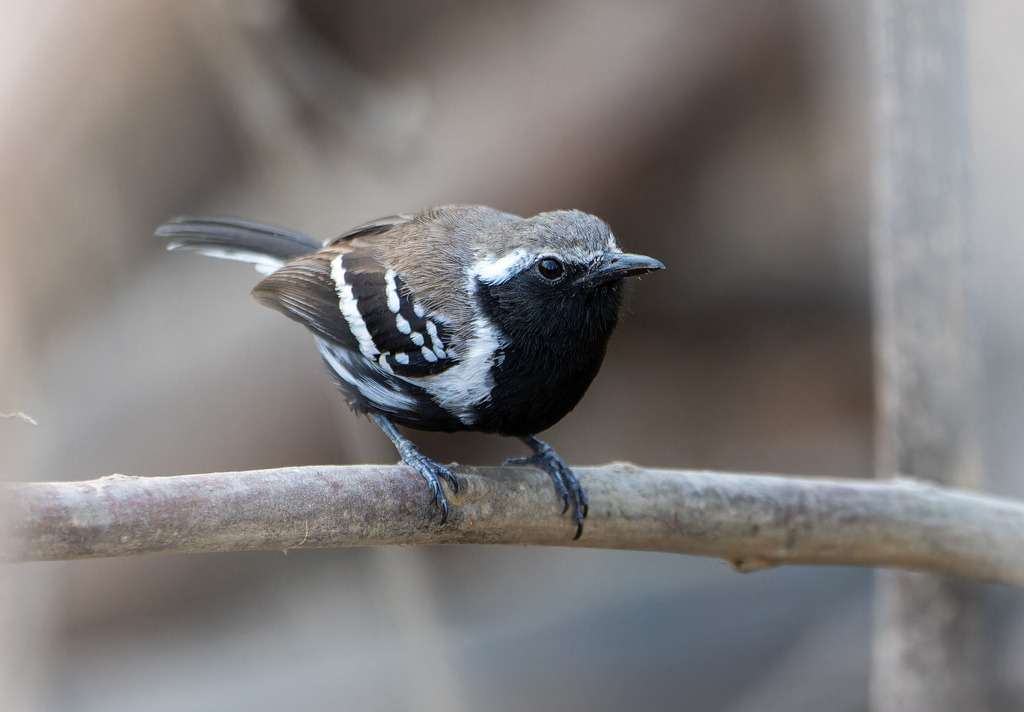
Northern White-fringed Antwren
Photo © David F. Belmonte
Photo © David F. Belmonte — CC BY 4.0 — Source: iNaturalist photo #366914685The northern white-fringed antwren (Formicivora intermedia) is an insectivorous bird in subfamily Thamnophilinae of family Thamnophilidae, the "typical antbirds". It is found in mainland Colombia and Venezuela, on the Pearl Islands of Panama, and on the islands of Tobago and Margarita. == Taxonomy and systematics == The German ornithologist Jean Cabanis described the northern white-fringed antwren in 1847 and coined its current binomial name Formicivora intermedia. It and what is now the southern white-fringed antwren (F. grisea) were later considered conspecific as the white-fringed antwren, which retained the binomial F. grisea. Worldwide taxonomic systems separated them again based primarily on their very different vocalizations detailed in a 2016 publication, though the Clements taxonomy did not do so until 2023. The North and South American Classification Committees of the American Ornithological Society retain the single white-fringed antwren species, though the South American Committee is seeking a proposal to adopt the split. The northern white-fringed antwren has these six subspecies: F. i. alticincta Bangs F. i. hondae (Chapman, 1914) F. i. fumosa (Cory, 1913) F. i. intermedia Cabanis, 1847 F. i. tobagensis Dalmas, 1900 F. i. orenocensis Hellmayr, 1904 == Description == The northern white-fringed antwren is 12 to 13 cm (4.7…
Natural Serranía de los Yariguíes National Park
El Carmen de Chucurí, Colombia
+320 birds+3 mammals
Where the northern cordilleras of Colombia rise toward cloud forest, the Serranía de los Yariguíes unfolds across nearly 1,820 square kilometers of some of the most…
VIEW NATIONAL PARKMorrocoy National Park
Municipio Silva
+290 birds
Where the Caribbean coast of northwestern Venezuela meets protected coastal waters, a mosaic of mangrove forests, sandy beaches, and coral reef systems defines Morrocoy National Park.…
VIEW NATIONAL PARKNo community photos yet. Log in to add the first one.
No community observations of this species yet.