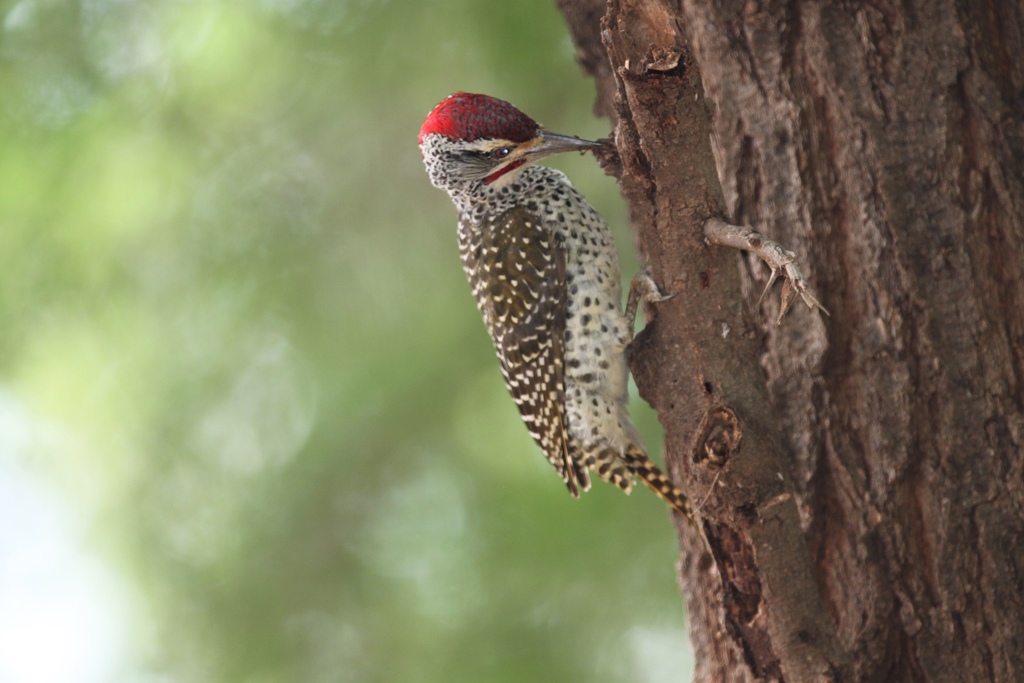
Nubian Woodpecker
Photo © danpatrick
Photo © danpatrick — CC BY 4.0 — Source: iNaturalist photo #54288583Identification
The Nubian woodpecker is a medium-sized species measuring about 21 cm in length. Males are distinctive with a bright red crown and nape, plus a reddish cheek streak. Females are quite different, sporting a black crown speckled with white, a red nape, and a dark cheek stripe with white speckling. Both sexes share olive-brown upper parts heavily marked with cream speckling and barring, greenish-brown wings barred white, and a greenish-yellow tail barred brown with golden shaft feathers. The underparts are white with black spotting and barring on the head, neck, breast and belly. The grey beak, red or pink eye, grey orbital ring, and olive-grey feet complete the picture.
Vocalisations are highly distinctive: shrill ringing or piping notes that are often musical but sometimes metallic, frequently delivered in duet between mates. These calls are often the first indication of the bird's presence in the field.
Range & Habitat
The Nubian woodpecker is endemic to eastern Africa, with a wide distribution spanning Chad, Democratic Republic of the Congo, Djibouti, Eritrea, Ethiopia, Kenya, Somalia, South Sudan, Sudan, Tanzania and Uganda. The species is non-migratory and can be found at altitudes up to 2,000 metres. It is rated as of least concern by conservation authorities, with a stable population across its fairly common range.
This woodpecker favours open savannah woodland, particularly areas dominated by Acacia and Euphorbia trees, as well as bushy scrub habitats. It is well-adapted to arid and semi-arid environments across the region.
Behaviour & Diet
The Nubian woodpecker often forages alone while maintaining contact with its mate through vocalisations. Unlike many woodpeckers, it feeds both in trees and on the ground, demonstrating considerable dietary flexibility. Its diet consists primarily of ants and termites, supplemented by spiders and beetles.
Best Time & Places to See It
This fairly common species can be encountered year-round across suitable habitats in eastern Africa. Look for it in open savannah woodlands with Acacia and Euphorbia, as well as in bushy scrub areas. Its vocal duets make it easier to locate than sight alone. Ethiopia, Kenya, Sudan and Uganda offer reliable opportunities for observation within the species' range.
Photography Tips
The striking sexual dimorphism makes photographing both male and female individuals rewarding, allowing comparison of their very different plumage patterns. The bird's habit of foraging on the ground as well as in trees provides varied compositional opportunities. Early morning is often productive for capturing birds actively foraging and vocalising. The red eye and fine barring and speckling on the plumage reward close-focus photography with good detail.
Bwindi Impenetrable National Park
Lake Mburo National Park
Mabamba Swamp
Murchison Falls National Park
Queen Elizabeth National Park
Abijata-Shalla Lakes National Park
Amboseli National Park
Arabuko Sokoke Forest Reserve
Arusha National Park
Nothing matches these filters.
No community photos yet. Log in to add the first one.
No community observations of this species yet.