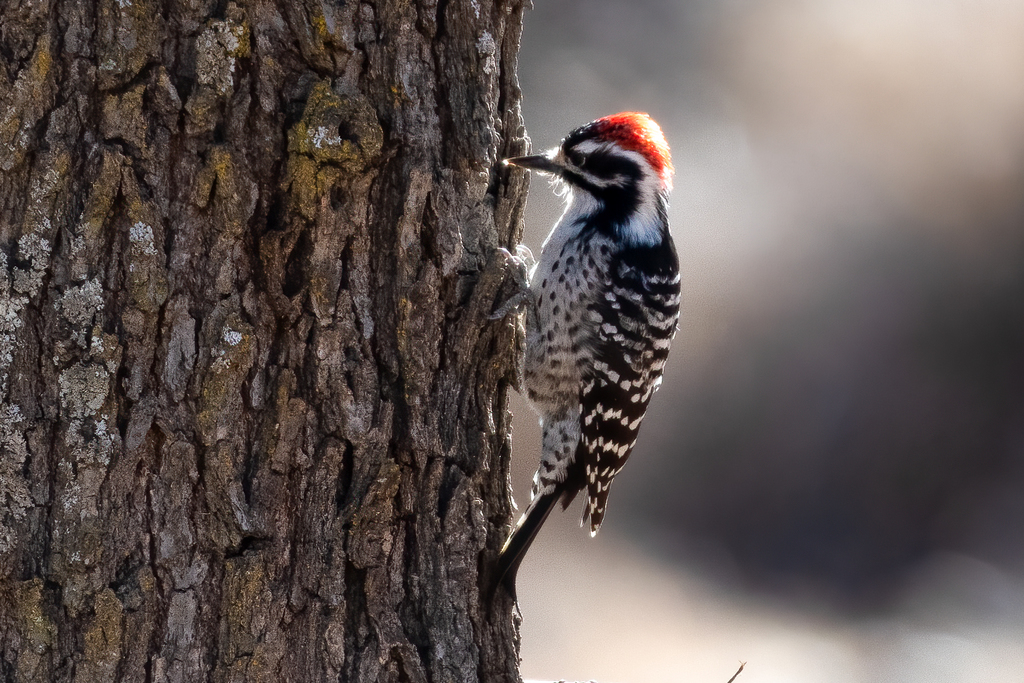
Nuttall’s Woodpecker
Photo © Jonathan Eisen
Photo © Jonathan Eisen — CC BY 4.0 — Source: iNaturalist photo #105176146Identification
Nuttall's woodpecker is a small to medium-sized woodpecker measuring 16 to 18 cm in length with a wingspan of approximately 38 to 43 cm, weighing between 30 to 45 grams. The most distinctive feature is its striking black and white plumage: striped wings and tail feathers contrasting with a primarily white undercarriage. Look for the unbarred black region on the upper back—this key feature distinguishes it from the similar ladder-backed woodpecker, which has barring continuing down to the nape. Adult males sport a distinctive red crown, while females lack this marking. Both juvenile males and females display the red crown, though juveniles often show white streaks on their heads. The bird's zygodactyl feet and stiff tail feathers enable the characteristic vertical tree-clinging posture typical of woodpeckers.
Range & Habitat
Nuttall's woodpecker is endemic to California and northwestern Baja California, Mexico, making it part of the California Endemic Bird Area. This non-migratory species inhabits oak woodlands from sea level to 1,250 meters elevation, occasionally reaching 2,000 meters. The species' range extends from northern California (Shasta and northwestern Lassen counties) southward through the foothills and Pacific Coast regions, including Sonoma County, down through the Los Angeles area and into Baja California as far south as Ensenada. In southern California, populations also occur in riparian habitats and along lower mountain slopes in eastern San Diego County. While oak woodlands remain preferred, these adaptable birds also occupy riparian sites and chaparral, particularly in the southern portions of their range where oak abundance decreases. The world population is estimated at over 100,000 individuals, with no obvious population trends, and the species has successfully adapted to urban and suburban areas, nesting in street trees and parks.
Behaviour & Diet
Nuttall's woodpeckers use a sophisticated array of vocalizations to communicate: call notes to locate mates, double calls for low-threat alarms, rattle calls to establish feeding territories, and the kweek call used primarily by females before copulation. Both sexes drum with relatively long rolls averaging over one second. These birds forage by tapping and probing oak tree crevices, feeding primarily on insect larvae—particularly wood borers, click beetles, and ants—which comprise nearly 80 percent of their diet when combined with adult beetles. They also consume tree sap from holes created by red-breasted sapsuckers and various berry seeds. Using their powerful beaks, they hammer into tree trunks at speeds of 13 to 15 miles per hour, drilling and peeling back bark layers to expose ant colonies and extract hidden insects. During colder months, oak sap becomes an important supplemental food source when insects are dormant.
Best Time & Places to See It
Year-round sightings confirm that Nuttall's woodpecker is a permanent resident throughout its range. Visit oak woodlands in California from the northern counties through the central valleys and foothills to the southern regions and coastal areas. The species is fairly common, particularly in San Bernardino County where densities reach approximately 20 birds per square kilometer. Look in riparian corridors and chaparral habitats in southern California, as well as in increasingly urban and suburban settings including parks and street trees. The bird's non-migratory nature means consistent viewing opportunities throughout the year in suitable oak woodland habitat.
Photography Tips
The contrasting black and white striped plumage of Nuttall's woodpecker provides excellent photographic subject matter against oak tree bark. Photograph males to capture the distinctive red crown—a key field mark absent in females. Capture the bird in its characteristic vertical tree-clinging posture to showcase the specialized zygodactyl feet and stiff tail feathers. Early morning foraging sessions in oak woodlands offer the best lighting and activity. Focus on the unbarred black back region and striped wings to distinguish this species from similar ladder-backed woodpeckers. Close-up shots of the bird's powerful beak at work, peeling bark or drilling, tell an effective behavioral story. Urban and suburban park settings provide accessible opportunities for obtaining sharp images of birds in managed landscapes.
Death Valley National Park
Don Edwards San Francisco Bay National Wildlife Refuge
Joshua Tree National Park
Kings Canyon National Park
Lassen Volcanic National Park
Pinnacles National Park
Sacramento National Wildlife Refuge
San Luis National Wildlife Refuge
Sequoia National Park
Nothing matches these filters.
No community photos yet. Log in to add the first one.
No community observations of this species yet.