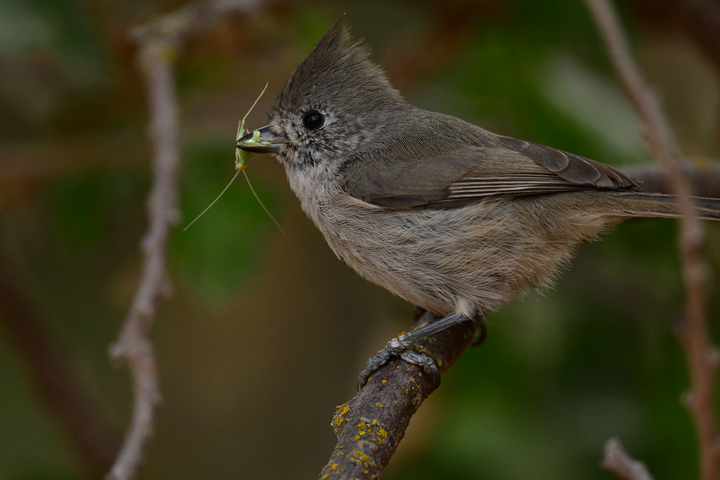
Oak Titmouse
Photo © Pat Farris
Photo © Pat Farris — CC BY 4.0 — Source: iNaturalist photo #160325865Identification
The oak titmouse is a small passerine with a distinctive appearance that makes it recognizable in the field. It is a brown-tinged gray bird with a small tuft or crest on its head, plain face, and lighter gray undersides. The sexes are similar, with very little to no sexual dimorphism. To distinguish it from the closely related juniper titmouse—the two were split from the plain titmouse in 1996—note that the oak titmouse has a browner back. The tufted titmouse, which occurs in different ranges entirely, has a whiter belly, rusty flanks, and black on the forehead.
Range & Habitat
The oak titmouse is a year-round resident of the Pacific slope, ranging from southern Oregon south through California west of the Sierra Nevada to Baja California, skirting the central San Joaquin Valley. It prefers open woodlands of warm, dry oak and oak-pine at low to mid-elevations, though it can be found in forests as long as adequate oak trees are present. The species typically inhabits coast live oak (Quercus agrifolia) and valley oak (Quercus lobata), which provide the cavities, dense foliage, and twig piles essential for nesting and roosting. However, rural residential sprawl, vineyard development, and habitat fragmentation now pose significant threats to California's oak woodlands, contributing to population decline.
Behaviour & Diet
Oak titmice are active foragers that eat insects, spiders, berries, acorns, and seeds. They are sometimes seen catching insects in mid-air and will hammer seeds against branches to crack them open. These birds forage on foliage, twigs, branches, trunks, and the ground, often hanging upside down in typical titmouse fashion. They roost in tree cavities, dense foliage, or birdhouses, choosing twigs surrounded by dense foliage or dead pine needles to simulate cavity roosting. Oak titmice form pairs or small groups rather than large flocks, and pairs typically stay together year-round, defending the same territory throughout the year. They may join mixed-species flocks after breeding season. The song is a series of repeated phrases of two or three notes with the last note lower in pitch, usually grouped in three to seven phrases. Males sing more frequently in spring; the call is a scratchy tsicka-dee-dee.
Best Time & Places to See It
Oak titmice are present year-round in their range, but breeding season from March into July, with peak activity in April and May, offers good opportunities for observation as males sing more frequently and pairs are actively defending territories. Look for them in open oak woodlands and oak-pine forests throughout California west of the Sierra Nevada and in southern Oregon. Early morning when birds are most vocal is an excellent time to locate them.
Photography Tips
The oak titmouse's habit of hanging upside down while foraging and its frequent visits to feeders stocked with suet, peanut butter, and sunflower seeds provide good opportunities for close photography. The bird's small size and active movements demand a fast shutter speed. Focus on capturing its distinctive crest and the contrast between its brown-tinged gray upperparts and lighter undersides. Early morning light in open woodlands will highlight the plumage details that distinguish it from the juniper titmouse.
Lassen Volcanic National Park
Shasta County, United States
+239 birds+18 mammals
Volcanic peaks and geothermal upheaval have sculpted 545 square kilometers of Northern California into a landscape where fire and water engage in perpetual dialogue. Lassen Peak…
VIEW NATIONAL PARKPinnacles National Park
San Benito County, United States
+197 birds+33 mammals
Jagged volcanic spires thrust from chaparral-covered ridges across 222 square kilometers of central California's inner Coast Ranges, their pale stone crowns catching the afternoon light like…
VIEW NATIONAL PARKJoshua Tree National Park
Riverside County, United States
+221 birds+23 mammals
Across 5,610 square kilometers of Riverside County's high desert, a landscape of geological drama unfolds where granite monoliths pierce through bajadas of creosote scrub and Joshua…
VIEW NATIONAL PARKYosemite National Park
Mariposa County, United States
+224 birds+28 mammals
Granite cliffs soar nearly a kilometer above the valley floor in this expanse of high Sierra wilderness, where glacial U-shaped valleys sculpt a landscape of dramatic…
VIEW NATIONAL PARKRedwood National Park
Humboldt County, United States
+343 birds+43 mammals
Where the Pacific fog rolls deep into northern California's coastal valleys, some of the tallest trees on Earth rise from a landscape shaped by tectonic forces…
VIEW NATIONAL PARKSequoia National Park
Tulare County, United States
+187 birds+27 mammals
Granite peaks rising above 3,600 meters dominate the southern Sierra Nevada, where Sequoia National Park sprawls across one of North America's most vertically compressed wilderness zones.…
VIEW NATIONAL PARKKings Canyon National Park
Fresno County, United States
+186 birds+20 mammals
Where granite peaks fracture the Sierra Nevada skyline and the Kings River has carved one of North America's most dramatic canyons, a landscape of extreme relief…
VIEW NATIONAL PARKTule Lake National Wildlife Refuge
Siskiyou County, United States
+255 birds+9 mammals
Across the high volcanic plateau of northeastern California, where summer heat scorches the alkali flats and winter winds sweep unobstructed through open water and marsh, Tule…
VIEW WILDLIFE SANCTUARYSacramento National Wildlife Refuge
Glenn County, United States
+247 birds+13 mammals
Across the flat expanse of Glenn County's Sacramento Valley, shallow pools and seasonal marshes create one of California's most vital wetland sanctuaries—a landscape shaped by water…
VIEW WILDLIFE SANCTUARYSan Luis National Wildlife Refuge
Merced County, United States
+219 birds+14 mammals
Across the floor of California's San Joaquin Valley, where semi-arid grasslands meet shallow seasonal wetlands, San Luis National Wildlife Sanctuary preserves a critical mosaic of habitats…
VIEW WILDLIFE SANCTUARYDon Edwards San Francisco Bay National Wildlife Refuge
Fremont, United States
+286 birds+20 mammals
Where the San Francisco Bay's shallow margins dissolve into tidal salt marshes and mudflats, this wildlife sanctuary preserves one of California's most ecologically vital estuarine systems.…
VIEW WILDLIFE SANCTUARYNo community photos yet. Log in to add the first one.
No community observations of this species yet.