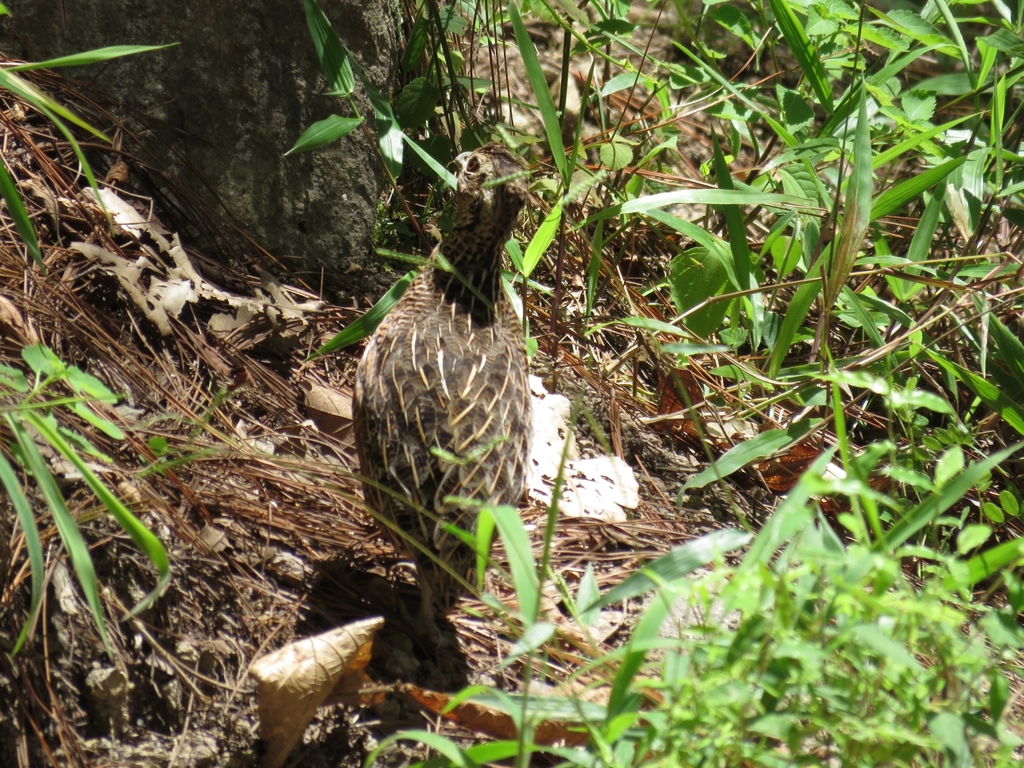
Ocellated Quail
Photo © Sobeida Morales
Photo © Sobeida Morales — CC0 1.0 — Source: iNaturalist #108487486Identification
The ocellated quail is a small quail, measuring 20.5 to 23 cm in length, with males weighing approximately 218 g and females around 182 g. The species is sexually dimorphic, with striking plumage differences between the sexes. Males are particularly distinctive, featuring a bold black and white harlequin pattern on the face, a buffy brown to olive brown crown and nape, and a prominent thick tawny crest on the rear of the crown. The male's throat is white with black stripes, while the upperparts are gray and brown with cinnamon stripes and black spots. The breast is tawny cinnamon with gray and cinnamon spots on the edges, the belly a deeper cinnamon, the flanks gray with cinnamon scallops, and the vent area black.
Females are more subdued in appearance, with a buffy and black face, tawny crest, and brown upperparts marked with buff lines. Their breast and belly are wine red with black bars and spots, providing good contrast to the male's warmer tones. These characteristics make the ocellated quail relatively identifiable among Central American quail species.
Range & Habitat
The ocellated quail is found in far southern Mexico, Guatemala, Honduras, and El Salvador, with only historical records from Nicaragua. Guatemala appears to be the stronghold for the species, with significant numbers of sightings recorded there since the late 1900s. However, the species has become scarce or absent in other parts of its former range; no recent sightings have been documented in El Salvador, while Nicaragua has only a specimen from around 1900 and a few early 2000s sight records near the Honduran border.
The species inhabits shrubland and open pine and oak forest, typically found at elevations between 750 and 3,050 m. This preference for highland forest clearings and scrubland makes it a bird of montane regions across Central America.
Behaviour & Diet
The ocellated quail is entirely terrestrial and forages on the ground by digging with its feet to uncover tubers and roots. During the breeding season, the species supplements its diet with a variety of insects. Almost nothing is known about the species' detailed breeding phenology, though in Guatemala birds are reported to breed between April and August. Notably, the nest and eggs of this species have never been formally described.
The ocellated quail produces vocalizations similar to those of its congener, the Montezuma quail. Males apparently sing a single descending, buzzy whistle, while females produce a descending series of short notes, though these calls have not been described in detail.
Best Time & Places to See It
Guatemala is currently the best location to search for ocellated quails, as it remains the stronghold for the species with the most consistent sightings. The breeding season between April and August may offer the best opportunity for encounters, as birds are likely to be more active and vocal during this period. However, the species is increasingly difficult to locate due to rapid population declines.
Searchers should focus on shrubland and open pine and oak forest habitats at elevations between 750 and 3,050 m. Early morning visits when birds are most active and vocalizations are most frequent would maximize chances of detection.
Photography Tips
Photographing ocellated quails presents a significant challenge given the species' terrestrial habits, small size, and declining population. Patient ground-level positioning in suitable habitat during the breeding season offers the best approach. The male's striking harlequin face pattern and distinctive crest provide excellent photographic subjects, while females' wine-red plumage with black markings offers contrasting opportunities.
Given the species' preference for foraging on the ground in shrubland and forest clearings, photographers should be prepared for low-angle shots and potentially obscured views. Early morning light in open pine and oak forests at elevation would provide optimal conditions for capturing the birds' distinctive plumage details.
No community photos yet. Log in to add the first one.
No community observations of this species yet.