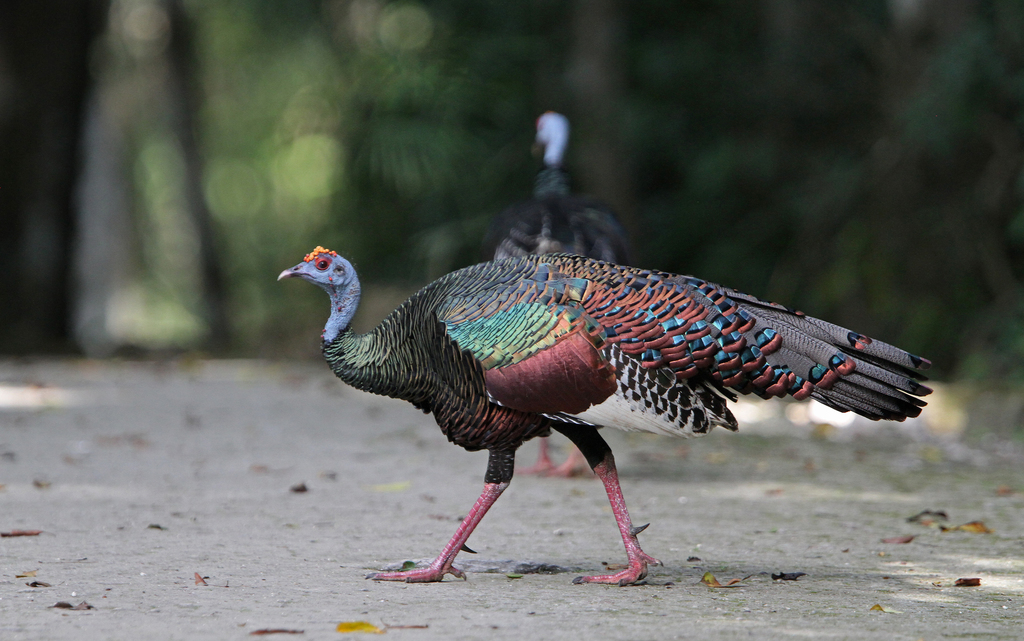
Ocellated Turkey
Photo © Christoph Moning
Photo © Christoph Moning — CC BY 4.0 — Source: iNaturalist photo #102472247Identification
The ocellated turkey is a relatively compact species, measuring 70–122 cm long, with females averaging 3 kg and males around 5 kg—noticeably smaller than North American wild turkeys. Both sexes display iridescent bronze and green body feathers, though females tend toward duller green tones. The most distinctive feature is the tail: bluish-grey feathers adorned with eye-shaped ocelli (spots) of blue and bronze with bright gold tips, resembling peacock markings. Neither sex possesses the characteristic "beard" of their northern relatives.
The head is striking: bright blue with orange or red nodules that swell and intensify during breeding season, particularly in males. Males also display a fleshy blue crown and are surrounded by a ring of brilliant red skin around the eye, most vivid when breeding. The legs are deep red and notably shorter and thinner than those of North American turkeys. Males over one year old sport impressive spurs averaging 4 cm, sometimes exceeding 6 cm—longer and thinner than their northern counterparts.
Range & Habitat
The ocellated turkey is endemic to a restricted range of approximately 130,000 km² centered on Mexico's Yucatán Peninsula, including parts of Quintana Roo, Campeche, Yucatán, Tabasco, and Chiapas. The species also inhabits northern and western Belize and northern Guatemala. This limited distribution makes it a sought-after species for birders exploring Central America.
Once considered endangered by Mexican authorities as recently as 2002, the ocellated turkey has been classified as Near Threatened by the IUCN since 2004, reflecting ongoing conservation concerns driven by habitat loss and unsustainable hunting pressure from local communities.
Behaviour & Diet
Ocellated turkeys are generalist foragers, spending most of their time on the ground searching for beetles, moths, leafcutter ants, grass seeds, nuts, and leaves. When threatened, they typically prefer running to flying, though they can burst into swift, powerful flight over short distances when necessary. At night, they roost high in trees, usually in family groups, to avoid predators such as jaguars.
The breeding season begins in early February and peaks in March, lasting through April. Males engage in elaborate displays, beginning with rapid foot-tapping followed by tail-fanning and wing-vibrating, dragging wing tips along the ground while circling females to showcase their dorsal tail feathers. Males produce a distinctive vocalization beginning 20–25 minutes before sunrise: a series of low-frequency thumps resembling a small motor starting, accelerating into six to seven bongo-like bass tones that crescendo into high-pitched, melodious chops—quite different from the gobble of North American turkeys. Females lay 8–15 eggs in concealed ground nests, with poults hatching May through July.
Best Time & Places to See It
February through April offers the best opportunity to observe ocellated turkeys, as males are most vocal and active during the breeding season. Early mornings, starting 20–25 minutes before sunrise, are prime viewing windows. The Yucatán Peninsula of Mexico, particularly in protected areas within Quintana Roo, Campeche, and Yucatán, provides the most reliable sightings. Northern Belize and Guatemala also host populations, though in smaller numbers.
Listen for the distinctive motor-like thumping that precedes the male's crescendo display. Birds are most active on the ground during daylight hours, making them visible despite the dense forest habitat. Patience and early morning positioning near roosting sites offer the best chances for encounters.
Photography Tips
The ocellated turkey's brilliant head coloration—electric blue, red, and orange—demands fast shutter speeds and accurate white balance to capture the intensity of these hues, especially during breeding season when colors are most vivid. Position yourself low to capture males during their ground-based displays, which showcase the striking tail ocelli and iridescent body plumage to greatest effect. Early morning light is crucial for rendering the bronze-green iridescence of the body and copper wing coverts.
The eye-spotted tail feathers are the signature feature; photograph the dorsal surface when males perform their spirited display. Bring a telephoto lens (at least 300–400 mm) to maintain distance while filling the frame, and allow extra depth of field to ensure sharp focus across the complex plumage patterns. Overcast mornings can be preferable to harsh sunlight, which can blow out the brilliant red and orange facial features.
Dzibilchantún National Park
Laguna del Tigre National Park
Ría Lagartos Biosphere Reserve
Sian Ka’an
Tikal National Park
Nothing matches these filters.
No community photos yet. Log in to add the first one.
No community observations of this species yet.