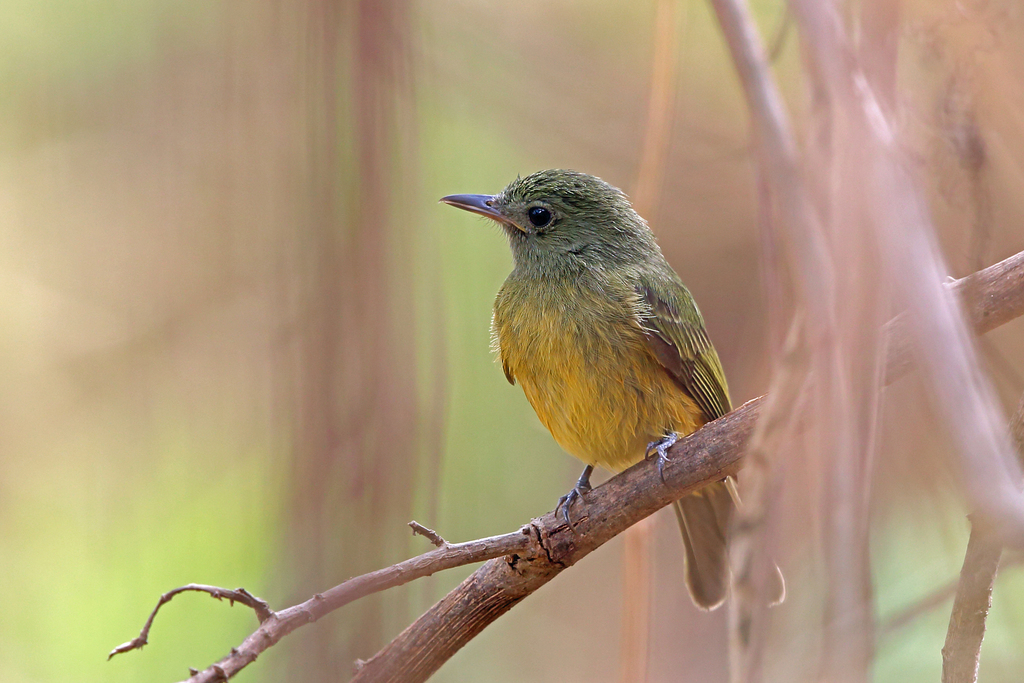
Ochre-bellied Flycatcher
Photo © Nigel Voaden
Photo © Nigel Voaden — CC BY 4.0 — Source: iNaturalist photo #2029461Identification
The ochre-bellied flycatcher is a small tyrant flycatcher measuring 12.5 to 14 cm in length. Both sexes are identical in plumage. The nominate subspecies displays a greenish-olive head, nape, back, and rump, with olive wings featuring distinctive buffy-ochraceous edges on the tertials and wing coverts that form visible wing bars. The tail is dark grayish-brown or dusky olive, while the throat and underparts are rich cinnamon-buff in color. All subspecies share a dark brown iris, black maxilla, and black mandible with a variably paler base, with gray legs and feet.
Other subspecies show subtle variations: some lack the prominent wing-covert edges, resulting in fainter wing bars, while others display grayer upperparts or variable olive washes on the throat. Despite these regional differences, the warm cinnamon-buff underparts remain a consistent field mark across all populations.
Range & Habitat
This species is found from southern Mexico through Central America and into South America, including Trinidad and Tobago. Seven subspecies occupy different ranges across Mexico, Central America, Colombia, Venezuela, the Guianas, Brazil, Ecuador, Peru, and Bolivia, with some populations also present in coastal southeastern Brazil.
The ochre-bellied flycatcher inhabits the interior and edges of humid to wet evergreen and semi-deciduous forests, along with secondary forest, gallery forest, plantations, and gardens. In the Amazon Basin, it occurs in both várzea and terra firme forest. Elevational range varies by region, from sea level to 1,800 meters in parts of Central America and northern South America, though typically below 1,000 meters in Ecuador.
Behaviour & Diet
This is a year-round resident throughout its range. The ochre-bellied flycatcher feeds on both fruits and insects, foraging at all forest levels though primarily in the middle strata. It employs a characteristic hover-gleaning technique, making short sallies from a perch to snatch food items, and also picks items while perched. Usually solitary, it occasionally joins mixed-species feeding flocks, particularly at fruiting trees.
Breeding behavior is notably flexible: males court both singly and at leks, with roughly half the population using each strategy. Courtship displays include singing, wing-flashing, and crown-feather erection. The species constructs a distinctive pear-shaped nest with a side entrance using plant material covered with moss and lined with soft fibers, suspended from vines or aerial roots. Clutches typically contain three eggs; females alone incubate for approximately 23 days.
Best Time & Places to See It
The ochre-bellied flycatcher is a year-round resident, making it potentially available for observation throughout the year. However, breeding activity varies geographically and has not been fully documented. The species is most vocal and active during breeding season, when courtship displays make detection easier.
Look for this bird in humid forest interiors and edges, secondary growth, and fruiting trees throughout its range from Mexico to Bolivia and southeastern Brazil. It typically forages in the middle levels of the forest canopy, making it more accessible to observation than some canopy specialists. Visiting during fruiting periods may increase encounter rates, as birds congregate at productive trees.
Photography Tips
The cinnamon-buff underparts and olive upperparts provide good contrast for photography, particularly in dappled forest light. Focus on capturing the distinctive wing bars and the warm underparts that characterize the species. Position yourself near fruiting trees where birds may remain stationary while feeding, allowing for steady shots.
During breeding season, males are more active and vocal, offering better opportunities for behavioral photography. Their wing-flashing and crown-feather erection during courtship provide dynamic photo opportunities. Be patient and use a fast shutter speed to freeze the hover-gleaning feeding behavior. Early morning light in forest clearings or gaps often produces the best results for this shade-loving species.
Amacayacu National Park
Amazônia National Park
Anavilhanas National Park
Arenal Volcano National Park
Bahuaja Sonene National Park
Barbilla National Park
Barra del Colorado National Wildlife Refuge
Baru Volcano National Park
Braulio Carrillo National Park
Nothing matches these filters.
No community photos yet. Log in to add the first one.
No community observations of this species yet.