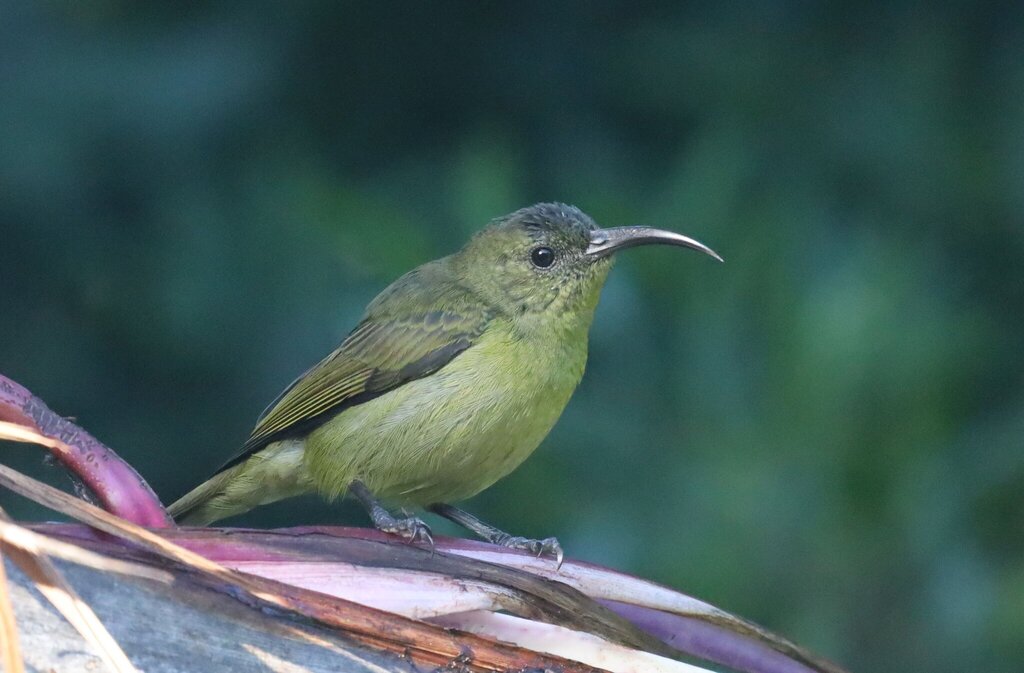
Olive Sunbird
Photo © Paul Hoekman
Photo © Paul Hoekman — CC BY 4.0 — Source: iNaturalist photo #500417599The olive sunbird (Cyanomitra olivacea) is a large African species of sunbird belonging to the family Nectariniidae which encompasses species of sunbirds, spiderhunters, and flowerpeckers, and sugarbirds. It has a large distribution that spans across central Africa from western countries including Senegal, Guinea, and Angola towards eastern countries including Ethiopia, Kenya, and Mozambique. This range also extends to southern African countries including South Africa and Zimbabwe. It is mainly nectarivorous and lives in a variety of forest, scrubland, and modified habitats. == Description == The olive sunbird is a large sunbird that ranges from 6.2-15 g in mass, 50–73 mm in wing length, 20–29 mm in bill length, 35–66 mm in tail length, and 12–15 cm in overall body size depending on the subspecies and sex. Its body colouration can vary from fully dark-olive to dull-olive with a paler olive-yellow or olive-grey underside. It has a long beak that curves downward and varies in colour from solid black to mottled grey, beige, and yellow-orange depending on the subspecies. Yellowish-orange pectoral tufts can be present in the males and females found in eastern subspecies while only males bear these tufts in western subspecies. Olive sunbirds show morphological differences between forest-savanna boundaries…
Arusha National Park
Tanzania
+555 birds+16 mammals
Where the slopes of Mount Mawenzi rise above the Arusha region, a compact yet ecologically rich national park unfolds across montane forest, moorland, and alpine zones.…
VIEW NATIONAL PARKVirunga National Park
Uganda
+418 birds+13 mammals
Where the Western Rift Valley fractures the landscape of North Kivu, Virunga National Park sprawls across terrain as geologically dramatic as it is ecologically vital. Volcanic…
VIEW NATIONAL PARKBwindi Impenetrable National Park
Kanyashogi, Uganda
+603 birds+26 mammals
Steep ridges cloaked in montane forest rise from Uganda's southwestern borderlands, where the landscape grows so dense and tangled that early explorers named it impenetrable. At…
VIEW NATIONAL PARKVolcanoes National Park
Musanze District, Uganda
+152 birds+6 mammals
Where volcanic cones rise sharply above the montane forests of northern Uganda, Volcanoes National Park protects one of East Africa's most dramatic high-altitude ecosystems. The park's…
VIEW NATIONAL PARKMurchison Falls National Park
Uganda
+608 birds+33 mammals
Where the Victoria Nile compresses through a narrow gorge and explodes across a 45-meter precipice, the landscape speaks in thunder. Murchison Falls National Park sprawls across…
VIEW NATIONAL PARKMgahinga Gorilla National Park
Cyanika, Uganda
+429 birds+6 mammals
Where the Virunga Mountains rise steeply from the Uganda–Rwanda–Democratic Republic of Congo frontier, montane forest cloaks the volcanic slopes in a dense, moisture-laden embrace. Mgahinga Gorilla…
VIEW NATIONAL PARKLake Mburo National Park
Uganda
+505 birds+24 mammals
Rolling acacia woodland and scattered lakes define this intimate savanna preserve in southwestern Uganda, where the rift valley's geological drama shapes every water source and grassland.…
VIEW NATIONAL PARKTsavo West National Park
Mwatate, Kenya
+513 birds+49 mammals
Where volcanic ridges and weathered lava flows meet the semi-arid lowlands of south-central Kenya, Tsavo West National Park unfolds across a landscape sculpted by fire and…
VIEW NATIONAL PARKMount Elgon National Park
Matumbei ward, Kenya
+164 birds+7 mammals
Where the volcanic slopes of Mount Elgon rise above the Trans-Nzoia landscape, a montane wilderness unfolds across multiple ecological zones, each harbouring distinct communities adapted to…
VIEW NATIONAL PARKKilimanjaro National Park
Kenya
+207 birds+16 mammals
Africa's highest mountain rises not in isolation but as the centerpiece of a vast national park that sweeps across the borderlands of northern Tanzania, where savanna…
VIEW NATIONAL PARKMount-Kenya National Park
Abothuguchi west ward, Kenya
+334 birds+11 mammals
Where the slopes of Kenya's second-highest mountain rise steeply from the Meru County foothills, a landscape of profound ecological richness unfolds across Mount Kenya National Park.…
VIEW NATIONAL PARKNgorongoro Conservation Area
Tanzania
+626 birds+55 mammals
Volcanic calderas and open grassland dominate this high plateau in northern Tanzania, where the landscape rises above 2,000 metres and ancient geological forces have shaped both…
VIEW WILDLIFE MANAGEMENT AREAToro-Semliki Proposed National Park
Uganda
+474 birds+5 mammals
Where the Albertine Rift's western escarpment rises above the Semliki River valley, a vast mosaic of forest, savanna and wetland converges to create one of East…
VIEW NATIONAL PARKQueen Elizabeth National Park
Uganda
+672 birds+30 mammals
Across the southwestern escarpment of Uganda, where the Western Rift Valley descends through ancient volcanic terrain, Queen Elizabeth National Park sprawls across more than 8,300 square…
VIEW NATIONAL PARKMabamba Swamp
Memere, Uganda
+464 birds+2 mammals
Across the Central Region of Uganda spreads one of Africa's most biodiverse freshwater wetlands, a sprawling nature reserve of roughly 283 square kilometres where papyrus swamps…
VIEW NATURE RESERVEKruger National Park
Ba-Phalaborwa Local Municipality, South Africa
+540 birds+91 mammals
Across the low-lying savanna of northeastern South Africa unfolds one of Africa's largest and most ecologically intact protected areas, where acacia woodlands merge into mopane scrub…
VIEW NATIONAL PARKIthala Game Reserve
uPhongolo Local Municipality, South Africa
+328 birds+26 mammals
Rolling thornbush savanna and acacia woodland dominate the landscape of this 494-square-kilometre national park in KwaZulu-Natal's uPhongolo Local Municipality, where granite outcrops punctuate grassland plateaus and…
VIEW NATIONAL PARKZiwa Rhino and Wildlife Ranch
Nakasongola, Uganda
+359 birds+11 mammals
Where papyrus wetlands merge into sprawling savanna, Uganda's central landscape opens into one of East Africa's most vital rhino recovery zones. Ziwa Rhino and Wildlife Ranch…
VIEW WILDLIFE SANCTUARYBale Mountains National Park
Ethiopia
+397 birds+20 mammals
Where the Ethiopian highlands rise above 4,000 metres, the Bale Mountains create a landscape of stunning ecological extremes—from afroalpine grasslands swept by wind and mist to…
VIEW NATIONAL PARKNairobi National Park
Nairobi, Kenya
+515 birds+35 mammals
Just minutes from Kenya's capital, where the Nairobi River winds through acacia woodland and open grassland, lies one of Africa's most paradoxical wildlife sanctuaries. The park's…
VIEW NATIONAL PARKAberdare National Park
Mweiga ward, Kenya
+394 birds+30 mammals
Where the central highlands of Kenya rise to their elemental grandeur, the Aberdare range unfolds across Nyeri County as a montane stronghold of cool, misty forest…
VIEW NATIONAL PARKMeru National Park
Igembe Central, Kenya
+408 birds+38 mammals
Granite outcrops and acacia woodland rise across the northern reaches of Meru, where semi-arid savanna transitions into drier scrubland under the fierce equatorial sun. The park's…
VIEW NATIONAL PARKSaiwa Swamp National Park
Sinyerere ward, Kenya
+255 birds+4 mammals
Where papyrus and sedge marshes stretch across a highland plateau in western Kenya, Saiwa Swamp National Park shelters one of East Africa's most productive freshwater wetland…
VIEW NATIONAL PARKChyulu Hills National Park
Kibwezi East, Kenya
+232 birds+30 mammals
Volcanic cones rise abruptly from the Kenyan savanna floor, their flanks clothed in dense acacia woodland and grassland that transforms the Chyulu Hills into an ecological…
VIEW NATIONAL PARKArabuko Sokoke Forest Reserve
Kilifi, Kenya
+383 birds+29 mammals
Coastal forest rises from the Indian Ocean plains of Kilifi County, where sandy soils and seasonal rainfall have sculpted a woodland ecosystem unlike anywhere else on…
VIEW NATURE RESERVEWatamu Marine National Park
Dabaso ward, Kenya
+328 birds+12 mammals
Where mangrove channels meet coral gardens and sandy shallows blend into the warm waters of the Indian Ocean, Watamu Marine National Park unfolds across the Kilifi…
VIEW NATIONAL PARKNo community photos yet. Log in to add the first one.
No community observations of this species yet.