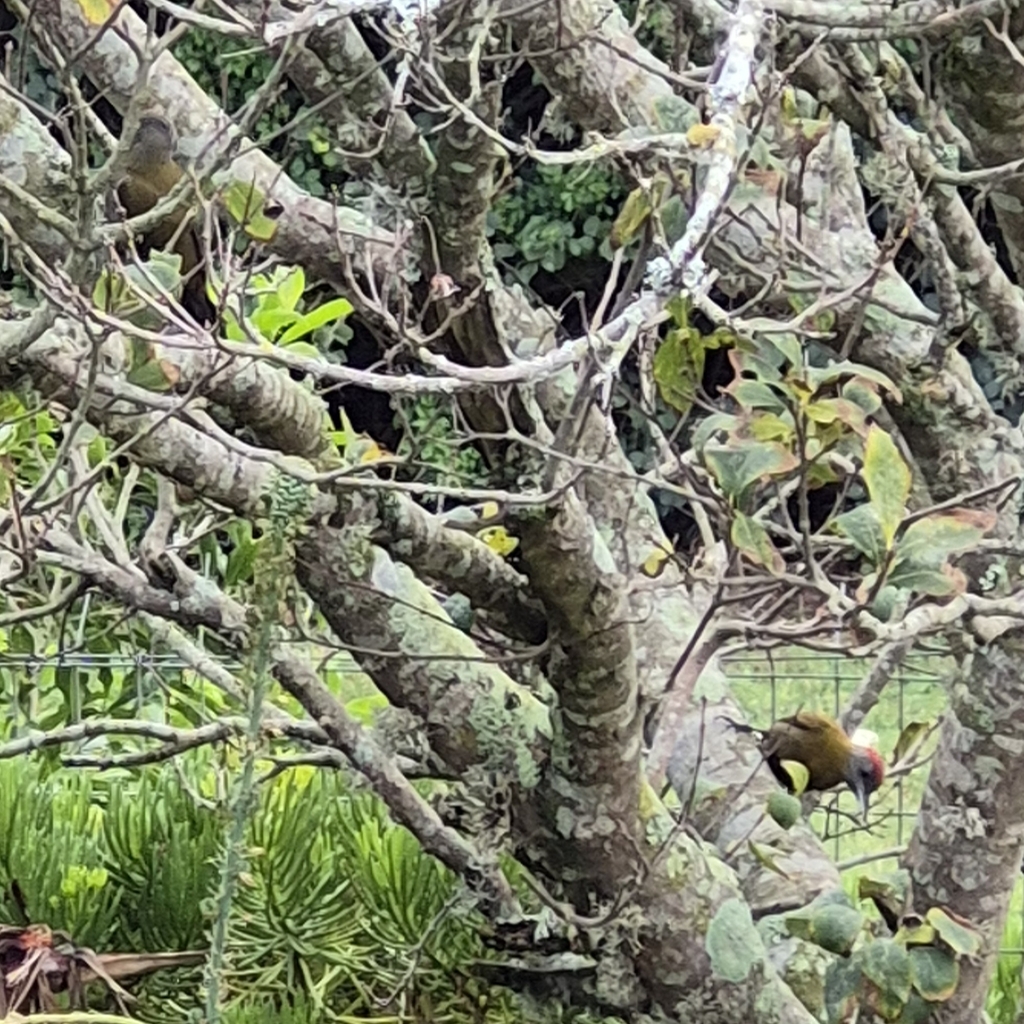
Olive Woodpecker
Photo © Henry de Lange
Photo © Henry de Lange — CC BY 4.0 — Source: iNaturalist #311890016Identification
The Olive Woodpecker is a small, rather plain woodpecker distinguished primarily by its bright scarlet rump and upper-tail coverts, which are particularly visible in flight. Its upper body displays bronze and olive tones, while the underparts are dark grey and olive with lighter golden tones on the breast. A variable red or pink belly patch is present, and the bird features a long, straight bill with a grey upper mandible and bluish lower mandible. The wings are bronze or dark brown with subtle white spotting and barring on the flight feathers.
Sexual dimorphism is evident: males display a prominent red nape and mid-crown, while females have fully grey heads and notably shorter bills. Juveniles are duller overall, with greener mantles, greyer breasts lacking yellow hues, and paler red rumps with little or no red on the belly. The three subspecies show distinct plumage variations: the red-bellied subspecies (ruwenzori) is notably brighter with more golden tones and an extensive belly patch; the montane subspecies (kilimensis) is the smallest with less yellow upperparts and more grey underparts; the southern subspecies (griseocephalus) represents the nominate form.
Range & Habitat
The Olive Woodpecker is endemic to southeast Africa, with three recognized subspecies occupying distinct regions. The red-bellied subspecies inhabits Angola, northern Zambia, northern Malawi, central Tanzania, southeast Democratic Republic of Congo, and southwest Uganda. The montane subspecies is found in northern and eastern Tanzania, while the southern subspecies ranges from southern Mozambique to South Africa.
These woodpeckers favour densely wooded and forested habitats across a broad elevation range from 450 to 3,700 metres. This remarkable altitudinal tolerance reflects the species' adaptation to diverse forest types throughout its geographic range, from lowland to montane woodland environments.
Behaviour & Diet
The Olive Woodpecker is insectivorous and is often observed foraging for ants and beetles in mossy trees, where it methodically searches for prey among the vegetation. Like other woodpeckers, it produces a wide range of vocalizations including alarm calls, specific take-off and flight sounds, and breeding calls used to attract mates.
Breeding season varies considerably depending on the local population, lasting anywhere from one to eight months. Clutch sizes are characteristically small, comprising only two to three eggs per clutch. Both parents share the responsibilities of incubating eggs and rearing chicks, a cooperative approach common among woodpeckers.
Best Time & Places to See It
The variable breeding season of the Olive Woodpecker means optimal viewing times differ by region and subspecies. Travellers should research local breeding schedules for their intended destination, as the species' activity patterns and vocalisations are most pronounced during these periods. The bird's preference for mossy, densely wooded forest habitats means searchers should focus on these microhabitats rather than open woodland.
The bright scarlet rump is most conspicuous when the bird is in flight, making forest edges and clearings promising observation points. Patient watchers in suitable forest habitat may hear the bird's various calls before spotting it, allowing them to pinpoint its location more effectively.
Photography Tips
Photographers should focus on capturing the Olive Woodpecker's defining feature—the bright scarlet rump and upper-tail coverts—which are best revealed when the bird is in flight or climbing vertically on tree trunks. Position yourself to capture these scarlet feathers against darker forest backgrounds to maximise contrast. The subtle bronze and olive tones of the upperparts and golden breast tones require careful exposure metering to render accurately without losing detail in the darker plumage areas.
Shooting in mossy forest habitats where the bird forages presents challenges due to dappled light, so fast film speeds or higher ISO settings may be necessary. Early morning sessions often provide the best lighting and increased bird activity. Patience is essential, as the bird's small size and preference for dense vegetation can make prolonged observation difficult. When capturing flight images, be prepared for quick movements, as the woodpecker's take-off and flight sounds indicate imminent movement.
Arusha National Park
Tanzania
+555 birds+16 mammals
Where the slopes of Mount Mawenzi rise above the Arusha region, a compact yet ecologically rich national park unfolds across montane forest, moorland, and alpine zones.…
VIEW NATIONAL PARKVirunga National Park
Uganda
+418 birds+13 mammals
Where the Western Rift Valley fractures the landscape of North Kivu, Virunga National Park sprawls across terrain as geologically dramatic as it is ecologically vital. Volcanic…
VIEW NATIONAL PARKBwindi Impenetrable National Park
Kanyashogi, Uganda
+603 birds+26 mammals
Steep ridges cloaked in montane forest rise from Uganda's southwestern borderlands, where the landscape grows so dense and tangled that early explorers named it impenetrable. At…
VIEW NATIONAL PARKVolcanoes National Park
Musanze District, Uganda
+152 birds+6 mammals
Where volcanic cones rise sharply above the montane forests of northern Uganda, Volcanoes National Park protects one of East Africa's most dramatic high-altitude ecosystems. The park's…
VIEW NATIONAL PARKMgahinga Gorilla National Park
Cyanika, Uganda
+429 birds+6 mammals
Where the Virunga Mountains rise steeply from the Uganda–Rwanda–Democratic Republic of Congo frontier, montane forest cloaks the volcanic slopes in a dense, moisture-laden embrace. Mgahinga Gorilla…
VIEW NATIONAL PARKLake Mburo National Park
Uganda
+505 birds+24 mammals
Rolling acacia woodland and scattered lakes define this intimate savanna preserve in southwestern Uganda, where the rift valley's geological drama shapes every water source and grassland.…
VIEW NATIONAL PARKKilimanjaro National Park
Kenya
+207 birds+16 mammals
Africa's highest mountain rises not in isolation but as the centerpiece of a vast national park that sweeps across the borderlands of northern Tanzania, where savanna…
VIEW NATIONAL PARKNgorongoro Conservation Area
Tanzania
+626 birds+55 mammals
Volcanic calderas and open grassland dominate this high plateau in northern Tanzania, where the landscape rises above 2,000 metres and ancient geological forces have shaped both…
VIEW WILDLIFE MANAGEMENT AREAToro-Semliki Proposed National Park
Uganda
+474 birds+5 mammals
Where the Albertine Rift's western escarpment rises above the Semliki River valley, a vast mosaic of forest, savanna and wetland converges to create one of East…
VIEW NATIONAL PARKQueen Elizabeth National Park
Uganda
+672 birds+30 mammals
Across the southwestern escarpment of Uganda, where the Western Rift Valley descends through ancient volcanic terrain, Queen Elizabeth National Park sprawls across more than 8,300 square…
VIEW NATIONAL PARKGarden Route National Park
George, South Africa
+353 birds+54 mammals
Sweeping across the Western Cape's coastal and mountainous terrain, this sprawling national park encompasses over five thousand square kilometers of extraordinarily diverse landscape—from coastal limestone cliffs…
VIEW NATIONAL PARKCederberg Wilderness Area
Cederberg Local Municipality, South Africa
+136 birds+12 mammals
Where ancient sandstone ridges rise dramatically from the semi-arid lowlands of Western Cape, the Cederberg Wilderness Area spreads across nearly 1,700 square kilometres of some of…
VIEW NATIONAL PARKKruger National Park
Ba-Phalaborwa Local Municipality, South Africa
+540 birds+91 mammals
Across the low-lying savanna of northeastern South Africa unfolds one of Africa's largest and most ecologically intact protected areas, where acacia woodlands merge into mopane scrub…
VIEW NATIONAL PARKBontebok National Park
Swellendam Local Municipality, South Africa
+204 birds+11 mammals
Where the Cape Fold Mountains give way to coastal lowlands, a landscape of rolling sandstone hills and fynbos heathland creates one of South Africa's most compact…
VIEW NATIONAL PARKAddo Elephant National Park
Sundays River Valley Local Municipality, South Africa
+388 birds+55 mammals
Where the Eastern Cape's semi-arid scrublands meet transitional woodland, Addo sprawls across 13,478 square kilometres of one of southern Africa's most biodiverse landscapes. The terrain rises…
VIEW NATIONAL PARKIthala Game Reserve
uPhongolo Local Municipality, South Africa
+328 birds+26 mammals
Rolling thornbush savanna and acacia woodland dominate the landscape of this 494-square-kilometre national park in KwaZulu-Natal's uPhongolo Local Municipality, where granite outcrops punctuate grassland plateaus and…
VIEW NATIONAL PARKNo community photos yet. Log in to add the first one.
No community observations of this species yet.