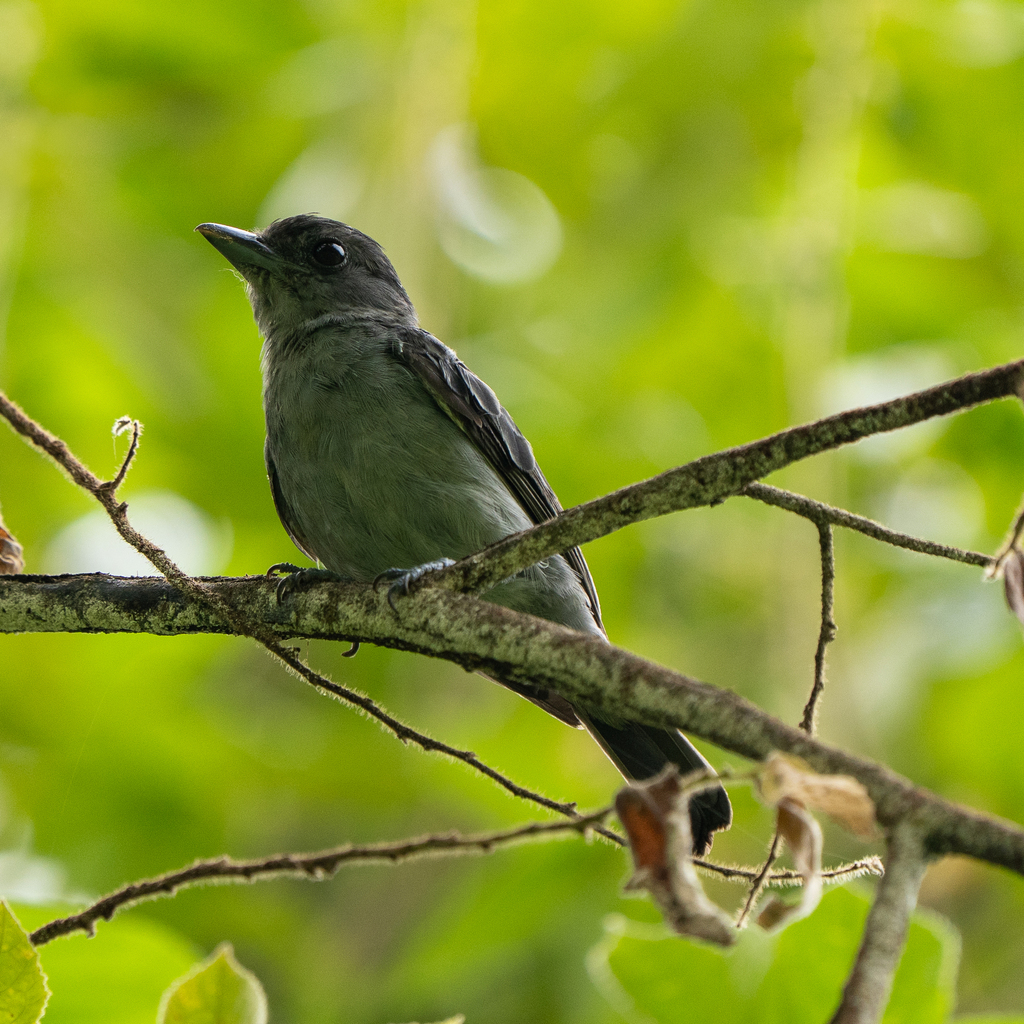
One-colored Becard
Photo © Anthony Batista
Photo © Anthony Batista — CC BY 4.0 — Source: iNaturalist photo #532685392Identification
The one-colored becard is a small bird, measuring about 16.5 cm (6.5 in) long and weighing approximately 35 g (1.2 oz). The species exhibits striking sexual dimorphism. Males of the nominate subspecies are predominantly dark slaty gray above, with a slightly darker crown and lighter rump, while the underparts are somewhat paler gray. The wings and tail are dark slaty gray with paler edges on the flight feathers, and males sometimes display a faint pinkish wash on the throat with a slight dusky tinge on the breast and upper belly. Females are dramatically different, featuring a rufous-chestnut to rufous-tawny crown, upperparts, and tail, with cinnamon-edged flight feathers and a buff-cinnamon face marked by a whitish cinnamon spot above the lores. Their underparts are mostly buffy cinnamon, lighter on the throat.
Range & Habitat
The one-colored becard is found across northwestern South America, including central and eastern Panama, Colombia, Ecuador, Peru, and Venezuela. The nominate subspecies has the largest range, occurring on both Caribbean and Pacific slopes from Panama through western Ecuador and into northwestern Peru. The other two subspecies occupy more restricted ranges in northwestern Colombia and Venezuela. This species inhabits diverse tropical forest types, including humid evergreen forest, deciduous forest, gallery forest, and secondary growth, as well as forest clearings and arid scrublands with tall trees. Overall, it occurs mostly from sea level to 900 m elevation, though it reaches up to 1,500 m in Ecuador.
Behaviour & Diet
The one-colored becard is a year-round resident throughout its range. It feeds on insects and fruit, foraging typically in pairs, though sometimes singly, and regularly joining mixed-species feeding flocks. Birds forage in the mid-story to subcanopy levels, particularly at forest edges. The species has a distinctive vocal repertoire, with a variable, loud, sharp, and sputtering song described as "stet-ee-ee-teet-tsit-tsit-tsitts-tsít" or "ske-e-et'et'ittt, tseer, tsrip," and also produces a squeaky, high-pitched call.
Best Time & Places to See It
The one-colored becard occurs year-round throughout its range, making it available for observation in any season. It is fairly common in Colombia, widespread and locally fairly common in Ecuador, and uncommon to locally fairly common in Peru, with only a few records known from Venezuela. Several protected areas in Ecuador provide reliable locations for sightings. The species is considered locally distributed rather than continuously present, so persistence and attention to habitat will increase your chances of encounter.
Photography Tips
This species forages in the mid-story to subcanopy, so patience and careful positioning will be necessary to capture good images. The dramatic sexual dimorphism makes this an interesting photographic subject—males' slaty plumage can be challenging to expose correctly in forest shade, while females' warm rufous and cinnamon tones are more forgiving. Early morning hours when mixed-species feeding flocks are most active offer the best opportunities. Look along forest edges and in gallery forest where lighting is often more favorable than in dense interior forest. The bird's small size and canopy preference mean that a telephoto lens will be essential for quality shots.
Cerros de Amotape National Park
Darién National Park
Natural Farallones de Cali National Park
Natural Utría National Park
Podocarpus National Park
Nothing matches these filters.
No community photos yet. Log in to add the first one.
No community observations of this species yet.