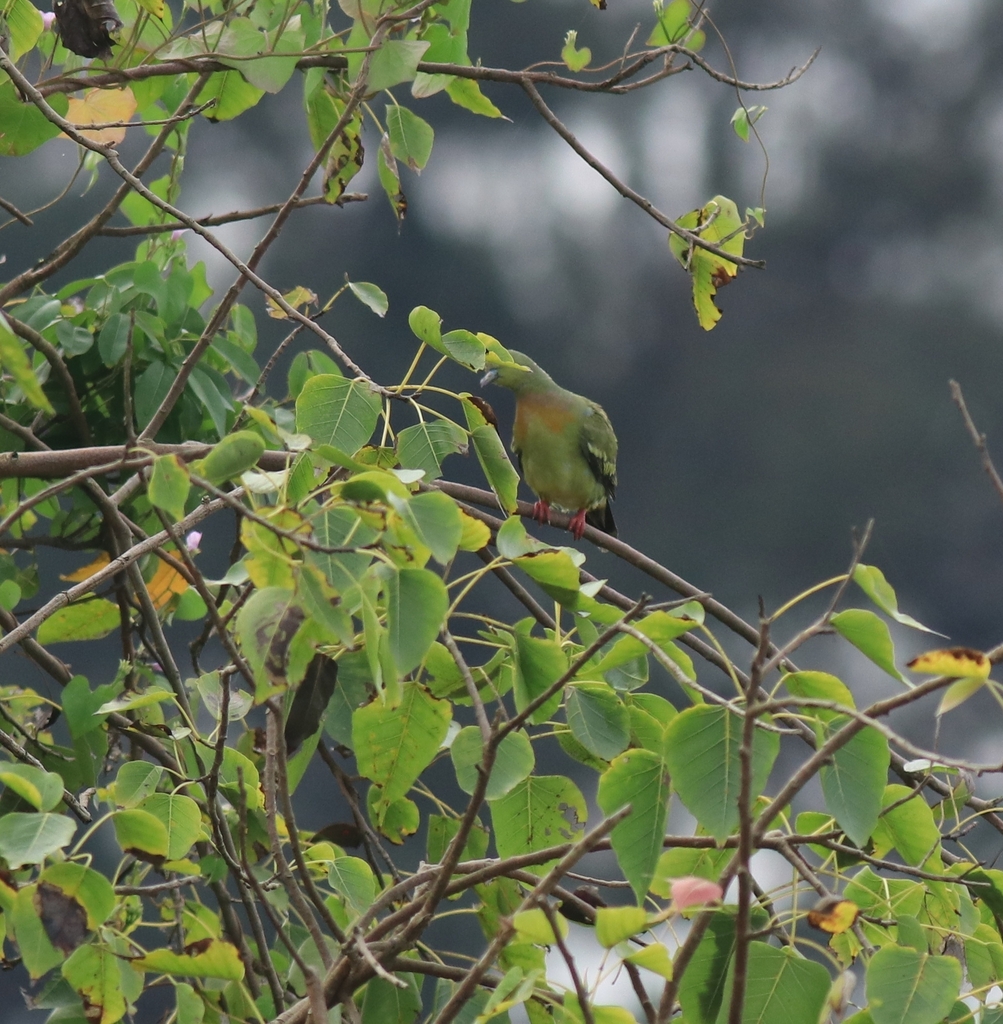
Orange-breasted Green Pigeon
Photo © Afsar Nayakkan
Photo © Afsar Nayakkan — CC BY 4.0 — Source: iNaturalist #332756740Identification
The orange-breasted green pigeon is a medium-sized pigeon most easily identified by its distinctive breast markings and overall plumage. Males are unmistakable, featuring a narrow lilac band on the upper breast with a broader orange band below—the characteristic that gives this species its common name. Females are quite different, displaying a bright yellow breast and lacking the male's colorful bands entirely. Both sexes share a yellowish-green crown and blue-grey nape, with bronzed uppertail coverts and cinnamon undertail coverts edged with yellow in males and duller cinnamon with greenish spots in females.
When distinguishing this species from similar green pigeons such as the yellow-footed and grey-fronted varieties, note that the orange-breasted green pigeon lacks any maroon on the wing. The tail is grey above with a prominent dark subterminal band. Several subspecies exist across its range, with the Sri Lankan population being slightly smaller-winged than other forms, while populations from Hainan, Java, Bali, and Thailand show minor variations in plumage.
Range & Habitat
This species is widely distributed across tropical Asia, ranging from the Terai and lower Himalayas (below 1,500 meters) through the Indian subcontinent and into Southeast Asia. Within India, it occurs mainly in the Western and Eastern Ghats, while in Sri Lanka it inhabits forests not far from the coast. The species is also found in Burma, Thailand, the Malay Peninsula, Vietnam, Java, and Hainan Island.
Orange-breasted green pigeons are forest birds, preferring woodland habitats where fruiting trees are abundant. Some seasonal movements have been documented, with occasional vagrant records from unexpected locations such as Sindh, suggesting limited dispersal beyond their core range.
Behaviour & Diet
These pigeons are typically encountered singly or in small groups, moving slowly and quietly through the canopy while foraging. They are fast and direct fliers, exhibiting the characteristic wing beats and sharp flicks typical of pigeons. Their most distinctive vocalization is a low, subdued series of modulated wandering whistles.
Orange-breasted green pigeons are specialist frugivores, feeding on seeds and fruits from a wide variety of plants and often congregating with other fruit-eating birds at fruiting fig trees. Remarkably, they feed on the fruits of Strychnos nux-vomica, which are toxic to mammals. Though primarily arboreal foragers, they are occasionally seen on the ground. During breeding season, males engage in aggressive displays, slapping each other with their wings and pecking in competition. The breeding season varies geographically: in India it runs from March to September with peak activity before June, while in Sri Lanka breeding occurs mainly from December to May. Pairs construct the typical flimsy twig platform nest of pigeons, laying two white eggs that hatch in approximately 12 to 14 days, with both parents sharing incubation duties.
Best Time & Places to See It
To find orange-breasted green pigeons, visit forested areas within their range during their breeding season. In India, visit the Western and Eastern Ghats between March and June for the best chances. In Sri Lanka, the period from December to May offers optimal viewing opportunities. Look in forests near the coast in Sri Lanka, and in lower Himalayan forests and hill stations across their Indian range.
These birds are most active when fruiting trees are productive, so timing your visit to coincide with local fruiting seasons will increase your success. Early morning visits to areas with abundant fig trees are particularly rewarding.
Photography Tips
Photograph males to capture the striking orange and lilac breast bands that define this species—these features provide excellent identification markers and striking compositional elements. The contrast between the yellowish-green crown and the colorful breast is particularly photogenic. Since these pigeons forage slowly along branches, patient photographers can often obtain detailed perched shots without excessive disturbance.
Frame your subjects against the canopy to highlight the bronze uppertail coverts and the distinctive tail pattern. Early morning light will best reveal the subtle plumage colors, particularly the blue-grey nape and yellow-edged undertail coverts. Be prepared for fast flight when birds are disturbed, as their direct, rapid wing beats make mid-flight photography challenging but rewarding if captured successfully.
Lunugamvehera National Park
Sri Lanka
+204 birds+14 mammals
Dry scrubland and shallow wetlands converge in Sri Lanka's southeastern lowlands, where Lunugamvehera National Park anchors one of the island's most ecologically vital landscapes. The park's…
VIEW NATIONAL PARKMinneriya National Park
Sri Lanka
+158 birds+9 mammals
Across the dry zone of Sri Lanka's North Central Province spreads a landscape of shallow tanks, grassland margins, and scattered dry forest—a mosaic of water and…
VIEW NATIONAL PARKWasgamuwa National Park
Sri Lanka
+156 birds+8 mammals
Dry deciduous forest and open grassland sweep across the North Central lowlands where Wasgamuwa National Park protects one of Sri Lanka's largest remaining tracts of this…
VIEW NATIONAL PARKHat Noppharat Thara-Mu Ko Phi Phi National Park
Ao Nang, Thailand
+253 birds+9 mammals
Where limestone karsts rise dramatically from turquoise waters, Hat Noppharat Thara-Mu Ko Phi Phi National Park unfolds across a mosaic of beach, mangrove forest, and island…
VIEW NATIONAL PARKKhao Yai National Park
Prachantakham District, Thailand
+377 birds+46 mammals
Evergreen dipterocarp forest blankets the rolling terrain of this national park in eastern Thailand, where limestone hills rise abruptly from the forest floor and seasonal streams…
VIEW NATIONAL PARKKhao Laem National Park
Sangkhla Buri District, Thailand
+197 birds
Where the Vajiralongkorn Reservoir sprawls across the forested valleys of Kanchanaburi's northern borderlands, Khao Laem National Park protects a landscape where limestone ridges rise dramatically from…
VIEW NATIONAL PARKKanha Tiger Reserve
Kanha Kisli F.V., India
+321 birds+23 mammals
Where sal forests give way to emerald meadows and crystalline streams carve through ancient valleys, one of India's finest wilderness reserves unfolds across the Maikal Range.…
VIEW NATIONAL PARKTadoba National Park
Palasgaon Singru, India
+270 birds+20 mammals
Where sal forests meet open grasslands and rocky outcrops rise from red laterite soil, central India's landscape unfolds in raw, untamed beauty. Ancient teak woodlands and…
VIEW NATIONAL PARKBandhavgarh National Park
Garhpuri, India
+285 birds+17 mammals
Where granite ridges rise dramatically above sal and bamboo forests, one of India's most pristine tiger reserves unfolds across the Vindhyan plateau. Ancient rock formations tower…
VIEW NATIONAL PARKKaziranga National Park
Kohora, India
+422 birds+26 mammals
Dawn breaks over the floodplains of the Brahmaputra, where tall grasslands stretch endlessly beneath monsoon-heavy skies. This sprawling wilderness of northeastern Assam is a mosaic of…
VIEW NATIONAL PARKTaman Nasional Baluran
Situbondo, Indonesia
+189 birds+9 mammals
Across the northeastern tip of East Java, where monsoon winds sweep down from the Bali Strait, a landscape of contrasts unfolds within 374 square kilometres of…
VIEW NATIONAL PARKWest Bali National Park
Gerokgak, Indonesia
+240 birds+8 mammals
Across West Bali's northwestern reaches, where the Indian Ocean meets volcanic slopes and limestone cliffs plunge toward turquoise shallows, sprawls a protected realm of roughly 325…
VIEW NATIONAL PARKNo community photos yet. Log in to add the first one.
No community observations of this species yet.