
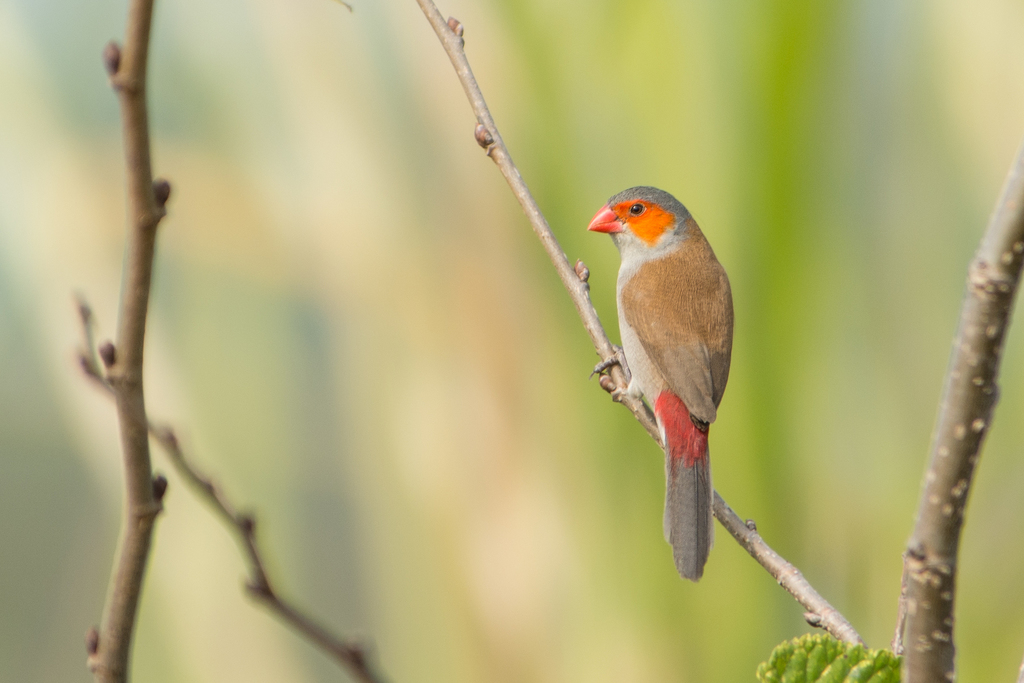
Orange-cheeked Waxbill
Estrilda melpoda
Photo © 尹若宇
Photo © 尹若宇 — CC BY-SA 4.0 — Source: iNaturalist photo #32091942ABOUT
The orange-cheeked waxbill (Estrilda melpoda) is a common species of estrildid finch native to western and central Africa, with an estimated global extent of occurrence of 3,600,000 km2. == Behavior == The orange-cheeked waxbill lives in small family parties or flocks of thirty of more individuals. Their high-pitched peeps are the best clue of their presence. Like most estridids, they are very acrobatic in their movements on twigs and grass stems, "climbing" up and down verticals and hanging upside down while feeding. Males usually have brighter orange patches on the abdomen. == Diet == They feed on tiny grass seeds, which they collect from the ground or, more often, directly from grass panicles. They hang on the stems and harvest the ripe or green seeds, sometimes while hanging upside down. Small insects such as termites, aphids, and gnats are taken during the breeding season. == Reproduction == This species prefers to nest close to or directly on the ground in tangled clumps of tall grass. They will collect the surrounding grass stems together, especially old seed heads (panicles), helping to camouflage the structure. Fine white feathers line the interior where three to six tiny white eggs will be incubated for…
HOTSPOTS
National Park
Toro-Semliki Proposed National Park
Uganda
+474 birds+5 mammals
Where the Albertine Rift's western escarpment rises above the Semliki River valley, a vast mosaic of forest, savanna and wetland converges to create one of East…
VIEW NATIONAL PARK5,0 (1)
National Park
Queen Elizabeth National Park
Uganda
+672 birds+30 mammals
Across the southwestern escarpment of Uganda, where the Western Rift Valley descends through ancient volcanic terrain, Queen Elizabeth National Park sprawls across more than 8,300 square…
VIEW NATIONAL PARKNational Park
Haleakalā National Park
Maui County, United States
+66 birds+4 mammals
Ascending from sea level to over 10,000 feet across a mere thirty miles, Haleakalā National Park commands one of the Pacific's most dramatic elevation gradients, where…
VIEW NATIONAL PARKCOMMUNITY
Share your photo of this species
No community photos yet. Log in to add the first one.
0
Observed by
0
Hotspots reported
0
Countries
No community observations of this species yet.