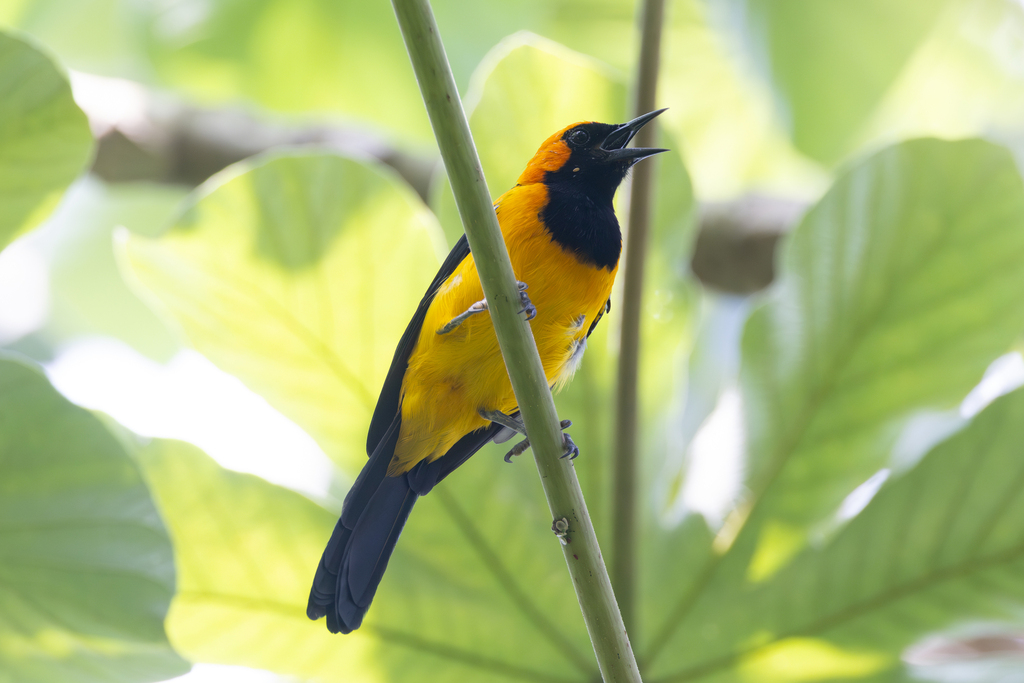
Orange-crowned Oriole
Photo © Ryan F. Mandelbaum
Photo © Ryan F. Mandelbaum — CC BY 4.0 — Source: iNaturalist photo #569158604Identification
The orange-crowned oriole is a small passerine measuring 18 to 20 cm in length, with males averaging about 33 g and females 32 g. Both sexes share identical plumage, making them straightforward to identify. Adults are unmistakable: they display a striking orange-red crown, nape, and sides of the head, contrasting sharply with black face, throat, breast, mantle, and upper back. The lower back and rump are bright yellow, and the tail is black. The wings are predominantly black with yellow lesser and median coverts forming a distinctive epaulet on the closed wing. Below the black breast, the underparts are yellow. The bill is black, the iris brown, and the legs and feet gray. Juveniles are considerably paler, with a yellow face, olive crown and upperparts, dusky wings and tail, and pale yellow underparts with a greenish wash on the breast.
Range & Habitat
The orange-crowned oriole is endemic to northern South America, found from eastern Panama through northern Colombia and northern Venezuela. Its distribution spans from Panama's Panamá and Darién provinces eastward across Colombia north of a line from northern Chocó to Norte de Santander, with populations also occurring south to Huila and northern Meta. In Venezuela, it inhabits the western and eastern bases of the Andes, ranging from Falcón east to Delta Amacuro and Monagas. Elevational range varies across its distribution, from sea level up to approximately 1,900 m in most areas, though records in Panama reach 2,000 m.
This species prefers semi-open landscapes including forest edges, gallery forest, secondary forest, and agricultural areas with scattered trees in tropical and subtropical zones. It is a year-round resident throughout its range.
Behaviour & Diet
The orange-crowned oriole feeds primarily on insects and arthropods, supplemented with smaller amounts of fruit and nectar. It typically forages in pairs or small family groups, working through the forest canopy and often joining mixed-species feeding flocks with other orioles.
Breeding occurs from April to June in northern Colombia and includes September in eastern Venezuela, though the full extent of the breeding season remains incompletely documented. The species constructs a woven nest from plant fibers, suspended from the underside of large leaves or palm fronds. Clutches consist of two whitish eggs marked with darker spots. The shiny cowbird parasitizes nests, though details of incubation, fledging, and parental care are not yet documented in the scientific literature.
Best Time & Places to See It
The orange-crowned oriole is common in Panama, fairly common in Colombia, and uncommon but present in Venezuela, making it most readily observed in Panama. As a year-round resident, it can be seen in any season. Look for it in semi-open habitats with mature trees—forest edges, gallery forests, and agricultural lands with scattered vegetation—across its elevation range. Early morning foraging in the canopy offers the best viewing opportunities.
Photography Tips
The bold orange-red crown and contrasting black and yellow plumage make this species visually striking and relatively straightforward to photograph once located. Focus on canopy-feeding birds in good light to capture the vivid orange crown and the yellow epaulet on the wing. Photograph pairs or family groups when possible to document the species' social structure. Early morning light best illuminates the distinctive head pattern and underparts. Listen for its loud, musical whistled song to locate birds in dense vegetation where visual detection may be challenging.
Chagres National Park
Darién National Park
El Tamá National Park
Morrocoy National Park
Natural el Cocuy National Park
Natural Serranía de los Yariguíes National Park
Nothing matches these filters.
No community photos yet. Log in to add the first one.
No community observations of this species yet.