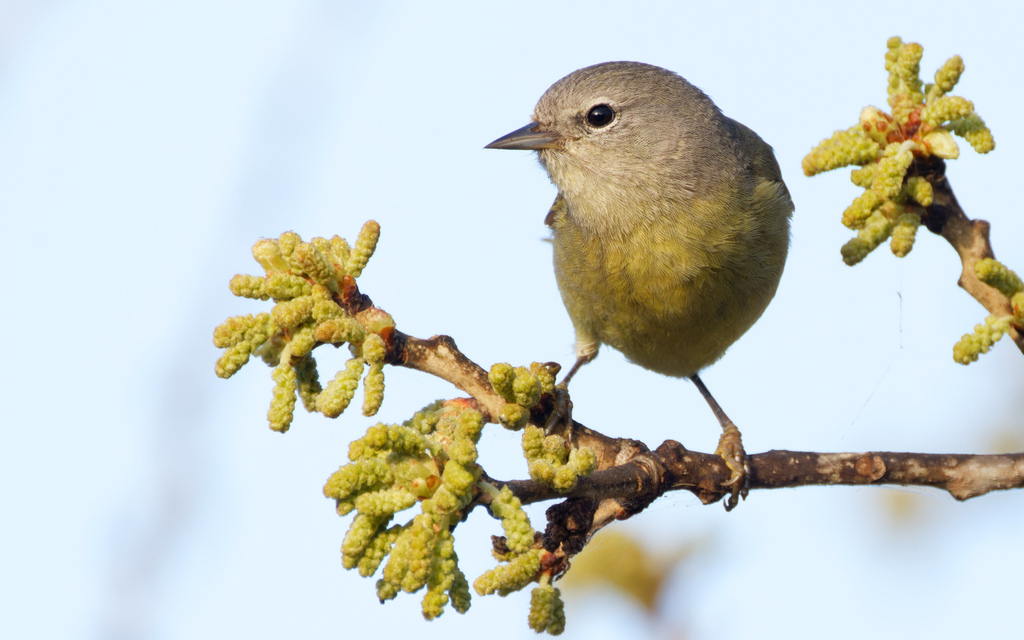
Orange-crowned Warbler
Photo © Brent Cox
Photo © Brent Cox — CC BY 4.0 — Source: iNaturalist photo #354779910Identification
The orange-crowned warbler is a small songbird with olive-grey upperparts and yellowish underparts marked by faint streaking. It features a thin pointed bill, a faint line over each eye, and a faint broken eye ring. Despite its name, the distinctive orange patch on the crown is usually hidden from view, making field identification challenging. Males are more brightly coloured than females and immatures, while western populations tend to be yellower than their eastern counterparts. The species is best distinguished by what it lacks: no wing bars, no strong facial markings, and no bright colouring—a combination that can make it resemble a dull fall Tennessee warbler or black-throated blue warbler. Its song is a trill that descends in both pitch and volume, while its call is a distinctive high chip.
Range & Habitat
Orange-crowned warblers breed across open shrubby areas spanning Alaska, Canada, and the western United States. Four subspecies occupy different regions: the nominate celata breeds from central Alaska to south Canada; lutescens occupies western Canada and the western USA; orestera is found in west-central populations; and sordida is a year-round resident of southern California and northwestern Mexico. The species is quite common throughout the western United States but remains uncommon in the east. During winter, northern and central populations migrate south to Guatemala and Mexico, while the southern resident population remains in place.
Behaviour & Diet
Orange-crowned warblers are active foragers that move dynamically through low shrubs, frequently flying from perch to perch and occasionally hovering while feeding. Their diet is diverse and opportunistic, comprising insects, berries, and nectar. Breeding birds construct small, open cup nests that are well-concealed on the ground beneath vegetation or positioned low in shrubs. Females alone build the nest, while both parents share in feeding the young. Clutch sizes typically range from four to six eggs.
Best Time & Places to See It
Birdwatchers in the western United States should look for orange-crowned warblers in their preferred open shrubby habitats, particularly during the breeding season when they are most active and vocal. Spring migration can offer reliable viewing opportunities in suitable habitat. The species is uncommon in eastern regions, so eastern birders will have better success focusing on the west. Winter visitors to Guatemala and Mexico may encounter migrant populations in appropriate scrubby vegetation.
Photography Tips
Photographing orange-crowned warblers presents a rewarding challenge due to their subtle plumage and active foraging behaviour. Use a fast shutter speed to freeze their frequent movements between shrubs. Dawn light often reveals the faint yellowing of the underparts more clearly than harsh midday sun. Focus on capturing diagnostic features such as the eye-line and broken eye ring, as the hidden orange crown will rarely be visible. Patience near known shrubby breeding areas during early morning will yield the best opportunities, as birds are more vocal and active at this time. The species' small size demands good optics and steady positioning to obtain sharp images.
Tombstone Territorial Park
Acadia National Park
Alaska Maritime National Wildlife Refuge
Alligator River National Wildlife Refuge
Arches National Park
Arctic National Wildlife Refuge
Badlands National Park
Banff National Park
Bear River Migratory Bird Refuge
Nothing matches these filters.
No community photos yet. Log in to add the first one.
No community observations of this species yet.