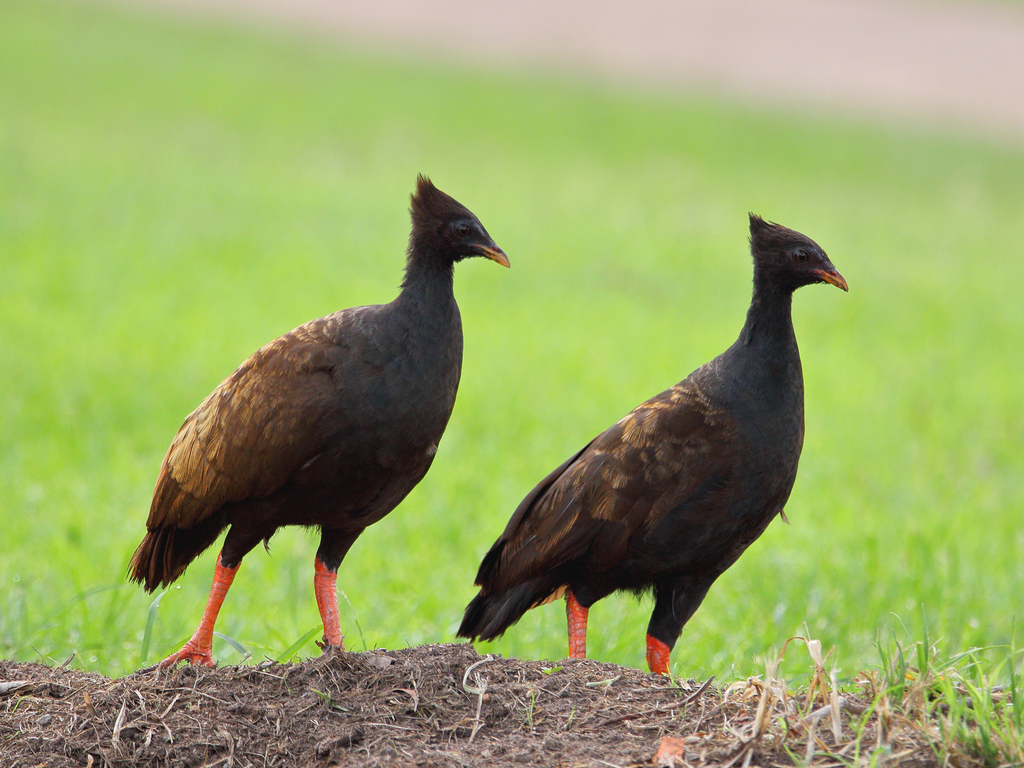
Orange-footed Scrubfowl
Photo © Graham Winterflood
Photo © Graham Winterflood — CC BY-SA 4.0 — Source: iNaturalist photo #56721295Identification
The orange-footed scrubfowl is a terrestrial bird roughly the size of a domestic chicken, making it a distinctive and relatively easy species to identify in the field. Its most striking features are its dark coloration and bright orange legs, which provide an unmistakable contrast and are particularly visible when the bird is moving through leaf litter or across open ground. The species also sports a pointed crest at the back of the head, adding to its characteristic profile. In some regions of Australia, particularly around Darwin, locals refer to this bird affectionately as the bush chook, bush chicken, bush turkey, or most commonly, the bush boiby.
Range & Habitat
The orange-footed scrubfowl is native to many islands in the Lesser Sunda Islands, as well as southern New Guinea and northern Australia. The species is highly adaptable and utilises a range of forest and scrub habitats throughout its range. Remarkably, it has colonised many small islands throughout its distribution, demonstrating considerable ecological flexibility. The bird has also successfully adapted to human-modified landscapes and is prolific in suburban Darwin gardens, where it has become a familiar sight to residents.
Behaviour & Diet
Like other members of the megapode family, the orange-footed scrubfowl employs a unique breeding strategy that sets it apart from most other birds. Rather than incubating eggs with body heat, the species constructs large mounds of sand, leaf litter, and other debris where heat generated by the decomposition of organic material serves to incubate the eggs. These impressive structures may reach 4.5 metres in height and 9 metres in diameter, and their construction and maintenance takes place throughout the year, representing a substantial investment of time and energy.
Outside of breeding, the orange-footed scrubfowl forages on the ground for seeds, fallen fruit, and terrestrial invertebrates. The bird's dark coloration and ground-feeding habits make it well-suited to moving through dense forest and scrub vegetation in search of food.
Best Time & Places to See It
The orange-footed scrubfowl's stable populations and Least Concern conservation status suggest it is reliably present throughout its range. The species is particularly easy to encounter in suburban Darwin gardens and other human-modified habitats in northern Australia, where it has become well-established. Its presence in forest and scrub habitats across the Lesser Sunda Islands, southern New Guinea, and northern Australia offers numerous opportunities for observation across its wide geographic range.
Photography Tips
The bright orange legs and dark plumage of the orange-footed scrubfowl create excellent contrast for photography. The bird's ground-feeding behaviour offers opportunities to photograph it foraging in natural leaf litter and forest understory settings. The distinctive pointed crest is a key identifying feature worth capturing in profile shots. In suburban settings such as Darwin gardens, the bird's habituation to human presence may allow relatively close approach, presenting good opportunities for detailed portraiture and behaviour documentation.
Herberton Range National Park
Australia
+115 birds+10 mammals
Rainforest-clad ridges and rocky outcrops define this 324-square-kilometre reserve in far north Queensland, where the mountainous terrain of the Herberton Range rises through layered eucalypt woodland…
VIEW NATIONAL PARKKakadu National Park
Kakadu, Australia
+273 birds+46 mammals
Kakadu National Park is Australia’s largest national park and one of the world’s most remarkable protected areas, covering nearly 20,000 square kilometres in the tropical north…
VIEW NATIONAL PARKDaintree National Park
Dedin, Australia
+362 birds+37 mammals
Daintree National Park is one of the world’s oldest and most biologically diverse tropical rainforests, protecting an extraordinary landscape where ancient forests meet the Great Barrier…
VIEW NATIONAL PARKEndeavour River National Park
Philadelphia, Australia
+203 birds+1 mammals
Where the Endeavour River winds through northeastern Queensland's tropical lowlands, a compact mosaic of rainforest, open woodland, and riverine corridor creates one of Australia's most ecologically…
VIEW NATIONAL PARKRinyirru National Park
Lakefield, Australia
+258 birds+7 mammals
Where the savanna grasslands of far north Queensland meet seasonal wetlands and eucalypt woodlands, Rinyirru National Park sprawls across more than 12,500 square kilometres of rugged,…
VIEW NATIONAL PARKWhitsunday Islands National Park
Whitsundays, Australia
+163 birds+9 mammals
Crystalline waters lap against seventy-four islands where rainforest canopies tumble down to pristine beaches and coral gardens flourish in the shallows. This archipelago off Queensland's coast…
VIEW NATIONAL PARKKomodo National Park
Komodo, Indonesia
+155 birds+14 mammals
Where volcanic peaks rise dramatically from turquoise waters, a primordial landscape unfolds across three main islands and countless smaller ones scattered throughout the Lesser Sunda archipelago.…
VIEW NATIONAL PARKLitchfield National Park
Australia
+175 birds+15 mammals
Where weathered sandstone plateaus rise above the savanna woodlands of Australia's Top End, Litchfield National Park unfolds as a landscape of dramatic contrasts shaped by a…
VIEW NATIONAL PARKNitmiluk National Park
Australia
+186 birds+27 mammals
Dramatic sandstone gorges carved by the Katherine River slice through the tropical savanna of Australia's Top End, creating a landscape where escarpments tower above crystalline pools…
VIEW NATIONAL PARKGirringun National Park
Australia
+231 birds+10 mammals
Where granite gorges cleave through subtropical woodland in North Queensland, Girringun National Park unfolds across rugged terrain shaped by millions of years of weathering and erosion.…
VIEW NATIONAL PARKWooroonooran National Park
Australia
+240 birds+28 mammals
Where the Great Dividing Range rises sharply inland from Queensland's tropical coast, Wooroonooran National Park encompasses a landscape of steep, forested gorges and cascading waterways carved…
VIEW NATIONAL PARKNo community photos yet. Log in to add the first one.
No community observations of this species yet.