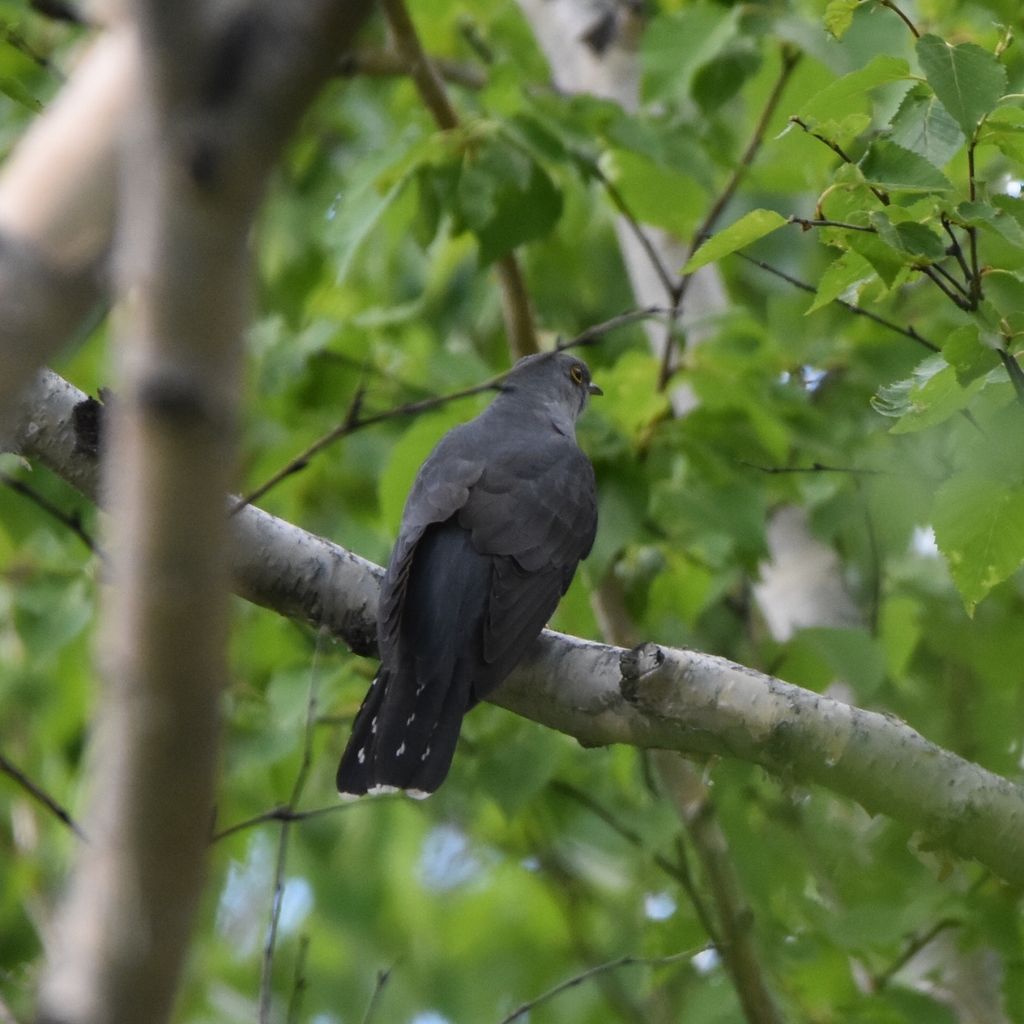
Oriental Cuckoo
Photo © Валерия Ковалева
Photo © Валерия Ковалева — CC BY 4.0 — Source: iNaturalist #84797219Identification
The Oriental cuckoo is a medium-sized cuckoo measuring 30–32 centimetres long with a wingspan of 51–57 centimetres. Adult males display a distinctive grey head, breast and upperparts, with a creamy-white belly marked by dark bars. The vent is often buff with minimal markings, and the legs, feet and bare eye-ring are bright orange-yellow. Females and juveniles exhibit two colour morphs: a grey morph similar to males but with a brownish wash on the breast, and a rufous morph featuring reddish-brown upperparts and pale underparts with strong dark bands throughout, including the rump.
The Oriental cuckoo closely resembles the common cuckoo, though the latter is slightly bulkier with longer wings and tail, a smaller head and bill, and paler overall plumage with narrower underpart barring. The Himalayan cuckoo is extremely similar but noticeably smaller with shorter wings. The male's distinctive call comprises low paired notes—'poo-poo'—with equal stress on both notes, somewhat reminiscent of a hoopoe's call. Females produce a deep bubbling trill, while birds are typically silent outside the breeding season.
Range & Habitat
This cuckoo has a large breeding range across northern Eurasia, stretching from Russia west to the Komi Republic with occasional sightings as far west as Saint Petersburg. Its breeding range extends through northern Kazakhstan, Mongolia, northern China, Korea and Japan. The exact wintering range remains uncertain due to the species' secretive nature and the difficulty of distinguishing it from similar species, but it is believed to winter across the Malay Peninsula, Indonesia, the Philippines, New Guinea, western Micronesia, the Solomon Islands, and northern and eastern Australia, with occasional birds reaching New Zealand.
The Oriental cuckoo primarily inhabits forests—coniferous, deciduous and mixed—across its range. It typically arrives later than the sympatric common cuckoo, with birds reaching their breeding grounds in southern Russia towards the end of April.
Behaviour & Diet
This species is characteristically secretive and difficult to observe. It feeds mainly on insects and their larvae, foraging actively in trees, bushes and on the ground. Like all cuckoos, the Oriental cuckoo is a brood parasite, laying its eggs in the nests of other bird species rather than raising its own young. It particularly favours the nests of Phylloscopus warblers, including the arctic warbler, eastern crowned warbler, willow warbler and chiffchaff, though it also uses the nests of olive-backed pipits and Asian stubtails.
The cuckoo's smooth, slightly glossy eggs vary in colour and often mimic those of the host species. Incubation lasts approximately 12 days. Upon hatching, the young cuckoo is naked with an orange gape marked with black patches. Within days, it ejects the eggs or nestlings of the host species from the nest. Older nestlings develop blackish feathers with white fringes and dark brown bellies with white bands, fledging after around 17–19 days.
Best Time & Places to See It
Finding the Oriental cuckoo requires patience and keen listening, as this secretive species is more often heard than seen. During the breeding season, from late April onwards, listen for the distinctive 'poo-poo' call of males in their northern Eurasian range, particularly in Russia, Mongolia, northern China, Korea and Japan. The species is elusive even at the height of breeding season, spending much of its time foraging discreetly within forest canopies.
For birdwatchers and photographers visiting wintering grounds across Southeast Asia and Australia, encounters are rare and unpredictable. The species' secretive habits and difficulty in separating it from the Himalayan cuckoo make it a challenging target. Visiting suitable forest habitats during the breeding season in Russia, Mongolia or Japan offers the best chances, though success depends heavily on hearing and locating calling males.
Photography Tips
Photographing the Oriental cuckoo presents significant challenges due to its secretive behaviour and preference for remaining hidden within dense foliage. During breeding season, use the male's distinctive 'poo-poo' call as a guide to locate birds, then position yourself quietly to await opportunities. Early morning when birds are most vocal offers the best window for encounters, though extended patience in suitable forest habitat is essential.
When photographing, pay particular attention to distinguishing features: the orange-yellow legs and eye-ring of males, the variation between grey and rufous morphs in females, and the overall proportions compared to the similar common cuckoo. The rufous morph's dark-barred rump is a key identification feature for field documentation. Use longer focal lengths to minimize disturbance to this already elusive species, and be prepared for poor lighting conditions within forest habitats. Capturing the subtle plumage details and colour variations between morphs will reward patient observers.
Aketajawe Lolobata National Park
Baikal National Park
Bogani Nani Wartabone National Park
Bribie Island National Park
Bunya Mountains National Park
Daintree National Park
Endeavour River National Park
Girringun National Park
Gorkhi-Terelj National Park
Nothing matches these filters.
No community photos yet. Log in to add the first one.
No community observations of this species yet.