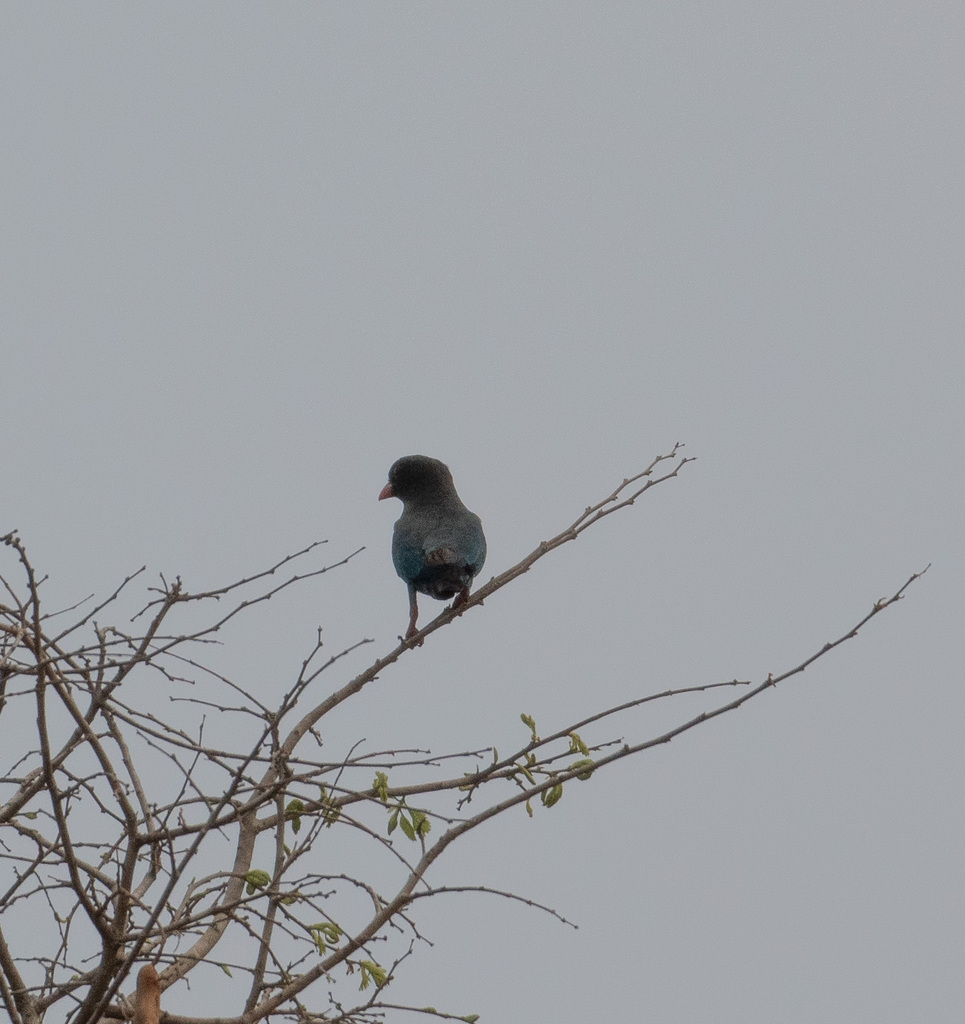
Oriental Dollarbird
Photo © Stefan C
Photo © Stefan C — CC0 1.0 — Source: iNaturalist #155288551Identification
The Oriental dollarbird is a striking medium-sized roller reaching up to 30 cm in length. Its most distinctive feature is the pale blue or white, coin-shaped spots on its wings—highly visible in flight and the source of its memorable name. The bird's plumage is dark brown, heavily washed with bluish-green sheen on the back and wing coverts, while its belly and undertail coverts are light coloured. A glossy bright blue throat and undertail patch are particularly eye-catching in mature birds, complemented by darker blue flight feathers.
Adults display an orange-red bill with a black tip, while immature birds are noticeably duller, lacking the blue throat colouring and sporting brown bills and feet instead. Females are slightly duller than males, though the sexes are broadly similar in appearance.
Range & habitat
The Oriental dollarbird has an extensive range spanning from Australia to Korea, Japan, and India, with ten recognized subspecies distributed across this vast territory. Some subspecies are migratory; for instance, the Australian subspecies breeds in northern and eastern Australia between September and April, then winters in New Guinea and nearby islands.
These birds favour open wooded areas with hollow-bearing trees, which they use for nesting. Their preference for such habitat makes them relatively accessible to birdwatchers and photographers across their range.
Behaviour & diet
The Oriental dollarbird is most commonly observed singly, perched upright on a bare branch high in a tree. From this vantage point, it hawks for insects, displaying characteristic flycatcher-like behaviour. After each aerial foray, the bird returns to the same perch to resume hunting, making it relatively predictable and rewarding to observe once located.
Best time & places to see it
The best opportunities to see Oriental dollarbirds depend on your location. In Australia, visit between September and April during the breeding season in northern and eastern regions. For migratory populations, winter months offer chances in New Guinea and nearby islands. The bird's preference for open wooded areas with tall trees means scanning the canopy in suitable habitats will improve your sightings.
Photography tips
Photograph this species from below to capture its characteristic upright perching silhouette against the sky. The pale blue dollar-spots on the wings are most dramatically visible when the bird is in flight, so be prepared to photograph it hawking for insects. Backlighting can enhance the glossy blue throat patch and the iridescent sheen on the back. Use a fast shutter speed to freeze the bird's rapid aerial manoeuvres as it hunts.
Aketajawe Lolobata National Park
Bako National Park
Bandipur National Park
Bardiya National Park
Barrington Tops National Park
Ben Boyd National Park
Berbak National Park
Blue Mountains National Park
Boodjamulla National Park
Nothing matches these filters.
No community photos yet. Log in to add the first one.
No community observations of this species yet.