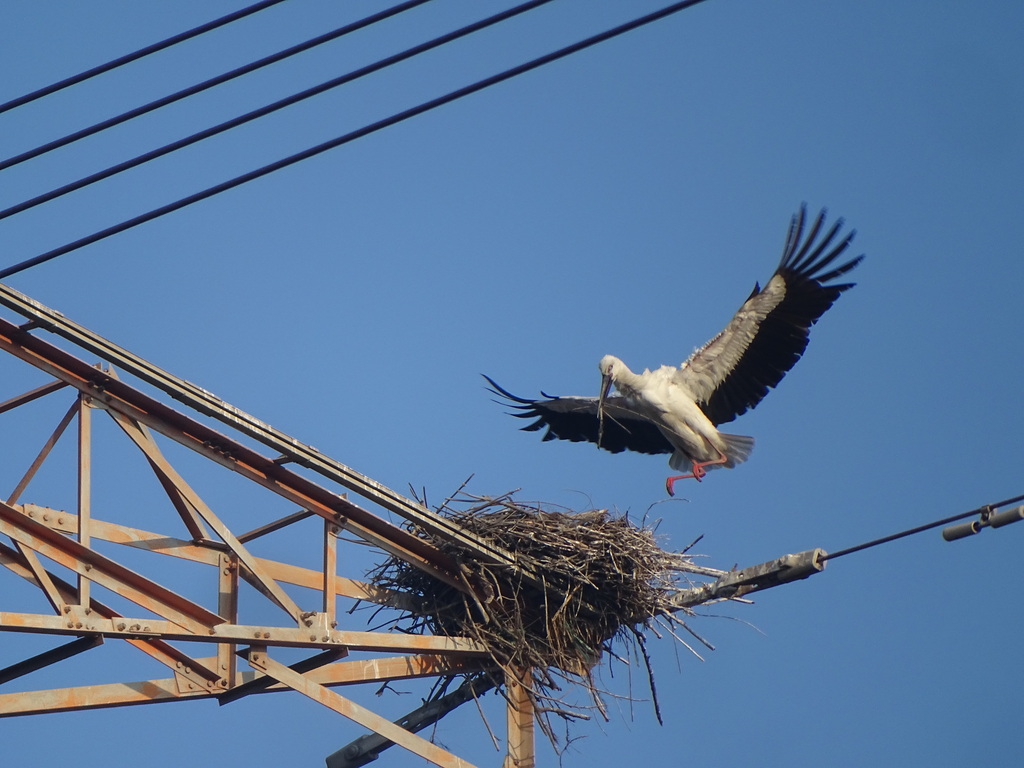
The Oriental stork (Ciconia boyciana; traditional Chinese: 東方白鸛; simplified Chinese: 东方白鹳; pinyin: dōngfāng bái guàn; Japanese: コウノトリ Konotori; Korean: 황새 Hwangsae) is a large, white bird with black-feathered wings in the stork family Ciconiidae. == Taxonomy == The species was first described by Robert Swinhoe in 1873. It is closely related to and resembles the European white stork (C. ciconia), of which it was formerly often treated as a subspecies. == Description == It is typically larger than the white stork, at 100–129 cm (39.5–51 in) long, 110–150 cm (43–59 in) tall, a weight of 2.8–5.9 kg (6.2–13.0 lb) and a wingspan of 2.22 m (7.3 ft). Unlike its more widespread cousin, the Oriental stork has red skin around its eye, with a whitish iris and black bill. Both sexes are similar. The female is slightly smaller than the male. The young are white with orange bills. == Distribution and habitat == The Oriental stork is found in Japan, China, Korea and Siberia. It was formerly extirpated from Japan and the Korean Peninsula as a breeding species but is being reintroduced in both Japan and South Korea. In May 2007 a wild hatchling was reported in Japan for the first…
Yancheng National Nature Reserve
Yancheng, China
+208 birds+4 mammals
Where the East China Sea's tidal rhythms sculpt the Jiangsu coast, Yancheng National Nature Reserve sprawls across one of Asia's most dynamic wetland complexes. This vast…
VIEW NATURE RESERVEZhalong National Nature Reserve
Qiqihar, China
+78 birds
Across the wetlands of northeastern China, where the Heilongjiang climate swings between brutal winters and warm summers, lies one of East Asia's most vital refuges for…
VIEW NATURE RESERVEPoyang Lake National Nature Reserve
Shangrao, China
+270 birds+7 mammals
Where the Yangtze River's massive floodplain spreads across central China, Poyang Lake National Nature Reserve encompasses one of the continent's most dynamic and water-rich wetland systems.…
VIEW NATURE RESERVENo community photos yet. Log in to add the first one.
No community observations of this species yet.