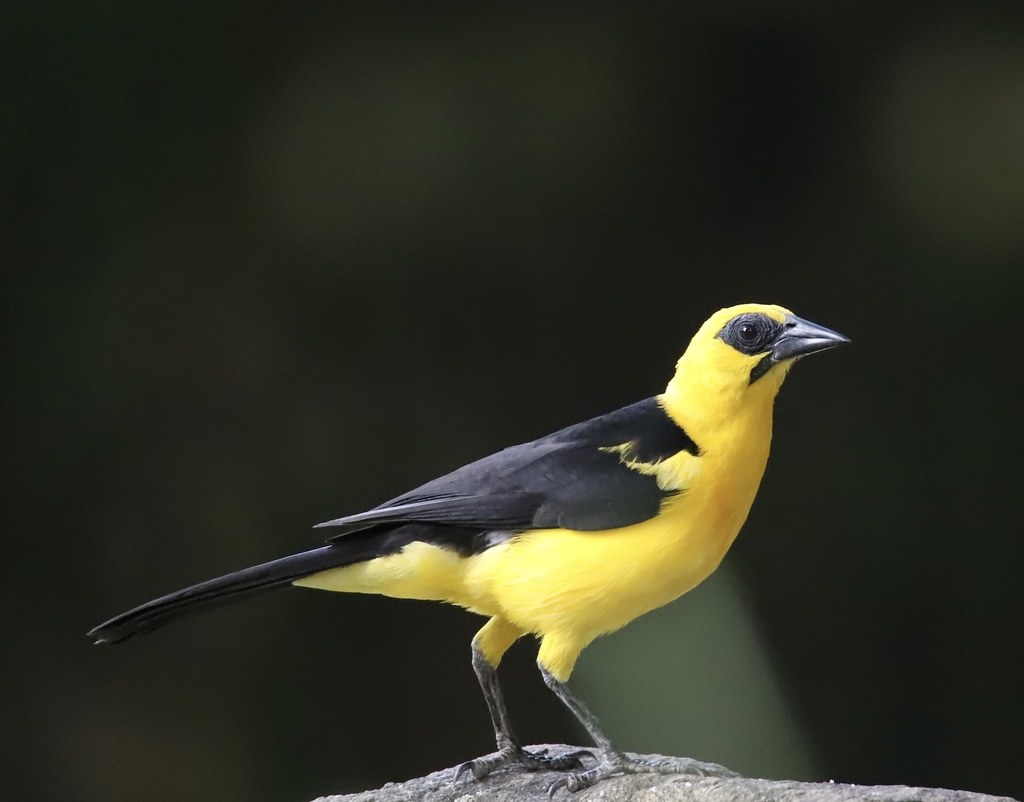
Oriole Blackbird
Photo © Aitor
Photo © Aitor — CC BY 4.0 — Source: iNaturalist photo #319214791The oriole blackbird (Gymnomystax mexicanus) is a species of bird in the family Icteridae. Its genus, Gymnomystax, is monotypic. It is a medium-sized yellow and black bird found in Brazil, Colombia, Ecuador, French Guiana, Guyana, Peru, Suriname, and Venezuela, where its natural habitats are subtropical or tropical moist lowland forest, subtropical or tropical moist shrubland, subtropical or tropical seasonally wet or flooded lowland grassland, and swamps. == Taxonomy == In 1760 the French zoologist Mathurin Jacques Brisson included a description of the oriole blackbird in his Ornithologie based on a specimen which he mistakenly believed had been collected in New Spain. He used the French name Le troupiale brun de la Nouvelle Espagne and the Latin Icterus Fuscus Novae Hispaniae. Although Brisson coined Latin names, these do not conform to the binomial system and are not recognised by the International Commission on Zoological Nomenclature. When in 1766 the Swedish naturalist Carl Linnaeus updated his Systema Naturae for the twelfth edition, he added 240 species that had been previously described by Brisson. One of these was the oriole blackbird. Linnaeus included a brief description, coined the binomial name Oriolus mexicanus, cited Brisson's work and gave the type location as Mexico. The…
Yasuní National Park
Aguarico, Ecuador
+601 birds+43 mammals
Where the western Amazon basin converges with Ecuador's Orellana Province, lowland rainforest reaches toward the horizon in an unbroken canopy of staggering botanical density. Yasuní National…
VIEW NATIONAL PARKNatural Sierra de Chiribiquete National Park
Solano, Colombia
+359 birds+27 mammals
Massive table-top mountains rise abruptly from the lowland rainforest of southeastern Colombia, their sheer sandstone cliffs and isolated summits creating some of the most dramatic topography…
VIEW NATIONAL PARKNatural el Cocuy National Park
Güicán, Colombia
+313 birds+3 mammals
Where the Andes rise to their highest peaks in Colombia's eastern cordillera, El Cocuy National Park sprawls across more than 6,600 square kilometers of some of…
VIEW NATIONAL PARKMorrocoy National Park
Municipio Silva
+290 birds
Where the Caribbean coast of northwestern Venezuela meets protected coastal waters, a mosaic of mangrove forests, sandy beaches, and coral reef systems defines Morrocoy National Park.…
VIEW NATIONAL PARKEl Tamá National Park
Toledo, Colombia
+435 birds
Where the Andes descend toward the Caribbean coastal lowlands of northern Colombia, El Tamá National Park sprawls across nearly 3,800 square kilometres of montane forest, cloud…
VIEW NATIONAL PARKNatural Sierra de la Macarena National Park
Vista Hermosa, Colombia
+566 birds+15 mammals
Across nearly 20,000 square kilometres of Colombia's Meta Department, the terrain rises from lowland savanna into Andean foothills through a mosaic of gallery forests, palm-fringed wetlands,…
VIEW NATIONAL PARKAmacayacu National Park
Leticia, Colombia
+567 birds+25 mammals
Where the Rio Amazonas curves through the tri-border region where Colombia, Peru, and Brazil converge, Amacayacu National Park sprawls across more than 5,250 square kilometres of…
VIEW NATIONAL PARKAnavilhanas National Park
Brazil
+468 birds+8 mammals
Across the Rio Negro in central Amazonas, an archipelago of over a thousand islands rises from the world's largest rainforest river system, creating a labyrinth of…
VIEW NATIONAL PARKTingo Maria National Park
Mariano Dámaso Beraún, Peru
+423 birds
Where the eastern slopes of the Peruvian Andes descend toward the Amazon basin, the landscape fractures into a maze of limestone ridges, humid gorges, and cloud-wrapped…
VIEW NATIONAL PARKNo community photos yet. Log in to add the first one.
No community observations of this species yet.