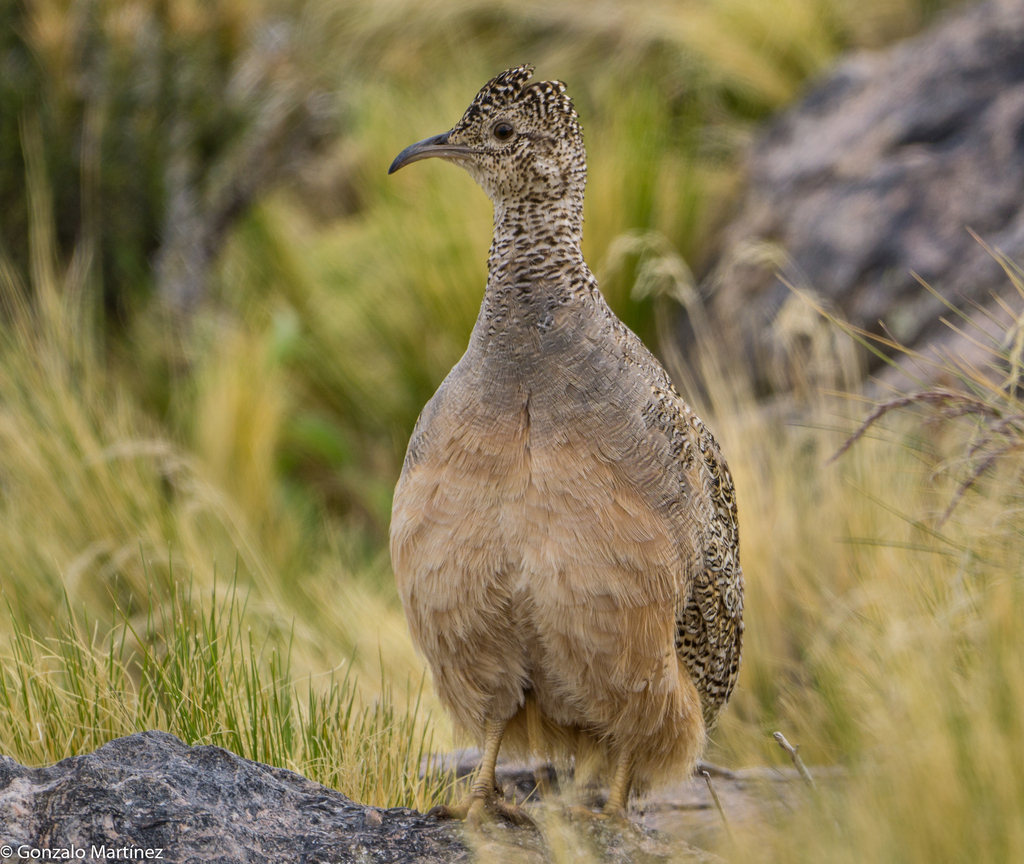
Ornate Tinamou
Photo © Gonzalo Martinez
Photo © Gonzalo Martinez — CC BY 4.0 — Source: iNaturalist photo #467714222Identification
The ornate tinamou is a compact bird, measuring approximately 32 cm (13 in) in length. It is distinctly marked with brownish-grey upperparts decorated with black and buff markings, while the underparts are tawny-buff with darker barring. The head and neck are particularly striking, displaying buff plumage with prominent black spots. Other identifying features include a slender, curved bill and legs that range from yellow to grey in colour. As a member of the tinamou family, it is a ratite—a group of flightless birds—though unlike most ratites, tinamous retain the ability to fly, albeit weakly.
Range & Habitat
The ornate tinamou inhabits the high-altitude regions of west central South America, with its range spanning the puna of central Peru, the Andes of southeastern Peru, western Bolivia, extreme northern Chile, and northwestern Argentina. Three subspecies are recognized across this distribution: the nominate race in southeastern Peru, northern Chile, and western Bolivia; branickii in central Peru's puna; and rostrata in the Andes of northwestern Argentina.
This species strongly prefers high-altitude grasslands and shrublands, typically at elevations between 3,450 and 4,700 m (11,320–15,420 ft). They occupy both high and low-elevation shrubland habitats and have demonstrated some success in adapting to farmland, making them moderately flexible in their ecological requirements.
Behaviour & Diet
Ornate tinamous are ground foragers, feeding on fruit collected from the ground or low-lying bushes. Their diet is supplemented with small quantities of invertebrates, flower buds, tender leaves, seeds, and roots. They are typically solitary or found in small groups as they forage across the high-altitude terrain.
The breeding system of this species is notably unusual: males are responsible for incubating eggs and caring for chicks, often brooding eggs from as many as four different females. After hatching, the male raises the young until they achieve independence, typically within 2–3 weeks. Nests are constructed on the ground in dense brush or between raised root buttresses, providing shelter and concealment in the exposed high-altitude environment.
Best Time & Places to See It
The ornate tinamou is most reliably encountered in the puna regions of Peru, Bolivia, and Argentina, particularly in central and southern Peru and the high Andes. The species occurs across a substantial range of 740,000 km² (290,000 sq mi) and is classified as Least Concern by the IUCN, indicating healthy population levels. Visitors should focus their efforts on high-altitude grasslands and shrublands between 3,450 and 4,700 m elevation, where the species is most common.
Photography Tips
Photographing ornate tinamous presents challenges typical of high-altitude grassland species. Their cryptic coloration—the brownish-grey and buff plumage with black spotting—provides excellent camouflage against rocky, shrubby terrain. Early morning hours, when birds are most active foraging, offer the best opportunities for encounters. Patience and slow, deliberate movement through suitable habitat are essential. The birds' preference for dense brush and root buttresses means they often remain partially concealed, so a telephoto lens will prove invaluable for capturing clear images without disturbing them.
Yanachaga–chemillén National Park
Palcazu, Peru
+639 birds+6 mammals
Where the eastern slopes of Peru's central cordillera plunge into cloud forest, Yanachaga–Chemillén National Park protects nearly three thousand square kilometres of montane wilderness that few…
VIEW NATIONAL PARKManu National Park
Manu, Peru
+892 birds+26 mammals
Across the eastern slopes of the Peruvian Andes, tropical rainforest descends into the Amazon basin with a complexity that few terrestrial ecosystems match. Manu National Park…
VIEW NATIONAL PARKHuascarán National Park
Independencia, Peru
+201 birds+5 mammals
Where granite peaks pierce the Andean sky above 6,000 metres, Huascarán National Park sprawls across more than 11,500 square kilometres of Peru's Cordillera Blanca, a landscape…
VIEW NATIONAL PARKLauca National Park
Putre, Chile
+139 birds+17 mammals
Where the Andes rise toward the altiplano in Chile's far north, Lauca National Park sprawls across more than 3,000 square kilometres of some of South America's…
VIEW NATIONAL PARKReserva Nacional las Vicuñas
Putre, Chile
+87 birds+6 mammals
High desert plateaus interlace with volcanic ridges across this 4,204-square-kilometre expanse at the border between Chile and Bolivia, where altitudes exceed 3,500 metres and the climate…
VIEW NATIONAL PARKLos Cardones National Park
Argentina
+193 birds+6 mammals
Where the Andes descend into northwestern Argentina, Los Cardones National Park sprawls across nearly 1,200 square kilometres of one of South America's most distinctive high-altitude desert…
VIEW NATIONAL PARKNo community photos yet. Log in to add the first one.
No community observations of this species yet.