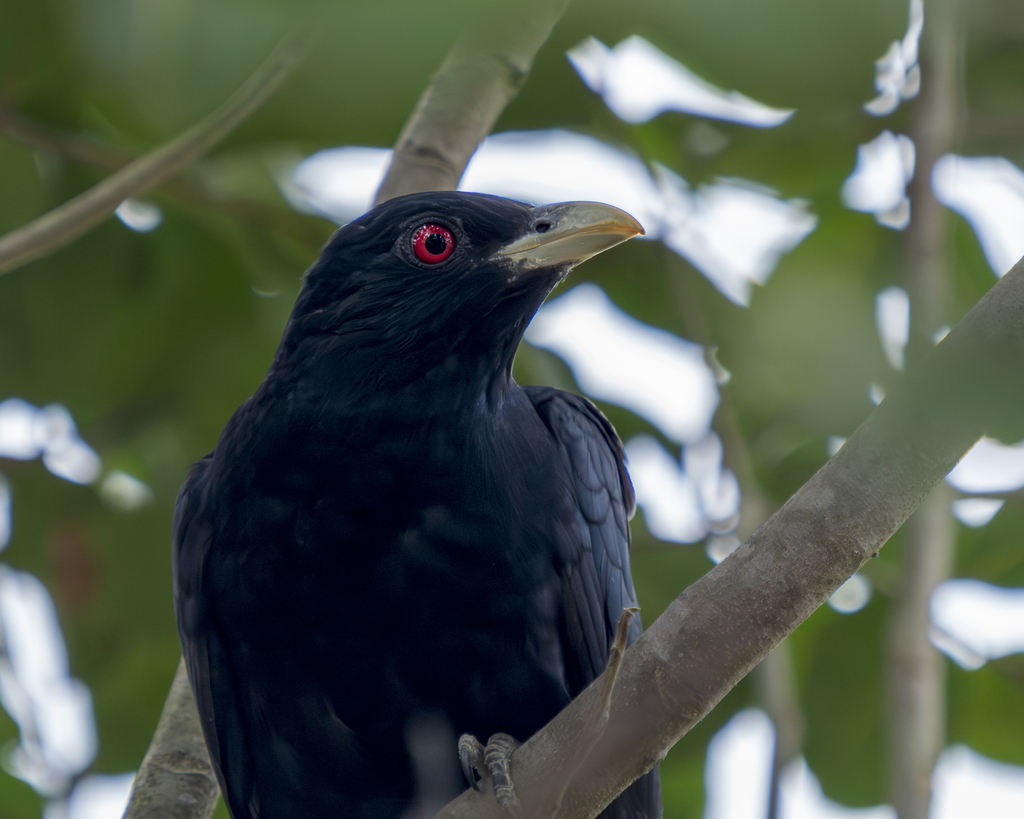
Pacific Koel
Photo © Austen Armstrong
Photo © Austen Armstrong — CC BY 4.0 — Source: iNaturalist photo #602689419Identification
The Pacific koel is a striking cuckoo easily identified by its glossy black plumage, often with blue and green iridescence, and distinctive red eyes. Sexual dimorphism is pronounced: males are entirely black, while females display brown plumage on the back with white spotting and a cream-coloured underside finely streaked with black. Juveniles resemble females but have darker eyes, making age determination straightforward in the field.
Range & Habitat
This species is distributed across a vast region from Wallacea eastward through the Solomon Islands and south to northern and eastern Australia. It inhabits forests, woodlands, plantations, and gardens throughout its range. In Australia, where it is colloquially known as the rainbird or stormbird, it is found from northeastern Western Australia and central eastern Queensland southward to New South Wales.
Behaviour & Diet
The Pacific koel is a brood parasite, laying its eggs in the nests of host species—primarily large honeyeaters such as noisy friarbirds and red wattlebirds. Notably, unlike most parasitic cuckoos, the young koels do not kill host chicks. As adults, Pacific koels are largely frugivorous. Males are highly vocal during breeding season, calling repeatedly throughout day and night to mark territory and signal breeding readiness. Recent studies suggest short-term pair-bonding may occur within their otherwise polygynous mating system.
Best Time & Places to See It
In Australia, the arrival of the Pacific koel signals the onset of spring and the rainy season, making it a culturally significant seasonal marker. The species is most conspicuous during breeding season when males' incessant calls make them easy to locate, even if visual confirmation proves challenging. Look in forests and well-vegetated gardens where suitable host species occur, particularly during the warmer months.
Photography Tips
The male's glossy black plumage and red eyes provide striking photographic subjects, though their iridescent blue-green tones are best captured in good light. Females and juveniles are more cryptic; patience and knowledge of their calls will aid location. Early morning or late afternoon light enhances the metallic sheen of male plumage. The vocal nature of males during breeding season allows photographers to approach calling birds, but move slowly to avoid flushing them from exposed perches.
Barrington Tops National Park
Ben Boyd National Park
Blue Mountains National Park
Boodjamulla National Park
Bouddi National Park
Bribie Island National Park
Bunya Mountains National Park
Cania Gorge National Park
Carnarvon National Park
Nothing matches these filters.
No community photos yet. Log in to add the first one.
No community observations of this species yet.