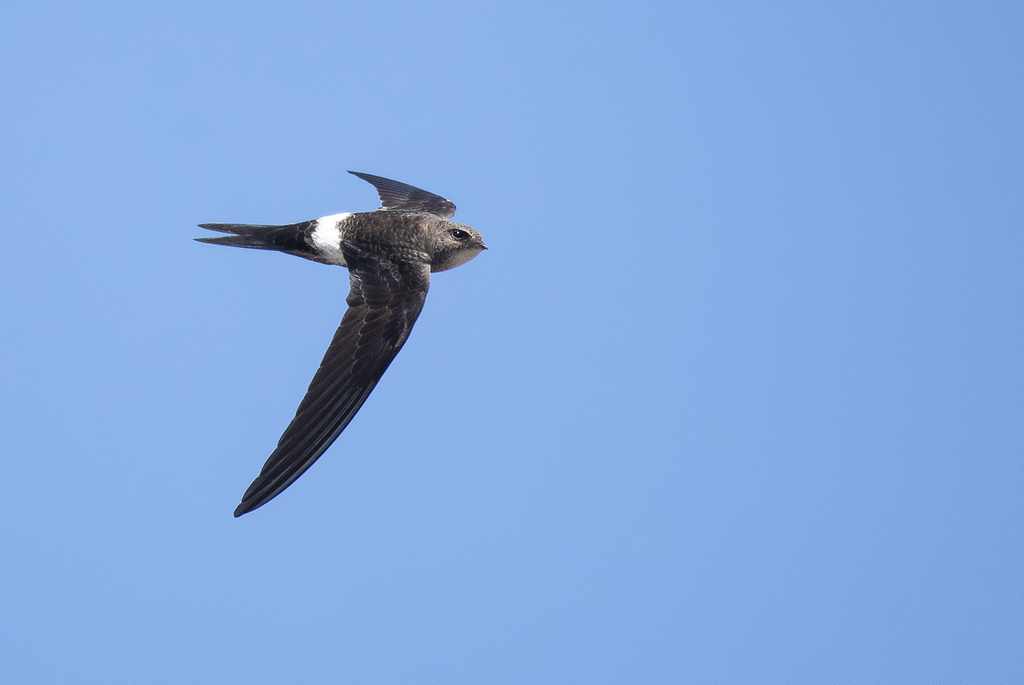
Pacific Swift
Photo © Griha Hasanov
Photo © Griha Hasanov — CC BY 4.0 — Source: iNaturalist photo #523365041Identification
At 17–18 cm in length with a wingspan of 43–54 cm, the Pacific swift is the largest of the Apus swifts. It resembles the common swift in general shape but is slightly longer-winged with a more protruding head, deeper tail fork, and broader rump. The most distinctive field marks are the white rump band and heavily marked underparts with white-fringed feathers giving the belly a scaly appearance. The upperparts are black with a somewhat greyer head, while the underwings are brown. Sexes are identical in plumage; juveniles can be distinguished by pale fringes to the wing feathers, particularly on the wings, which are absent in adults.
The white-rumped swift is superficially similar but has a slender body and long, deeply forked tail appearing quite different from the Pacific swift's more powerful build. A possible pitfall is a partially leucistic common swift with a white rump, but the Pacific swift can be distinguished by its deeper tail fork, longer wings, bigger head, larger white throat patch, and patterned underparts.
Range & Habitat
The Pacific swift breeds in eastern Asia and is strongly migratory, spending the northern hemisphere's winter in Southeast Asia and Australia. It has occurred as far afield as the US and New Zealand, and is a very rare vagrant in Europe. The species is found in a wide range of climatic zones and habitats, breeding in sheltered locations such as caves, natural rock crevices, or under the roofs of houses.
Behaviour & Diet
Like all swifts, the Pacific swift feeds exclusively on insects caught in flight and tends to hunt higher than most of its relatives. It builds a distinctive half-cup nest of dry grass and fine material gathered in flight, cemented with saliva and attached to a vertical surface. Typically two or three white eggs are laid and incubated for about seventeen days. The chicks remain in the nest for a long but variable period before fledging; remarkably, they can survive for days without food during bad weather by metabolising body fat.
This swift's main call is a screech typical of its family—a trilled tsiririri or harsher spee-eer that resembles common swift cries but is softer and less wheezy. The species is less vocal on the wintering grounds, producing various twitters and buzzes instead.
Best Time & Places to See It
The Pacific swift has a large population and extensive breeding area, facing few threats from predators or human activities and classified as least concern by the IUCN. Watch for migrating flocks in spring and autumn, particularly in Southeast Asia where they pass through resident ranges of related species.
Photography Tips
These highly aerial birds hunt high in the sky, making photography challenging. Look for them in breeding areas near caves, rock crevices, and buildings at dawn and dusk when they are most active. The distinctive white rump band is the key identifying feature to capture, along with the scaly underparts visible when birds pass overhead. Fast shutter speeds and tracking skills are essential for photographing these swift fliers.
Aketajawe Lolobata National Park
Altai Tavan Bogd National Park
Baikal National Park
Baima Snow Mountain National Nature Reserve
Bako National Park
Barrington Tops National Park
Ben Boyd National Park
Blue Mountains National Park
Bouddi National Park
Nothing matches these filters.
No community photos yet. Log in to add the first one.
No community observations of this species yet.