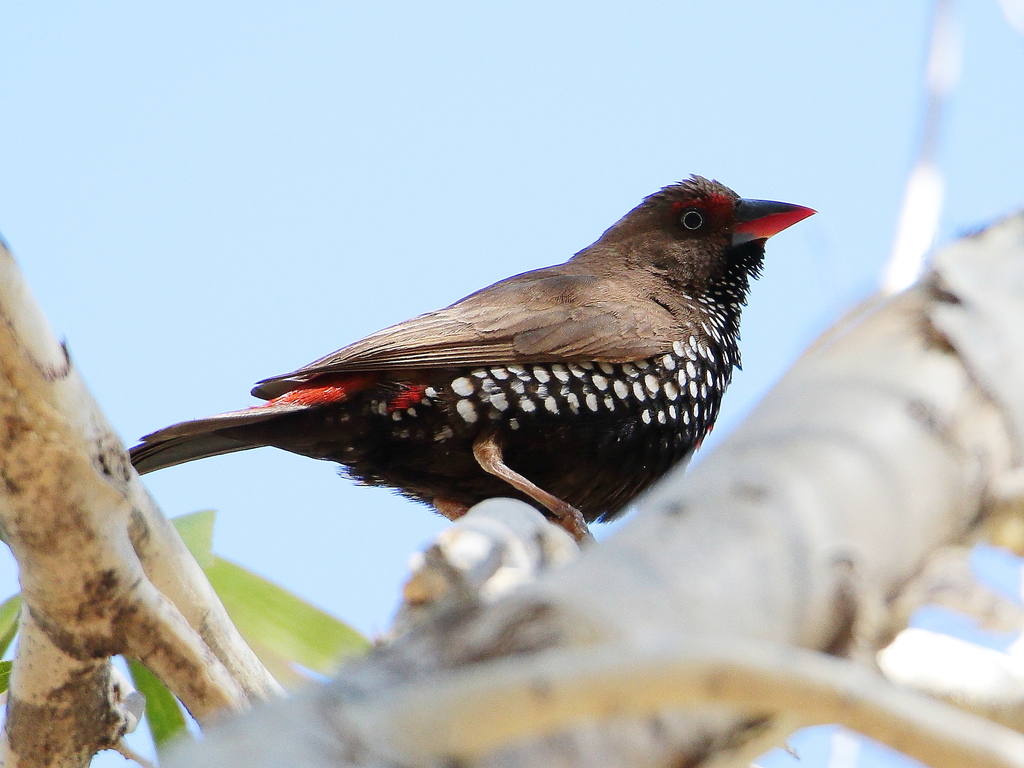
Painted Finch
Photo © Graham Winterflood
Photo © Graham Winterflood — CC BY-SA 4.0 — Source: iNaturalist #91930019Identification
The painted finch is a small passerine, measuring just 10–12 cm in length and weighing around 11.5 g. Both sexes are instantly recognizable by their distinctive red and white spotted and mottled underparts, which inspired the bird's common name. Males are particularly striking, displaying a bright red forehead and face contrasting sharply with a black breast adorned with a vivid red patch in the centre. The sides of the breast, belly and flanks are black with prominent white spots. Their upper body and wings are reddish-brown, while the rump and upper tail coverts are predominantly red and highly conspicuous in flight. The bill is long, slender and pointed, with the upper mandible mostly black tipped with red and the lower mandible mostly red with light blue-grey patches at the base.
Females are similar to males but more subdued, with duller red colouration restricted to the lores, cheeks and around the eyes. Their breast patch is likewise duller, and their overall underparts are a duller brownish-black, though more heavily spotted than males. Juveniles resemble females but are duller and browner, lacking facial red entirely, with a black bill that becomes pinkish on the lower mandible and grey-brown eyes.
Range & Habitat
The painted finch is found in the arid and semi-arid zones of Australia, occurring in Western Australia and the Northern Territory. This species favours rocky areas with a ground cover of spinifex grass, which forms the foundation of its habitat requirements and food sources.
Behaviour & Diet
Painted finches usually occur in pairs and small flocks, though larger congregations of up to 100 individuals gather around water sources, often mixing with other finch and honeyeater species. Despite being less vocal than other Australian grassfinches, their calls are among the loudest and harshest in their species group, described variously as trut, chek-chek, or ced up, cheddy-up. Males produce loud wheezing and chattering songs when alone, while females utter rattling calls in response to nest threats.
These finches feed primarily on grass seeds from spinifex species, foraging on the ground by hopping and bouncing among rocks and grass tussocks to glean fallen seeds. They occasionally consume fruit and grass blades. Monogamous and breeding opportunistically when conditions suit, painted finches may nest almost any time except November and December, constructing loose, bottle-shaped or domed nests in concealed spinifex clumps, sometimes in natural cavities or low shrubs. Females lay 3–5 white eggs incubated by both parents for 13–14 days, with young fledging at 21–26 days old.
Best Time & Places to See It
Look for painted finches in arid and semi-arid regions of Western Australia and the Northern Territory, particularly around rocky areas dominated by spinifex grassland. Water sources are reliable focal points, where larger flocks congregate. Since these birds breed opportunistically across most months (avoiding only November and December), they may be encountered year-round, though breeding activity peaks between March and October when nestlings are present.
Photography Tips
The painted finch's striking red and white plumage and distinctive spotted underparts make it highly photogenic. The conspicuous red rump and upper tail coverts are particularly striking in flight, so anticipate takeoff moments from ground foraging. Water sources offer excellent opportunities to photograph larger congregations and capture behaviour such as drinking and bathing. Early morning light will enhance the brilliant reds and contrasts of male plumage. Position yourself near spinifex clumps during breeding season to document courtship displays and nesting behaviour, though maintain respectful distance to avoid disturbance. The bird's small size demands a telephoto lens and patience to capture fine detail of the facial markings and spotted underparts.
Uluru-Kata Tjuta National Park
Petermann, Australia
+146 birds+10 mammals
Uluru-Kata Tjuta National Park is one of Australia’s most iconic protected areas, renowned for its breathtaking desert landscapes, extraordinary geological formations, and deep cultural significance. Located…
VIEW NATIONAL PARKVulkathunha-Gammon Ranges National Park
Australia
+97 birds+8 mammals
Granite ridges and quartzite peaks rise abruptly from the red earth of South Australia's mid-north, their steep slopes carved into gorges where seasonal waterfalls cascade through…
VIEW NATIONAL PARKBoodjamulla National Park
Australia
+142 birds+3 mammals
Where red sandstone gorges carve through the semi-arid interior of far north Queensland, Boodjamulla National Park reveals a landscape shaped by seasonal water availability and ancient…
VIEW NATIONAL PARKKarijini National Park
Australia
+117 birds+5 mammals
Ochre ridges and rust-coloured gorges slice through the Pilbara's ancient landscape, where Karijini National Park sprawls across a wilderness of iron-rich plateaus and plunging ravines carved…
VIEW NATIONAL PARKCape Range National Park
Australia
+159 birds+15 mammals
Where arid limestone ridges plunge toward turquoise waters, Cape Range National Park frames one of Australia's most dramatic desert-ocean interfaces. The park's spine—a stark, weathered range…
VIEW NATIONAL PARKPurnululu National Park
Australia
+114 birds
Towering sandstone domes and dramatic gorges carved by seasonal watercourses define this remote corner of the Kimberley, where ancient rock formations create a maze of narrow…
VIEW NATIONAL PARKNo community photos yet. Log in to add the first one.
No community observations of this species yet.