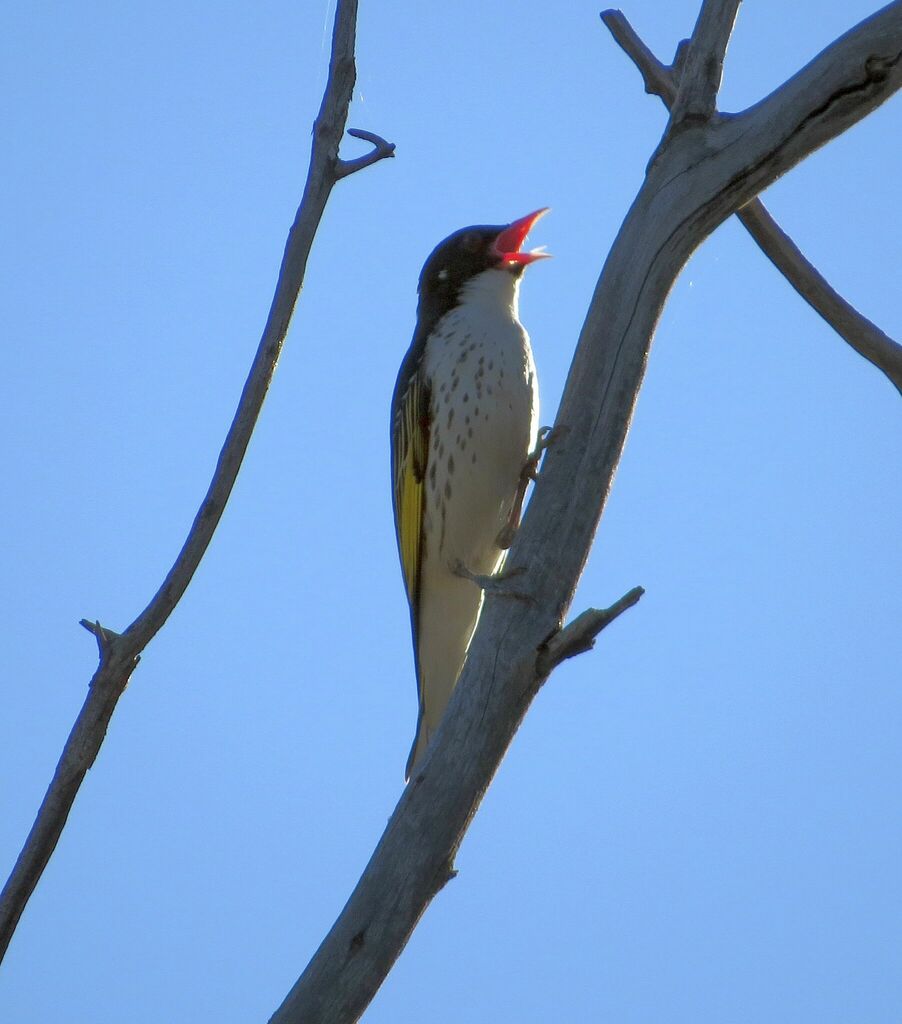
Painted Honeyeater
Photo © ian_mcallan
Photo © ian_mcallan — CC BY 4.0 — Source: iNaturalist #214292293The painted honeyeater (Grantiella picta) is a species of honeyeater in a monotypic genus. == Taxonomy == A member of the family Meliphagidae, Grantiella picta is the sole species under this genus. The painted honeyeater was first described in 1838 by Gould and given the name Entomophila picta, but it was renamed Grantiella picta in 1911 by Mathews. It took another sixty years from its initial description before details of its eggs, habits, and distribution began to be investigated and recorded. Its genus name is in reference to Robert Grant, a Scottish-born taxidermist and collector, while the species name originates from the Latin word for painted, pictus, and refers to the yellow markings on the feathers of its tail and wings. DNA sequencing has helped in organising genera within the family Meliphagidae into four main clades, which show relationships between species. However, a shortage in sampling and statistical analysis has led to some branches within the clades being more strongly linked than others. A study conducted by Driskell and Christidis suggested that Grantiella is in the fourth clade and has associations with Plectorhyncha and Xanthotis. The relationship reported between Grantiella and Plectorhyncha was an unexpected discovery, due to their morphological…
Greater Bendigo National Park
Whipstick, Australia
+202 birds+8 mammals
Across the red volcanic plains of inland Victoria, Greater Bendigo National Park sprawls across more than 1,000 square kilometres of eucalyptus woodland, open grassland, and scattered…
VIEW NATIONAL PARKChiltern-Mt Pilot National Park
Australia
+229 birds+12 mammals
Granite ridges and eucalyptus woodlands define this 869-square-kilometre park straddling the border between Victoria and New South Wales, where rugged terrain rises sharply from gentler foothill…
VIEW NATIONAL PARKLittle Desert National Park
Australia
+200 birds+11 mammals
Across northwestern Victoria's semi-arid interior, sandstone ridges and heathland plateaus rise from red earth in a landscape sculpted by fire and drought rather than water. Little…
VIEW NATIONAL PARKSundown National Park
Australia
+211 birds+9 mammals
Granite ridges and eucalypt woodlands define this 305-square-kilometre expanse of southeastern Queensland, where the landscape descends from sandstone plateaus into open forests and grassy clearings that…
VIEW NATIONAL PARKBald Rock National Park
Australia
+122 birds+15 mammals
Granite peaks and weathered stone dominate the landscape of this 202-square-kilometre national park in inland New South Wales, where rugged tors and rocky outcrops rise dramatically…
VIEW NATIONAL PARKKu-ring-gai Chase National Park
Sydney, Australia
+216 birds+39 mammals
Where Hawkesbury sandstone cliffs plunge toward sheltered bays and creeks, Ku-ring-gai Chase National Park unfolds across rugged terrain just north of Sydney, a mosaic of eucalyptus…
VIEW NATIONAL PARKWarrumbungle National Park
Coonabarabran, Australia
+183 birds+22 mammals
Volcanic peaks and weathered ridges rise abruptly from the inland tablelands of central New South Wales, their exposed rock faces glowing ochre and rust in the…
VIEW NATIONAL PARKGrampians National Park
Australia
+214 birds+18 mammals
Where sandstone ridges rise above the Western District of Victoria, Grampians National Park unfolds across rolling terrain sculpted by ancient geology and sustained by a temperate…
VIEW NATIONAL PARKGreat Otway National Park
Australia
+255 birds+42 mammals
Temperate rainforest and wet eucalyptus woodland cloak the ridges and gullies of Victoria's Great Otway National Park, where persistent moisture and mild year-round temperatures sustain a…
VIEW NATIONAL PARKNo community photos yet. Log in to add the first one.
No community observations of this species yet.