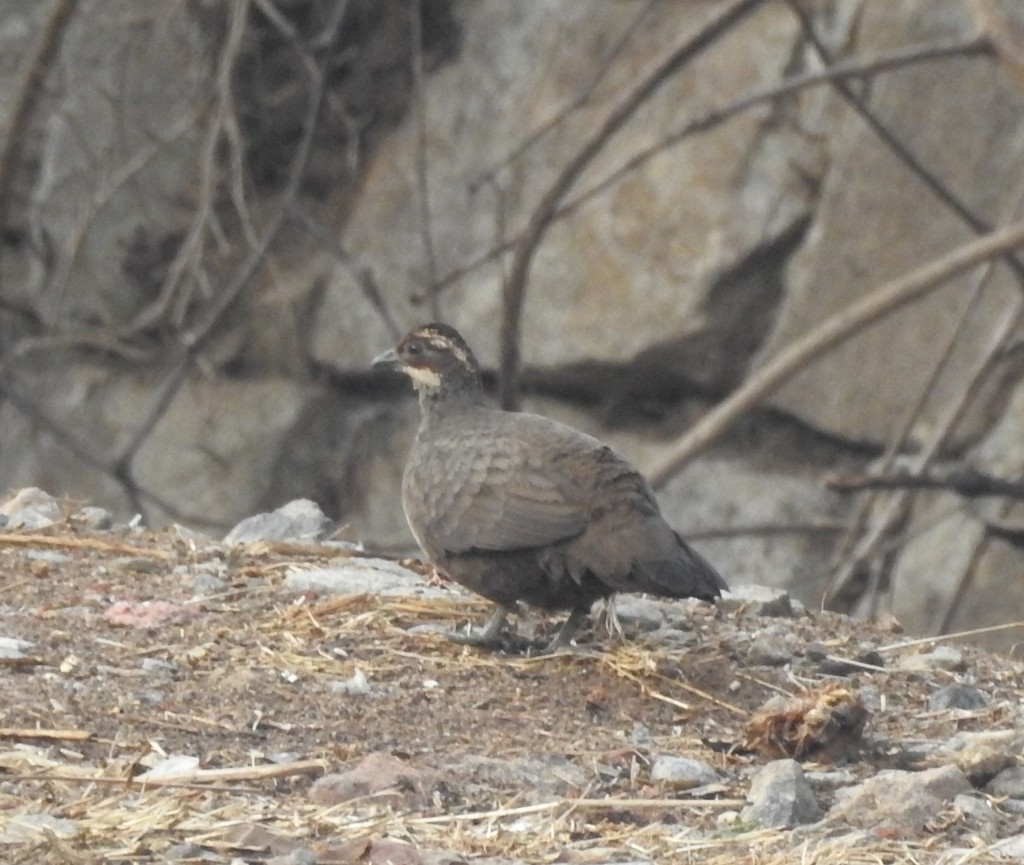
Painted Spurfowl
Photo © Manoj Karingamadathil
Photo © Manoj Karingamadathil — CC BY-SA 4.0 — Source: iNaturalist #29238201Identification
The painted spurfowl is a distinctive member of the pheasant family, immediately recognizable by its lack of bare facial skin—a feature that sets it apart from its relative, the red spurfowl. Males are the more striking sex, sporting a black head and neck adorned with a subtle green sheen and fine white spotting. The mantle, rump, and wing coverts are chestnut-coloured, while the upperparts display bold white spots edged in black. The underparts are warm ochre, contrasting sharply with the darker plumage above, and the tail is black, sometimes held upright. Females are considerably duller, featuring rufous brow and ear coverts with a pale, spotted throat, but lacking the white body spotting of males. Both sexes have dark grey bills and legs, with males bearing two to four tarsal spurs and females possessing one or two spurs.
Range & habitat
This species is endemic to peninsular India, occurring across several distinct regions including the Aravalli ranges of Rajasthan, the hills of central India such as Pachmarhi, the rocky hills and dry forest areas of southern India, and the Nallamala region of the Andhra Pradesh Eastern Ghats. Unlike the red spurfowl, the painted spurfowl favours drier habitats, preferring rocky hills with scrub slopes and scrub forest undergrowth—terrain it shares with species such as the yellow-throated bulbul. These birds are ground-loving birds of rocky and scrub-forest habitats rather than dense woodland.
Behaviour & diet
Painted spurfowls are highly terrestrial birds, found in pairs or small family groups of up to six individuals, where they remain hidden in dense undergrowth. They are reluctant fliers, preferring to escape danger by running rather than taking to the wing. Their presence is often revealed by their loud, distinctive calls—a repeated series of "chuguk" notes. They feed on berries such as Ziziphus oenoplia and Lantana camara, supplemented with insects and flowers including those of Madhuca longifolia, visiting waterholes in the early morning hours. The breeding season runs from January to June, with the peak in February, though chicks have been recorded in August following the rains. Males court females by offering food held in the bill. Like other spurfowls, they are believed to be monogamous. Nests are simple scrapes in the ground lined with leaves, often sheltered beneath boulders. Females lay clutches of three to four eggs, occasionally five, and incubate them alone while both parents subsequently care for the chicks, employing distraction displays to protect them from predators.
Best time & places to see it
The painted spurfowl's preference for dense undergrowth and reluctance to fly makes it challenging to observe. Early morning visits to waterholes in rocky scrub-forest habitats offer the best chance of encounter. The breeding season (January to June) may provide opportunities to observe courtship behaviour or family groups with chicks.
Photography tips
Patience and stillness are essential when photographing this ground-dwelling species. Early morning light at waterholes offers optimal conditions. Since the bird remains in undergrowth and rarely takes flight, position yourself carefully to avoid flushing birds unnecessarily. A longer lens will help you maintain distance and capture both the striking patterning of males and the subtler plumage of females without disturbance.
Ranthambhore National Park
Sawai Madhopur, India
+294 birds+20 mammals
Granite ridges and ravines carved through the Aravalli Range frame this protected landscape in eastern Rajasthan, where deciduous forest mingles with open scrubland and seasonal water…
VIEW NATIONAL PARKKanha Tiger Reserve
Kanha Kisli F.V., India
+321 birds+23 mammals
Where sal forests give way to emerald meadows and crystalline streams carve through ancient valleys, one of India's finest wilderness reserves unfolds across the Maikal Range.…
VIEW NATIONAL PARKBandhavgarh National Park
Garhpuri, India
+285 birds+17 mammals
Where granite ridges rise dramatically above sal and bamboo forests, one of India's most pristine tiger reserves unfolds across the Vindhyan plateau. Ancient rock formations tower…
VIEW NATIONAL PARKPanna National Park
Badgadi Kalan, India
+271 birds+17 mammals
Where granite gorges slice through central India's Vindhyan plateau, a landscape of stark beauty unfolds across nearly six hundred square kilometers. The Ken River carves through…
VIEW NATIONAL PARKPampadum Shola National Park
Vattavada, India
+258 birds+14 mammals
Where misty shola forests cling to the high plateaus of the Nilgiri Mountains, ancient evergreen remnants create a world apart. This 2,316-hectare reserve protects one of…
VIEW NATIONAL PARKNo community photos yet. Log in to add the first one.
No community observations of this species yet.