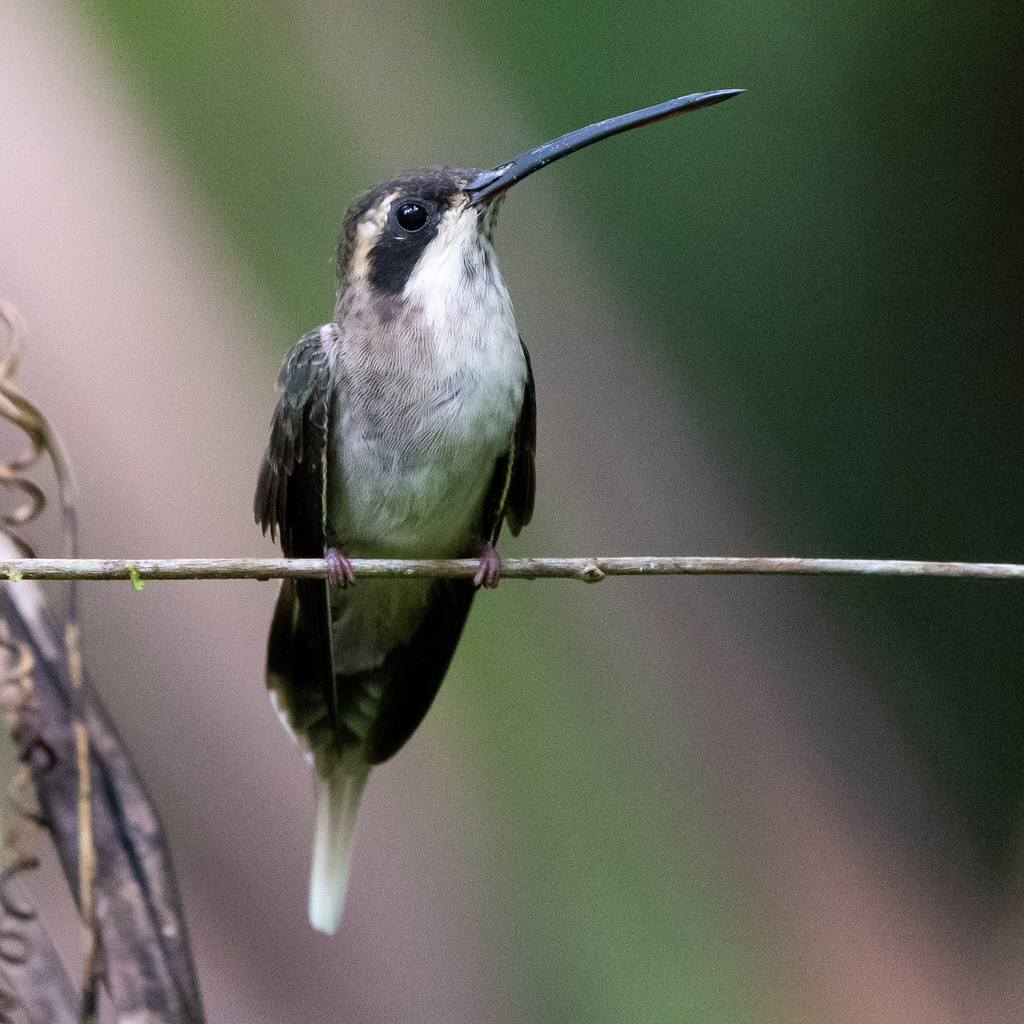
Pale-bellied Hermit
Photo © Anthony Batista
Photo © Anthony Batista — CC BY 4.0 — Source: iNaturalist photo #416393019Identification
The pale-bellied hermit is a medium-sized hummingbird measuring approximately 13 cm in length, with males weighing 4.5 to 5.5 grams and females slightly lighter at 4 to 5 grams. This species displays the characteristic features of its genus: dark green to olive-green upperparts contrasting with light gray underparts that give it its common name. The face is distinctive, marked by a black "mask" with a buffy supercilium and mostly white throat. Males possess an almost straight bill, while females have a noticeably decurved bill—a useful field mark for distinguishing the sexes. Two recognized subspecies occur within the range: the nominate P. a. anthophilus and P. a. hyalinus, which displays more bluish-green upperparts and paler underparts than its counterpart.
Range & Habitat
The pale-bellied hermit is endemic to northern South America and Central America, occurring in Colombia, Panama, and Venezuela. The nominate subspecies inhabits central Panama, northern, central, and eastern Colombia, and western and northern Venezuela, while the subspecies P. a. hyalinus has a restricted range limited to the Pearl Islands off Panama's Pacific coast. This hummingbird favors semi-deciduous forests but shows considerable habitat flexibility, also occupying drier woodlands, secondary forest, gallery forest, plantations, and brushy or thorny landscapes. Elevational range extends from sea level to approximately 1,500 meters, making it accessible to travelers exploring lowland and foothill regions throughout its distribution.
Behaviour & Diet
Like other hermit hummingbirds, the pale-bellied hermit is a "trap-line" feeder, maintaining a regular circuit through its territory and visiting a wide variety of flowering plants to harvest nectar. This feeding strategy allows the species to exploit diverse food sources across different microhabitats. Beyond nectar, it supplements its diet with small arthropods, providing essential protein. The species exhibits breeding behavior typical of its genus, constructing cone-shaped nests suspended beneath drooping leaves—an adaptation that provides shelter and concealment. Breeding seasons appear to vary across its geographic range, though detailed information remains incomplete. The species produces rather piercing, high-pitched calls, though its complete song repertoire has not been well documented.
Best Time & Places to See It
The pale-bellied hermit is rated as uncommon to locally common throughout most of its range, with populations reaching abundance in select regions. Several protected areas within its distribution provide reliable viewing opportunities. While specific breeding seasons vary by location and require further study, observers visiting during periods of peak flowering will likely encounter this species as it works its feeding territories. The wide elevation range and habitat diversity mean that travelers exploring different regions and elevations across Colombia, Panama, and Venezuela have reasonable chances of encountering this hermit.
Photography Tips
Photographing the pale-bellied hermit requires patience and attention to its trap-line feeding behavior. Position yourself along flowering plants that attract this species and wait for predictable visits. The distinctive black facial mask and pale underparts provide good contrast for photography. Note that sexual dimorphism in bill shape offers an opportunity to document both males and females—focus on capturing the straight male bill versus the decurved female bill as diagnostic features. Early morning light will best illuminate the subtle green and gray plumage. Since this species frequents both flowering plants and secondary growth, be prepared to work in variable lighting conditions and partially shaded habitats typical of woodland and forest-edge environments.
Natural Catatumbo Barí National Park
Convención, Colombia
+13 birds
Where the Andes descend into the humid lowlands of Norte de Santander, the 2,817-square-kilometre expanse of Natural Catatumbo Barí National Park spans a mosaic of montane…
VIEW NATIONAL PARKNatural el Cocuy National Park
Güicán, Colombia
+313 birds+3 mammals
Where the Andes rise to their highest peaks in Colombia's eastern cordillera, El Cocuy National Park sprawls across more than 6,600 square kilometers of some of…
VIEW NATIONAL PARKMorrocoy National Park
Municipio Silva
+290 birds
Where the Caribbean coast of northwestern Venezuela meets protected coastal waters, a mosaic of mangrove forests, sandy beaches, and coral reef systems defines Morrocoy National Park.…
VIEW NATIONAL PARKGuácharos Cave National Natural Park
Acevedo, Colombia
+359 birds
High in the Andean foothills of southern Huila, where mist-laden slopes rise above 1,600 metres, lies a landscape carved by underground rivers and crowned by karst…
VIEW NATIONAL PARKNatural Sierra de la Macarena National Park
Vista Hermosa, Colombia
+566 birds+15 mammals
Across nearly 20,000 square kilometres of Colombia's Meta Department, the terrain rises from lowland savanna into Andean foothills through a mosaic of gallery forests, palm-fringed wetlands,…
VIEW NATIONAL PARKDarién National Park
Tucutí, Panama
+534 birds+13 mammals
Where the spine of Central America crumbles into wetland and rainforest, Darién National Park sprawls across more than 20,000 square kilometres of some of the tropics'…
VIEW NATIONAL PARKNo community photos yet. Log in to add the first one.
No community observations of this species yet.